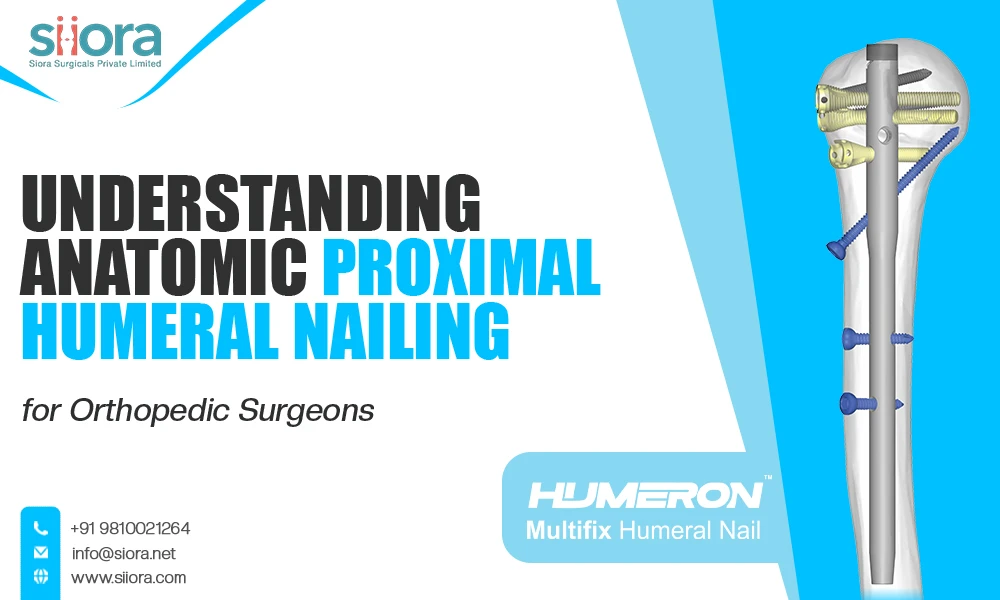

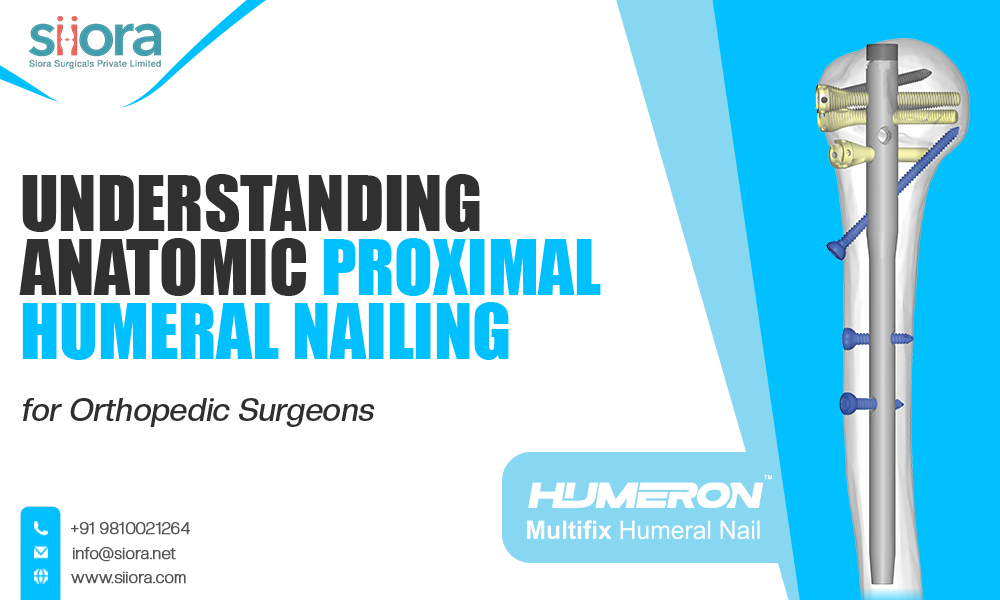
Proximal humerus fractures challenge even seasoned ortho surgeons—complex patterns, poor bone stock, and rotator cuff demands make fixation tricky. Anatomic proximal humeral nailing offers a smart workaround: intramedullary rods pre-bent to match the humerus's natural bow, delivering load-sharing stability with minimal soft-tissue hit. Unlike straight nails that scrape cortex or force malreduction, these designs glide in smoothly, prioritizing head control and early rehab.
Why Anatomic Over Straight Nails?
The humerus bows anteriorly about 5-10 degrees in its proximal third, with valgus angulation at the surgical neck. Straight nails fight this geometry, risking eccentric reaming. Anatomic nails—like multi-lock or modern ETN-style systems—curve to fit, centering the canal and preserving endosteal blood supply. This cuts reaming trauma, speeds union (10-14 weeks average), and dodges common pitfalls like greater tuberosity migration.
For surgeons, it's a workflow win: less intraoperative fiddling, confident fluoroscopy shots, and versatility across Neer II-IV patterns plus shaft extensions.
Key Design Smarts
These nails shine through targeted features:
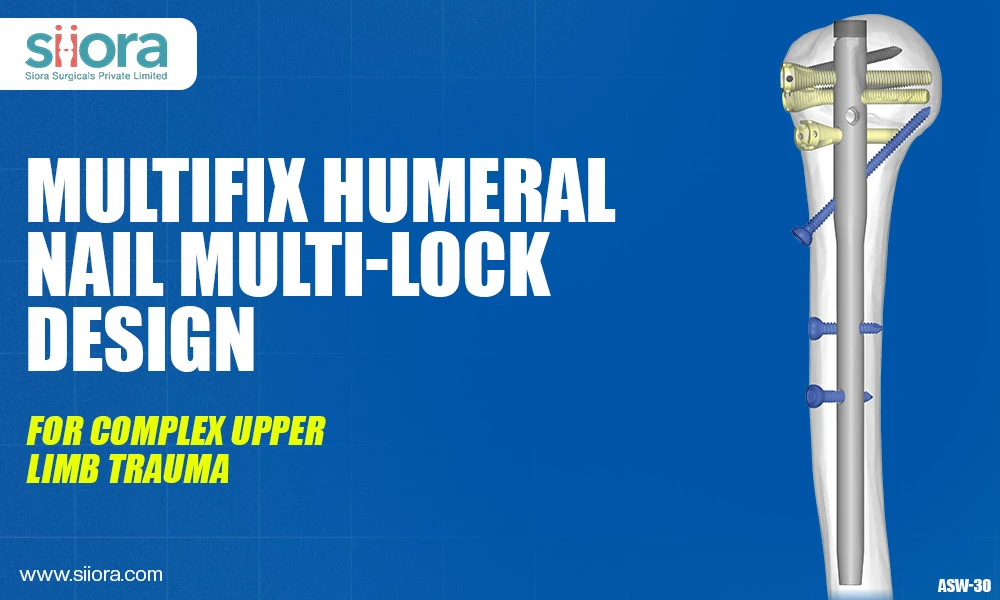
- Proximal geometry: Trapezoidal or cloverleaf shapes hug the metaphysis, resisting rotation. Multi-plane holes (3-5 proximal screws) allow calcar support, lateral tuberosity grabs, and screw-in-screw boosters for osteoporotics.
- Shaft curve: Gentle anterior bow (matching 7-12 degrees) plus slight medial-lateral flare ensures distal purchase without cortex violation. Diameters 8-11 mm, lengths 200-320 mm cover most adults.
- Distal locking: AP/ML/oblique options (2-3 screws) control length/rotation, staying safe between radial/median nerves. Compression slots dynamize transverse breaks.
- Cannulation and targeting: Guidewire-first entry, reversible aiming arms (left/right universal), color-coded jigs speed setup.
Modern iterations add angular stability and headless screws to minimize prominence.
Surgical Technique Pearls
Patient prep: Beach chair or lateral decubitus—full shoulder access key. Supraspinatus split (3-4 cm) over bicipital groove; protect cuff fibers.
Entry point: Dead-center rotator cuff, medial on articular margin (135-140° head-shaft angle target). Too lateral invites varus; too anterior risks acromial impinge.
Reduction first: Provisional pins or joystick wires align head-shaft before reaming. Slight valgus preferred over varus.
Reaming: Flexible over guidewire, 1 mm over nail size. Sequential to avoid thermal necrosis.
Insertion: Hand-rotate to follow bow; lock proximal first (calcar mandatory), then distal. Countersink 1-2 mm below cartilage.
Closure: Cuff repair with #2 Ethibond—transosseous or side-to-side. Drain optional.
Fluoro checks: True AP (head-shaft angle), axillary lateral (screw tips 5-8 mm subchondral), Y-view (impingement).
Ops average 60-75 minutes, blood loss <150 ml.
Clinical Edge and Patient Wins
Anatomic nails excel in three/four-part fractures and osteoporotics: Constant scores hit 75-85 at one year, DASH <20. Unions 92-97%, revisions <5%. Early pendulum exercises (day 3) build abduction to 120° by month three; athletes return overhead by six months.
Versus plates: less stiffness (preserved biology), fewer infections (1-2% vs 5%), no axillary nerve risks. Plates suit valgus-impacted simples; nails own multi-frag shaft combos.
Complications? Watch rotator impingement (countersink!), screw cutout (multi-locking), or tuberosity resorption (early motion).
When to Reach for It?
- Neer III/IV with shaft extension
- Osteoporotic heads needing calcar buy
- Polytrauma quick-stables
- Failed plate revisions
Contraindications: narrow canals (<8 mm), active infection, open wounds.
Surgeon Takeaways
Anatomic proximal humeral nailing blends IM efficiency with head-specific control—less exposure than ORIF, stronger than wires. Mastery comes after 15-20 cases: nail the entry, love the curve, secure the calcar. Patients trade slings for swings faster, shoulders function near-normal. In trauma call, it's the reliable workhorse turning "tough humerus" into "done humerus."
If you want to explore new and improved trauma implants, along with other cutting-edge healthcare products, register for WHX Dubai 2026.








Sign in to leave a comment.