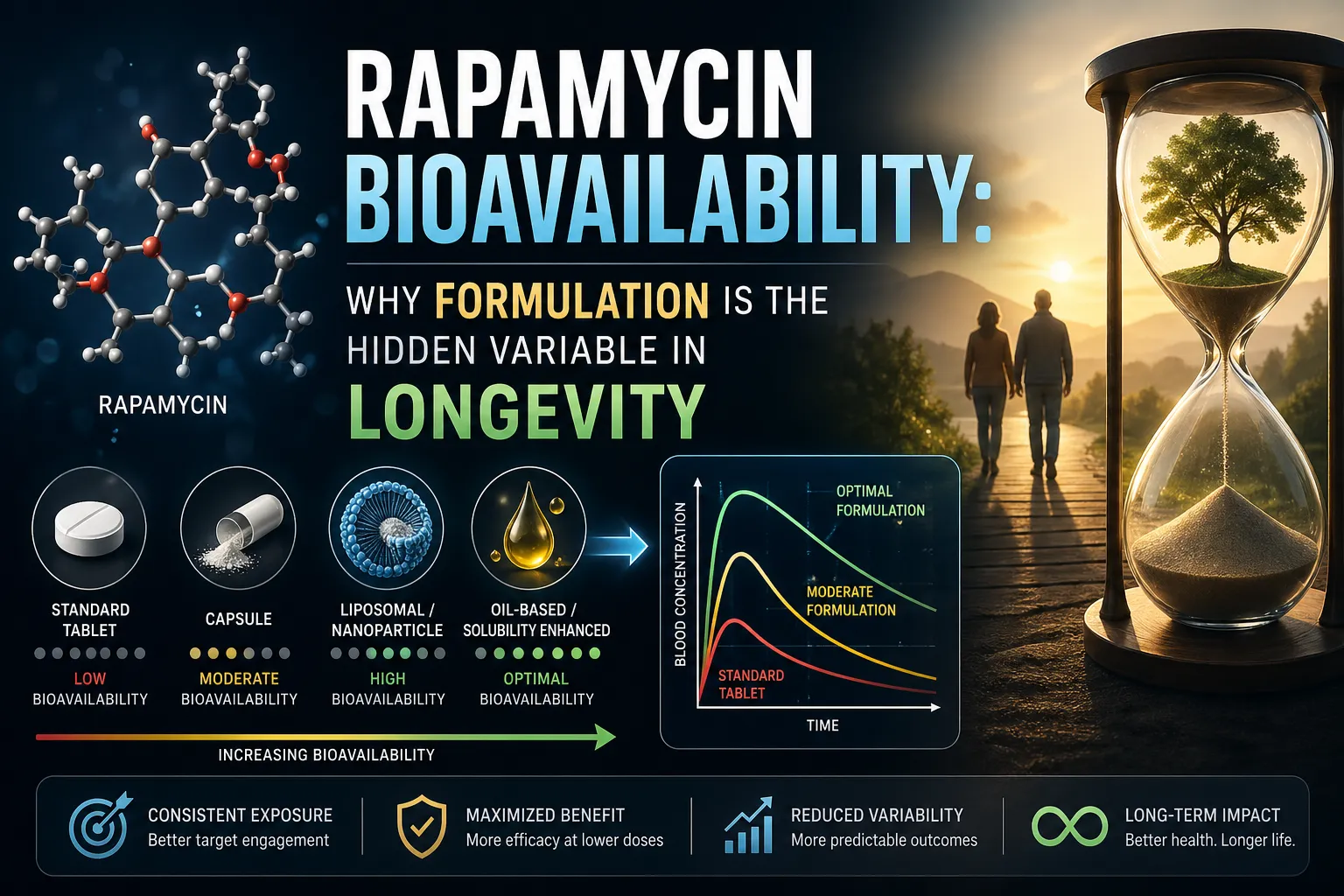

Rapamycin bioavailability is one of the most exciting and actionable variables in modern longevity science. The same molecule — sirolimus — can deliver dramatically different results depending entirely on how it is formulated and delivered to the body. Understanding this hidden variable empowers you to get the most out of your rapamycin protocol, whether you choose a commercial tablet or a compounded preparation. While the active compound remains identical in both cases, the engineering behind its delivery system determines whether you achieve meaningful mTOR inhibition (mTOR = a cellular "aging switch"; rapamycin turns it down to promote healthy longevity) and its associated longevity benefits. The choice between commercial and compounded rapamycin is not just a matter of cost — it is a matter of science, precision, and results.
Understanding the Absorption Challenge: Why Rapamycin Needs Smart Delivery
How Does the Digestive System Handle Sirolimus Absorption?
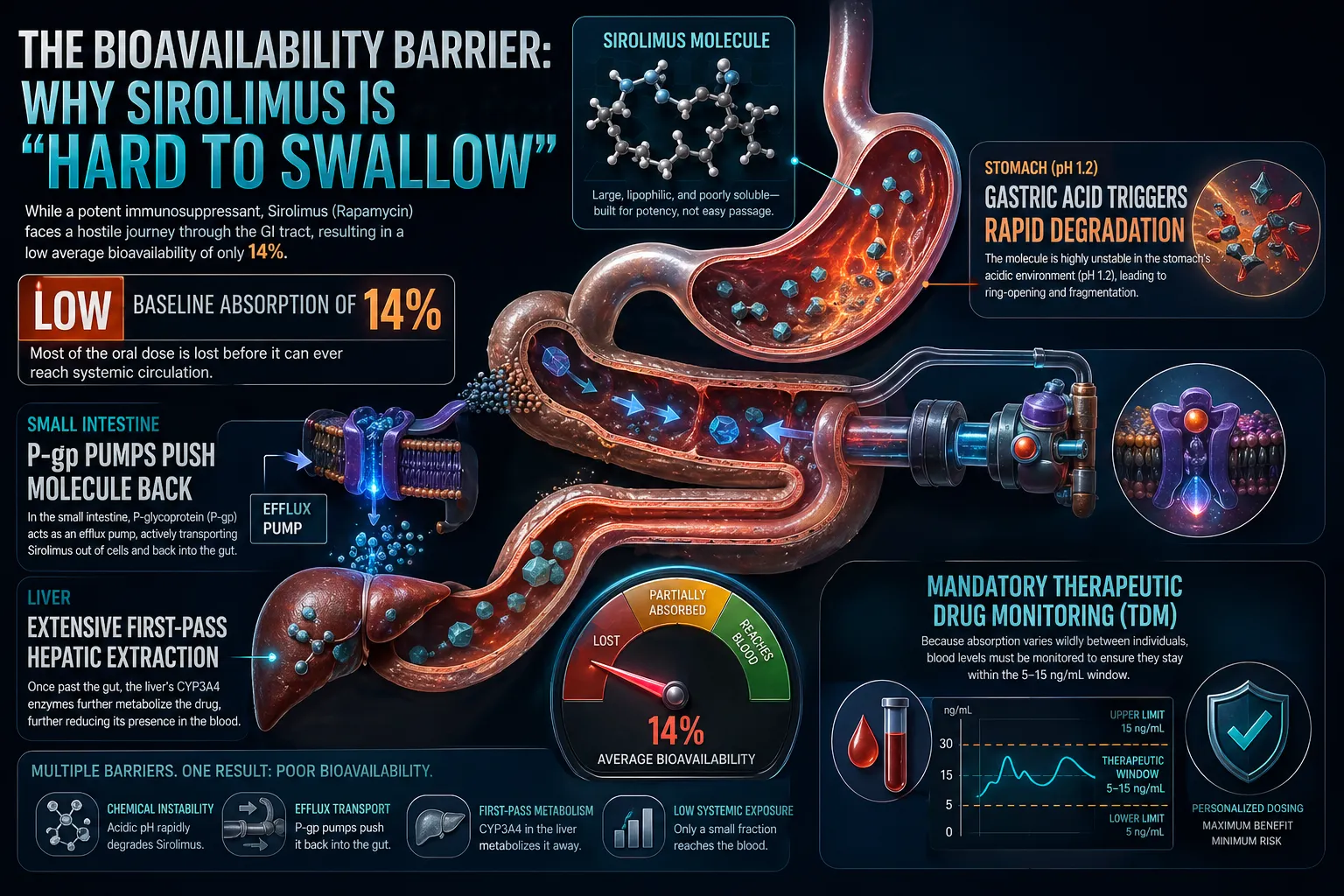
Sirolimus is classified as a BCS Class II drug — it passes through cell walls easily (high permeability) but struggles to dissolve in water (low aqueous solubility). Because a drug must first dissolve before it can be absorbed into the bloodstream, this solubility challenge is where pharmaceutical formulation engineering becomes the decisive factor.
Rapamycin is also highly lipophilic (fat-loving), meaning it actively resists the water-based environment of the digestive tract. It also faces a powerful two-part biological defense system inside the body:
- Cytochrome P450 3A4 (CYP3A4) — an enzyme (a biological catalyst) in the gut wall and liver that intercepts and breaks down sirolimus before it ever reaches the bloodstream.
- P-glycoprotein (P-gp) — a protein transporter that acts like a biological "bouncer," actively pumping absorbed sirolimus back out of cells and into the intestine.
In rat studies, nearly 50% of sirolimus was metabolized within the intestinal wall alone — before even arriving at the liver. This explains why the average absolute bioavailability of a raw oral sirolimus solution is just 14% without enhanced pharmaceutical delivery. But this is not discouraging news — it is a powerful invitation to choose your formulation wisely, because the right technology can overcome these barriers significantly.
14%
Avg. bioavailability of raw sirolimus without enhanced delivery
~50%
Metabolized in the intestinal wall before reaching the liver
316
Real-world longevity users studied in the 2025 cohort
8×
Maximum individual blood-level variation at identical doses
Buy Rapamycin online
Gastric Acid Stability: Why Enteric Coating Changes Everything
Rapamycin is chemically unstable in highly acidic conditions. In simulated gastric fluid at pH 1.2 — matching the acidity of a human stomach — raw sirolimus begins breaking down within minutes through a chemical process called ring-opening, essentially unraveling the molecule before it has any chance to be absorbed.
A high-quality enteric coating (a protective pharmaceutical shell engineered to survive stomach acid) solves this problem elegantly. The coating remains intact in the stomach's low-pH environment, then dissolves at pH 5.5 or above — precisely when the drug reaches the small intestine, which is the optimal "absorption window" for sirolimus.
Recent pharmaceutical research into amorphous solid dispersions (a technique dispersing the drug molecule in a stabilizing polymer matrix) using coatings such as Eudragit® E has demonstrated measurable improvements in sirolimus absorption compared to simple powder capsules. The science of pharmaceutical delivery is advancing rapidly — and that is genuinely great news for longevity users.
The Food Effect: Using Meals to Your Advantage
One of rapamycin's most predictable and useful characteristics is how food modulates its absorption. A high-fat meal consumed alongside commercial sirolimus can:
- Increase Cmax (peak blood concentration) by up to 65%
- Increase overall AUC (total drug exposure over time — "area under the curve") by 23–35%
Practical tip: The most important factor is not whether you eat with it — it is consistency. Take rapamycin with the same type of meal, at the same time, every week. This single habit is the most reliable path to stable, predictable mTOR inhibition over the long term.
Buy Rapamycin online
Commercial vs. Compounded Rapamycin: What Real-World Data Shows
The Bioavailability Gap — and How to Work With It
A landmark large-scale analysis of 316 real-world longevity users gave us the clearest picture yet of how commercial and compounded formulations compare in practice:
| Feature | Commercial (Rapamune / Generics) | Compounded (Pharmacy Capsules) |
|---|---|---|
| Blood level per 1 mg dose | 0.87 ng/mL | 0.27 ng/mL |
| Core technology | NanoCrystal® wet-milled particles | Mostly crude powder |
| Bioavailability | Reference — 100% | ~31% of commercial |
| Consistency | High — FDA/EMA regulated | Variable — pharmacy-dependent |
| Absorption peak (Tmax) | ~1–2 hours | Potentially up to 2 days |
| Gastric protection | Standard enteric coating | Variable enteric coating |
| Cost per mg | Higher | Lower |
NanoCrystal® technology (a pharmaceutical process that mills drug particles to nanoscale, dramatically increasing surface area and therefore solubility) is the defining advantage of commercial tablets. It transforms poorly soluble rapamycin into a consistently absorbable medicine.
The empowering takeaway: both formulations genuinely work. Compounded rapamycin is bioavailable — it simply requires a proportionally higher dose to achieve equivalent blood levels. This flexibility gives users real options without sacrificing results.
Why Consistency Matters More Than Which Formulation You Choose
A 2025 study revealed something particularly encouraging: among real-world longevity users, sirolimus blood levels stabilized predictably over 6–18 months, regardless of formulation — provided users stayed consistent with the same brand and pharmacy. The body's response became more reliable over time.
The core principle: Your most consequential decision is not commercial versus compounded — it is staying consistent with whichever you choose. Switching formulations or pharmacies without retesting blood levels introduces the very unpredictability that undermines a precision longevity protocol.
Get Rapamycin now
How to Optimize Your Rapamycin Protocol with Blood Testing
Peak and Trough Testing: The Gold Standard
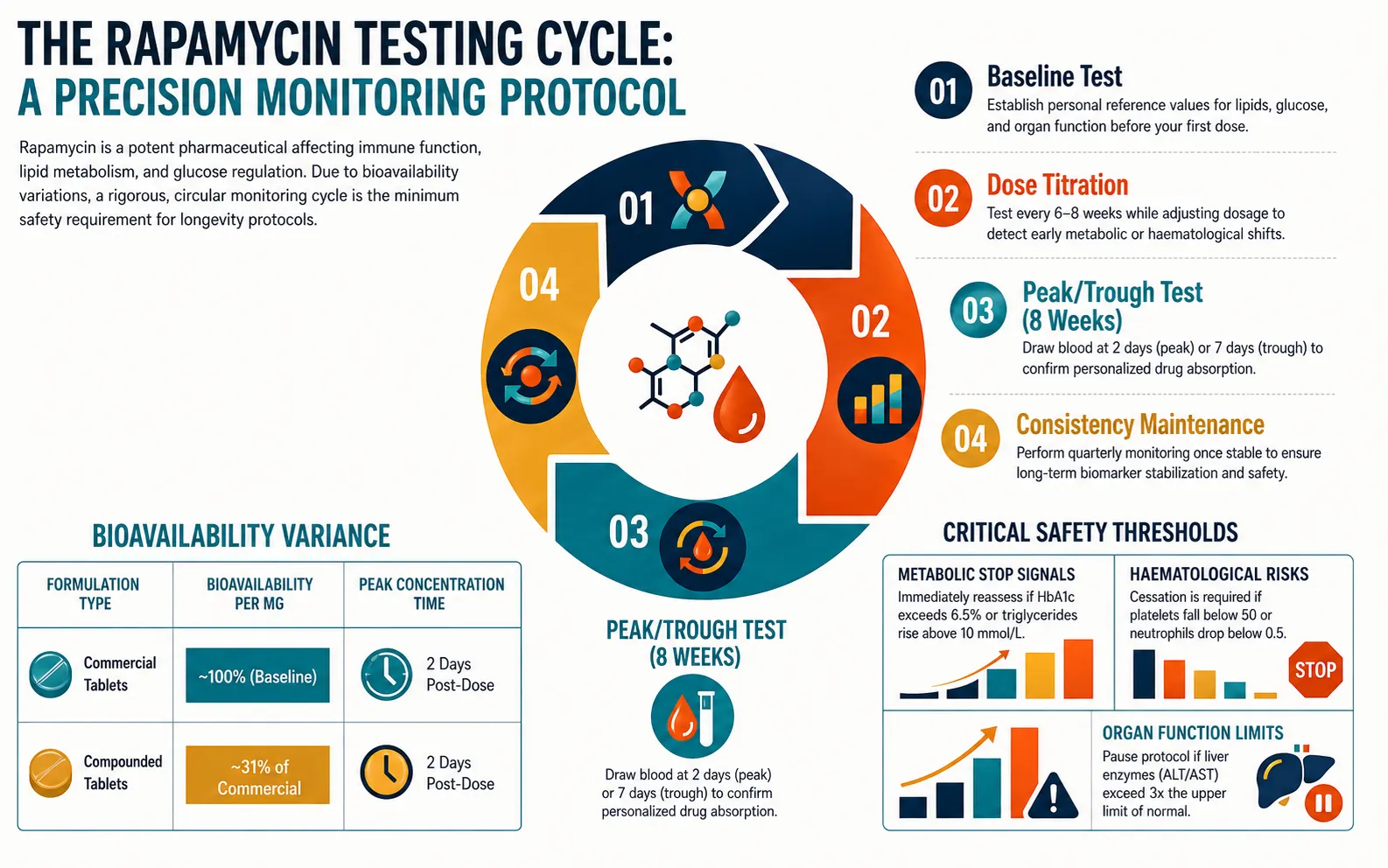
Because individuals show up to an eight-fold difference in sirolimus blood concentrations at the same dose, blood testing is the only reliable way to know whether your protocol is working — or whether you are taking too little, or too much. This is what transforms rapamycin from a "hope for the best" supplement into a precisely calibrated longevity intervention.
1.Baseline Test (before starting)
Establish your personal reference point before beginning any protocol. This is your foundation for all future comparisons.
2.Peak Test (1–2 hrs post-dose, or up to 2 days in longevity cohorts)
Confirms the drug is absorbing and reaching concentrations sufficient to inhibit mTOR. If your peak is low, your formulation or dose likely needs adjustment.
3.Trough Test (immediately before next scheduled dose)
Ensures sirolimus is clearing your system between doses and not accumulating to unintended immunosuppressive levels — especially important for those with mild liver impairment, who may clear the drug 33% more slowly.
4.Ongoing Monitoring (every 6–8 weeks → every 3 months once stable)
Once your target trough level is confirmed, quarterly testing sustains long-term confidence in your protocol without excessive disruption.
Switching Formulations Safely
If you change from commercial to compounded rapamycin (or switch compounding pharmacies), clinical guidelines recommend retesting your trough concentration 1–2 weeks after the switch. This simple step eliminates guesswork and ensures your mTOR inhibition remains in its optimal range throughout any transition.

Frequently Asked Questions About Rapamycin Bioavailability
Can I crush rapamycin tablets and put them in a smoothie?
No — this is strongly discouraged. Crushing destroys both the enteric coating and the NanoCrystal® particle structure, exposing the drug directly to gastric acid where it degrades within minutes. Bioavailability has not been established for crushed, chewed, or split tablets. Always swallow them whole to preserve the pharmaceutical engineering that makes them effective.
Does grapefruit juice really increase rapamycin absorption?
Yes — significantly and unpredictably. Grapefruit juice inhibits both the CYP3A4 enzyme and the P-gp transporter in the gut wall, potentially increasing sirolimus blood exposure by up to 350%. Because this effect varies widely between individuals and batches of grapefruit juice, it can easily produce dangerously high, immunosuppressive blood levels. Avoid grapefruit unless under direct medical supervision with frequent monitoring.
Why is my 24-hour blood level lower than expected on compounded rapamycin?
This is expected and well-documented. Compounded formulations using crude powder average approximately 31% of the bioavailability of commercial tablets — meaning you may need roughly three times the dose to achieve equivalent blood concentrations. This does not mean compounded rapamycin is inferior; it simply means dose calibration must reflect the formulation. Always use blood testing rather than guesswork to find your correct dose.
Should I take rapamycin with a high-fat meal?
A high-fat meal increases total sirolimus absorption (AUC) by 23–35% and peak concentration (Cmax) by up to 65%, which can genuinely support your protocol. More important than the meal's fat content, however, is consistency: take your dose with the same type of meal every single week. Predictable blood levels come from predictable habits — not from optimizing one dose in isolation.
How often should I test my sirolimus blood levels?
Start with a baseline test before your first dose. During dose-finding, test every 6–8 weeks until your trough levels are stable. Once stable, quarterly testing (every 3 months) is sufficient for ongoing safety and efficacy monitoring. Always retest within 1–2 weeks of any formulation or pharmacy change, as even a switch between compounding pharmacies can significantly alter your blood levels.
What is the single most important factor when choosing a rapamycin formulation?
Enteric coating quality and pharmaceutical delivery technology. A well-engineered enteric-coated tablet — whether commercial or compounded — shields the drug from gastric acid and ensures it reaches the small intestine intact. When evaluating compounded options, ask your pharmacy specifically about their coating method, coating thickness, and whether they use any nanoparticle or amorphous solid dispersion technology. These details matter enormously for the blood levels you ultimately achieve.
Is it safe to use rapamycin for longevity without a doctor?
Working with a knowledgeable physician is strongly recommended. While many longevity enthusiasts use rapamycin with positive outcomes, the variability in individual blood levels — up to eight-fold at identical doses — means that self-dosing without blood monitoring carries meaningful risk. A physician familiar with longevity protocols can help you set appropriate target ranges, order the necessary blood tests, and adjust your dose safely over time.
Where can I find high-quality rapamycin with proper enteric coating?
RapaShop offers medical-grade rapamycin tablets with professional enteric coating, specifically engineered to protect the drug through the stomach's acid environment and release it in the small intestine where absorption is highest. Their formulations are designed with longevity users in mind, prioritizing consistent blood levels and reliable bioavailability.
Conclusion: The Hidden Variable Is Now in Your Hands
The science of rapamycin bioavailability delivers genuinely empowering news: we now have real-world data from hundreds of longevity users, clear mechanistic explanations, and practical tools to optimize any protocol. A 6 mg dose of a well-formulated, enteric-coated commercial tablet may deliver the same blood concentration as 18 mg of crude compounded powder — but once you know that, you can account for it with precision.
By committing to regular blood level testing, maintaining strict formulation consistency, and choosing products backed by proven pharmaceutical delivery technology, sirolimus becomes exactly what longevity researchers envision: a reliable, precision-calibrated tool for healthy aging. The hidden variable is not hidden anymore — and that changes everything.



















Sign in to leave a comment.