
A few years ago, the idea sounded like science fiction.
Today, it feels like a real conversation.
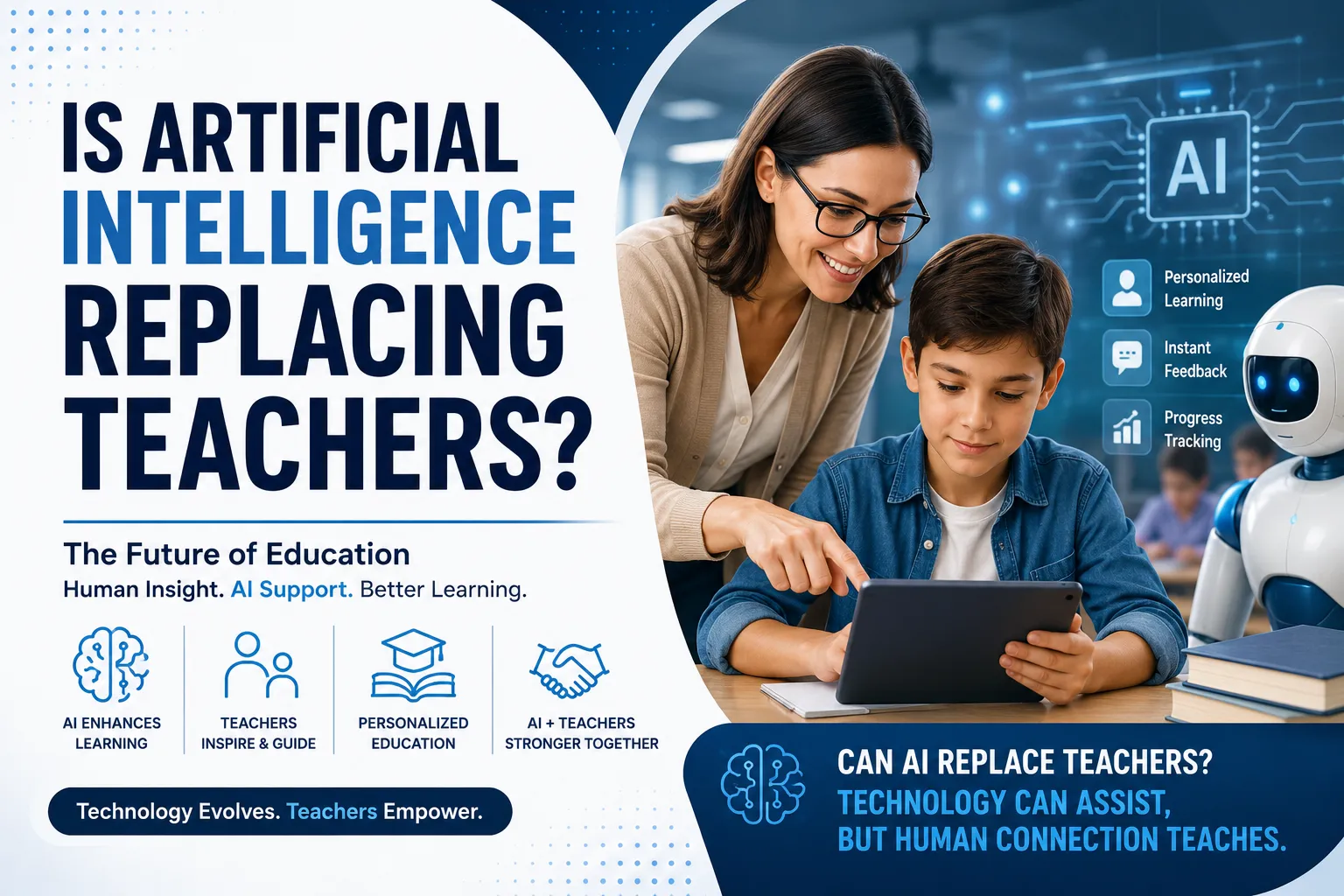
Students are using AI tools to study. Teachers are experimenting with AI-powered learning platforms. Schools are exploring ways to automate administrative tasks and personalize education. With technology advancing so quickly, it's no surprise that many people are asking whether artificial intelligence replacing teachers is something we may eventually see.
The question is understandable.
But the answer isn't quite as simple as many headlines make it seem.
While artificial intelligence is undoubtedly changing education, the reality is that teaching involves much more than delivering information. And that's where the conversation becomes interesting.
Why AI Is Becoming More Common in Education
Education has always evolved alongside technology.
Classrooms once relied entirely on chalkboards and printed textbooks. Then came computers, interactive whiteboards, online learning platforms, and virtual classrooms.
AI is simply the latest step in that progression.
Today's educational technologies can help with:
- Personalized learning experiences
- Automated grading
- Progress tracking
- Content recommendations
- Administrative efficiency
- Student performance analysis
- Language assistance
- Accessibility support
These capabilities can save time and help educators manage growing workloads.
And honestly, many teachers welcome that support.
What AI Does Extremely Well
Artificial intelligence excels at processing large amounts of information quickly.
That's one reason it has become useful in educational settings.
AI systems can:
- Analyze student performance data
- Identify learning patterns
- Recommend study materials
- Provide instant feedback
- Generate practice exercises
- Track academic progress
A student struggling with mathematics, for example, may receive customized learning resources based on individual performance.
That level of personalization would be difficult to provide manually for every student in a large classroom.
The efficiency is impressive.
There's no denying that.
But Teaching Is More Than Delivering Information
This is where the discussion often changes.
People sometimes assume teaching is primarily about sharing facts and knowledge.
If that were true, replacing teachers might be easier.
But education is rarely that straightforward.
Teachers do things that extend far beyond lesson delivery.
They:
- Build relationships with students
- Encourage confidence
- Recognize emotional struggles
- Resolve classroom conflicts
- Inspire curiosity
- Adapt communication styles
- Provide mentorship
- Support personal development
A student who feels discouraged doesn't always need information.
Sometimes they need encouragement.
That's a very different challenge.
The Human Side of Learning Matters
Think back to your favorite teacher.
Chances are, you don't remember them simply because they explained a subject well.
You probably remember how they made you feel.
Maybe they believed in you when you doubted yourself.
Maybe they helped you through a difficult period.
Maybe they sparked an interest that influenced your future career.
Those experiences are deeply human.
AI can generate answers.
It cannot genuinely care about a student's well-being.
At least not in the way people do.
And for many educators, that's one of the strongest arguments against the idea of complete replacement.
Why Schools Are Adopting AI Anyway
If AI isn't replacing teachers, why are schools investing in it?
The answer is fairly practical.
Many educational institutions face challenges such as:
- Growing student populations
- Administrative workloads
- Limited resources
- Diverse learning needs
- Teacher shortages
AI can help address some of these issues by improving efficiency and supporting educators rather than replacing them.
For example, AI-powered educational solutions can assist with grading, scheduling, lesson planning, and student performance tracking. This allows teachers to spend more time focusing on instruction and student engagement.
In many cases, that's exactly where teachers provide the most value.
Can AI Replace Teachers Completely?
This brings us to the question many people are really asking:
The short answer is that it can replace certain tasks.
It cannot fully replace the role.
Artificial intelligence may handle:
- Routine grading
- Data analysis
- Content delivery
- Administrative functions
- Basic tutoring support
However, education involves far more than task completion.
Students often require:
- Motivation
- Emotional support
- Critical thinking guidance
- Social development
- Ethical discussions
- Human interaction
These areas remain difficult for AI systems to replicate authentically.
Technology may become more advanced.
But human connection continues to play a central role in learning.
The Future Is More Likely Collaboration Than Replacement
Sometimes discussions about technology become extreme.
People imagine one side winning completely.
Either humans remain in control or machines take over.
Reality is usually more balanced.
The future of education will likely involve collaboration between educators and technology.
AI can support teachers by handling repetitive tasks and providing valuable insights. Teachers can then focus on creativity, mentorship, communication, and student development.
That combination may actually improve educational outcomes.
Rather than replacing teachers, AI may help them become more effective.
Benefits of AI-Assisted Education
When implemented thoughtfully, AI can offer meaningful advantages.
Potential benefits include:
- Personalized learning experiences
- Faster feedback
- Improved accessibility
- Better student performance monitoring
- Reduced administrative workload
- Enhanced learning flexibility
- Greater scalability
These benefits explain why schools and educational institutions continue exploring AI-powered solutions.
The goal isn't necessarily automation for its own sake.
It's often about improving learning experiences.
Challenges Schools Still Need to Consider
Of course, AI isn't perfect.
Educational institutions must also address concerns such as:
- Data privacy
- Bias in algorithms
- Technology access disparities
- Overreliance on automation
- Reduced human interaction
- Ethical considerations
Successful implementation requires careful planning and oversight.
Technology works best when it's used responsibly and strategically.
What This Means for Students
For students, AI will likely become an increasingly common part of education.
They may use intelligent tutoring systems, personalized learning platforms, and AI-powered study tools throughout their academic journeys.
That's not necessarily a bad thing.
In many cases, these tools can provide additional support and flexibility.
The key is ensuring that technology enhances learning rather than replacing the human relationships that make education meaningful.
Final Thoughts
The debate around artificial intelligence replacing teachers will probably continue for years.
Technology is advancing quickly, and educational institutions are constantly exploring new ways to improve learning outcomes. At the same time, teaching remains one of the most human-centered professions in existence.
So, can AI replace teachers entirely?
For now, and likely for the foreseeable future, the answer appears to be no.
AI can assist.
AI can automate.
AI can personalize.
But teaching involves empathy, mentorship, inspiration, and human connection—qualities that remain difficult for technology to replicate.
The future of education may not be about choosing between teachers and artificial intelligence.
It may be about helping them work together to create better learning experiences for everyone.

























Sign in to leave a comment.