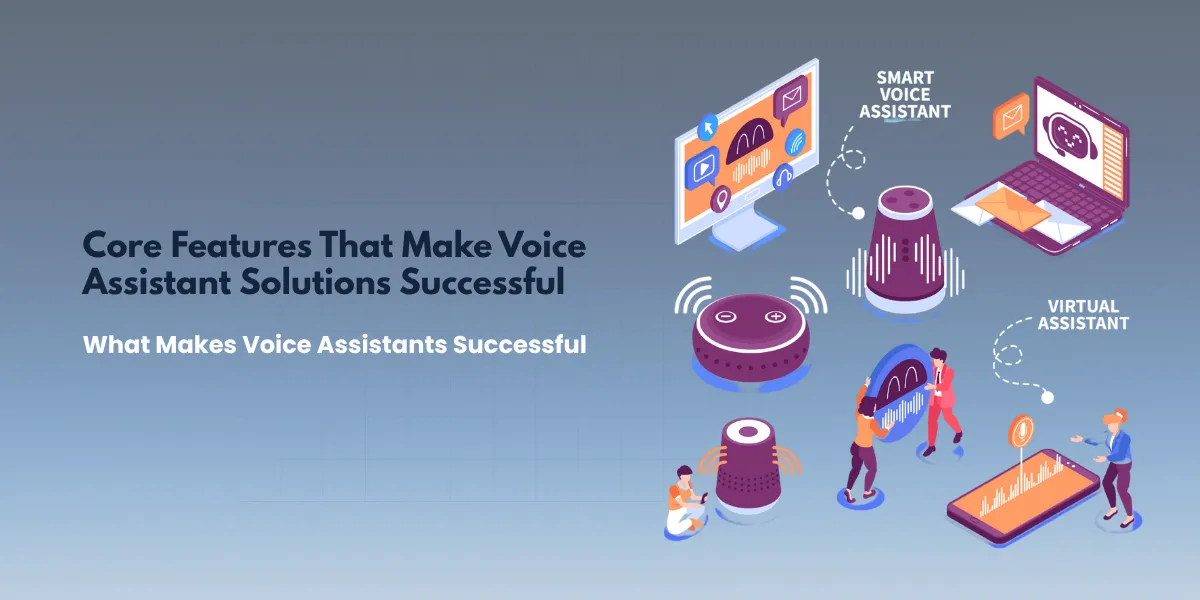

Voice is quietly changing how people interact with apps. Not dramatically, but steadily. People are getting used to speaking instead of typing. It feels faster. Less effort. More natural.
So when businesses think about building a Voice Assistant App like Alexa, the real question isn’t “can we build it?” It’s “will people actually keep using it?”
And that usually comes down to features. Not flashy ones. The practical ones that make the assistant feel useful in everyday situations.
List of Must-Have Features of Voice Assistant App like Alexa
Take a look at these:
1. Automatic Speech Recognition
If the voice assistant app, like Alexa, doesn’t understand the user properly, nothing else really matters. Automatic Speech Recognition (ASR) is where everything starts.
But accuracy alone isn’t enough. It should work across accents, speaking speeds, and even background noise. That’s what makes the interaction feel effortless instead of frustrating.
2. Customization
Most businesses don’t need a generic assistant. They need something that fits their workflow, tone, and customer journey.
Customization helps shape how the assistant speaks, responds, and behaves. This is where voice assistant solutions become more than just technology—they start aligning with business needs.
3. Task Automation
People use voice because they want things done quickly. Not to explore menus.
Task automation allows users to complete actions in one go. Booking something, setting reminders, checking updates. Simple actions, but they remove friction. And that’s what keeps users coming back.
4. Multi-Functional Capabilities
Users don’t want five different tools for five different tasks. They expect one assistant to handle multiple needs.
A good voice assistant app like Alexa should move between tasks smoothly—answering a question, then executing a command, then maybe pulling data. All in one flow. That continuity matters more than we often realise.
5. Smart Home Integration
For many users, voice assistant solutions are already tied to devices around them. Lights, ACs, appliances.
So integration becomes important. Not just for homes, but even for offices or connected environments. It shifts the assistant from being informative to being actionable.
6. Multilingual Support
Language can easily become a barrier if not handled well. Especially in markets where people switch between languages naturally.
Supporting multiple languages makes the assistant feel accessible. It also expands reach without needing separate systems.
7. Query Handling
Not every user speaks clearly or completely. Sometimes queries are half-formed or vague.
A strong voice assistant app like Alexa should still understand intent. That’s where good query handling comes in. It makes conversations feel smoother, even when the input isn’t perfect.
8. Wake Word Detection
This sounds simple, but it’s often overlooked. The wake word is the first interaction point.
If it fails to respond or triggers randomly, it breaks trust. A well-tuned wake word system keeps interactions clean and predictable.
9. Location-Based Services
Context improves everything. And location is one of the most useful contexts.
Whether it’s suggesting nearby options or giving location-specific updates, this feature makes responses more relevant. It turns generic answers into practical ones.
10. Language Transmission
Sometimes users need more than just responses. They need communication support across languages.
Language transmission helps with that. It allows translation or interaction between different languages in real time. Subtle feature, but quite powerful in the right use cases.
Why Do These Features Matter for Businesses?
Building a Voice Assistant App like Alexa is not just about ticking feature boxes. It’s about creating something people actually rely on.
These features directly affect usability. And usability affects adoption. If the assistant feels smooth and helpful, users stay. If not, they leave quietly.
For businesses, that translates into engagement, efficiency, and in some cases, even revenue impact.
Conclusion
Voice technology is evolving, but expectations are evolving faster. Users don’t compare you to your competitors anymore. They compare you to the best experience they’ve had anywhere.
That’s why building strong voice assistant solutions is less about adding more features and more about choosing the right ones.
Because in the end, the assistant that feels simple usually has the most thought behind it.






















Sign in to leave a comment.