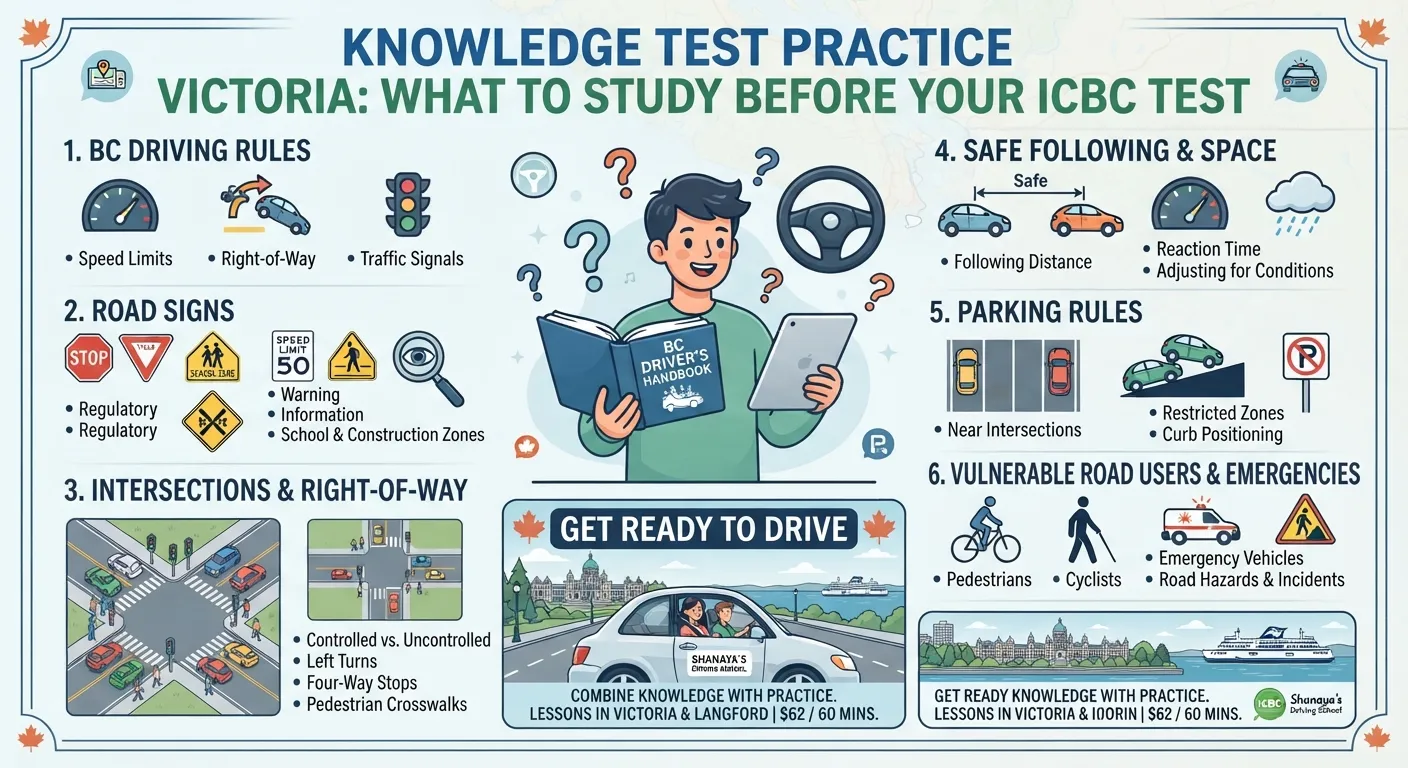

Preparing for the ICBC knowledge test can feel overwhelming when you are not sure what to study first. New drivers in Victoria often spend time reading different resources without having a clear idea of which road rules, signs, and driving situations deserve the most attention. A structured approach to knowledge test practice Victoria can make preparation more organized and help you understand what you are learning rather than simply memorizing answers.
The ICBC knowledge test is designed to assess your understanding of important driving rules and safe road practices. Before taking the test, it is useful to build your knowledge across several key areas, practice regularly, and review the topics where you make mistakes.
Start With the British Columbia Driving Rules
One of the most important parts of preparing for the knowledge test is understanding the basic rules that apply to drivers in British Columbia.
Instead of trying to memorize isolated facts, learn why particular rules exist and how they apply in everyday driving situations. This makes it easier to answer questions that describe a situation rather than simply asking for a definition.
Important areas to study include:
- Speed limits and appropriate speed
- Right-of-way rules
- Intersections
- Turning procedures
- Lane positioning
- Passing other vehicles
- Following distances
- Traffic signals
- Parking rules
- School and playground zones
- Emergency vehicles
- Sharing the road with pedestrians and cyclists
During knowledge test practice Victoria, pay attention to situations where two or more road rules may apply at the same time. Understanding the relationship between rules can be more useful than memorizing individual statements.
Learn the Meaning of Road Signs
Road signs are another major area to include in your study routine. A driver needs to recognize signs quickly and understand what action a sign requires.
Start by becoming familiar with different categories of signs rather than attempting to memorize them randomly.
For example, you should understand the purpose of:
- Regulatory signs
- Warning signs
- Guide and information signs
- School-zone signs
- Construction and road-work signs
- Parking signs
- Lane-use signs
- Railway crossing signs
Look carefully at the shape, colour, symbol, and wording of each sign. Some signs communicate a prohibition, while others warn drivers about a potential hazard or provide information about road conditions.
When practicing, ask yourself what you would actually do after seeing a particular sign. This turns sign recognition into a practical driving skill.
Understand Intersections and Right of Way
Intersections deserve special attention because they involve multiple vehicles, pedestrians, traffic signals, and possible turning movements.
Study situations involving:
- Controlled intersections
- Uncontrolled intersections
- Left turns
- Right turns
- Stop signs
- Yield signs
- Traffic lights
- Pedestrian crossings
- Four-way stops
Rather than memorizing who "always goes first," learn how right-of-way is determined by the specific situation.
A knowledge question may describe several vehicles approaching an intersection and ask which action is appropriate. If you understand the underlying rule, you can work through the situation even when the wording is unfamiliar.
Study Safe Following and Space Management
Safe driving is not only about knowing signs and traffic signals. You should also understand how drivers manage space around their vehicles.
Review concepts such as:
- Following distance
- Stopping distance
- Visibility
- Reaction time
- Adjusting speed for conditions
- Maintaining a safe space around your vehicle
- Increasing distance when road conditions become difficult
Weather, traffic, road surface, visibility, and vehicle speed can all affect the amount of space a driver needs.
This is particularly important because knowledge-test questions may present a driving situation rather than directly asking you to define a term.
Review Parking Rules
Parking is another useful area to include in your preparation.
Make sure you understand where parking or stopping may be restricted and why certain locations create risks for pedestrians and other road users.
Your study should cover topics such as:
- Parking near intersections
- Parking near crosswalks
- Parking near driveways
- Parking on hills
- Parking near signs
- Curb positioning
- Areas where stopping is prohibited
When reviewing parking rules, think about visibility and safety rather than memorizing distances without understanding their purpose.
Include Vulnerable Road Users
Drivers share the road with people who are not protected by a vehicle. Your preparation should therefore include pedestrians, cyclists, motorcyclists, and other vulnerable road users.
Review how drivers should respond around:
- Crosswalks
- Pedestrian crossings
- Bicycle lanes
- Cyclists at intersections
- School areas
- People entering or leaving vehicles
- Motorcycles and smaller vehicles
A safe driver needs to anticipate that another road user may behave differently from a vehicle. Learning these situations can also help you apply defensive-driving principles during real-world driving.
Learn How to Respond to Emergency Situations
Emergency vehicles and unexpected road situations are also important areas of preparation.
Review the appropriate response when you encounter emergency vehicles using lights or sirens. You should also understand how to react to hazards that may suddenly appear on the road.
Other useful situations to study include:
- Vehicles stopped on the roadside
- Road construction
- Debris
- Poor visibility
- Sudden hazards
- Traffic congestion
- Disabled vehicles
The goal is not simply to memorize a response but to understand how drivers can create more space and reduce risk.
Build a Simple Study Routine
Trying to study everything in one sitting can make preparation difficult. A better approach is to divide your study into manageable sessions.
For example:
Day 1: Basic road rules and traffic signals
Day 2: Road signs and pavement markings
Day 3: Intersections and right-of-way
Day 4: Parking and stopping rules
Day 5: Sharing the road and vulnerable road users
Day 6: Safe driving, following distance, and hazards
Day 7: Practice questions and review of weak areas
You can adjust the schedule according to your own experience. If you already understand road signs, spend more time on intersections or other topics where you are less confident.
Use Practice Questions to Find Knowledge Gaps
Practice questions should not replace studying the underlying rules. Their greatest value is showing you where your knowledge needs improvement.
After getting a question wrong, avoid simply memorizing the correct answer. Instead, identify:
- What rule did the question test?
- Why was your original answer incorrect?
- What detail did you miss?
- Could the same rule apply in another situation?
This approach turns each mistake into a learning opportunity.
Shanaya’s Driving School can also help learners prepare for driving-related knowledge and practical skills in Victoria and Langford. Combining structured knowledge preparation with professional driving instruction can help learners connect road rules with real driving situations.
Give Yourself Time to Review
Last-minute studying can leave you with a large amount of information but limited understanding. Give yourself enough time to revisit difficult topics.
Keep a short list of areas that consistently cause mistakes. For example, you may find that you understand signs but have difficulty with right-of-way questions. Another learner may have the opposite problem.
Your final review should therefore be based on your own weak areas rather than repeating information you already know well.
Consider Professional Driving Instruction
Knowledge-test preparation and practical driving lessons serve different purposes, but they can complement each other. A driving instructor can explain how rules are applied while driving and help you develop safer habits behind the wheel.
Shanaya’s Driving School offers driving lessons for $62 for 60 minutes in Victoria and Langford, giving learners the opportunity to combine their knowledge preparation with practical instruction.
Whether you are a first-time learner or preparing to progress toward your road test, understanding the rules before getting behind the wheel can make your learning process more structured.
Final Preparation Checklist
Before your ICBC knowledge test, review the following:
- British Columbia road rules
- Traffic signs
- Traffic signals
- Intersections
- Right-of-way
- Parking and stopping
- Following distance
- Pedestrian safety
- Cyclist awareness
- Emergency vehicles
- Road hazards
- Safe driving practices
- Your personal list of weak topics
The goal of knowledge test practice Victoria should be understanding the rules well enough to apply them to different situations. A consistent study routine, targeted practice, and review of mistakes can make your preparation more productive.
FAQs
1. What should I study first for the ICBC knowledge test?
Start with basic road rules and traffic signs. Once you understand those fundamentals, move into intersections, right-of-way, parking, and other driving situations.
2. How can I make my knowledge test practice more effective?
Practice regularly and review every incorrect answer. Understanding why an answer is correct is more useful than memorizing the answer alone.
3. Should I study road signs separately?
Yes. Studying signs by category can make it easier to recognize their purpose and understand what action a driver should take.
4. Does Shanaya’s Driving School provide lessons in Victoria?
Yes. Shanaya’s Driving School offers driving lessons in Victoria and Langford.
5. How much are driving lessons at Shanaya’s Driving School?
Shanaya’s Driving School offers driving lessons for $62 for 60 minutes in Victoria and Langford.

























Sign in to leave a comment.