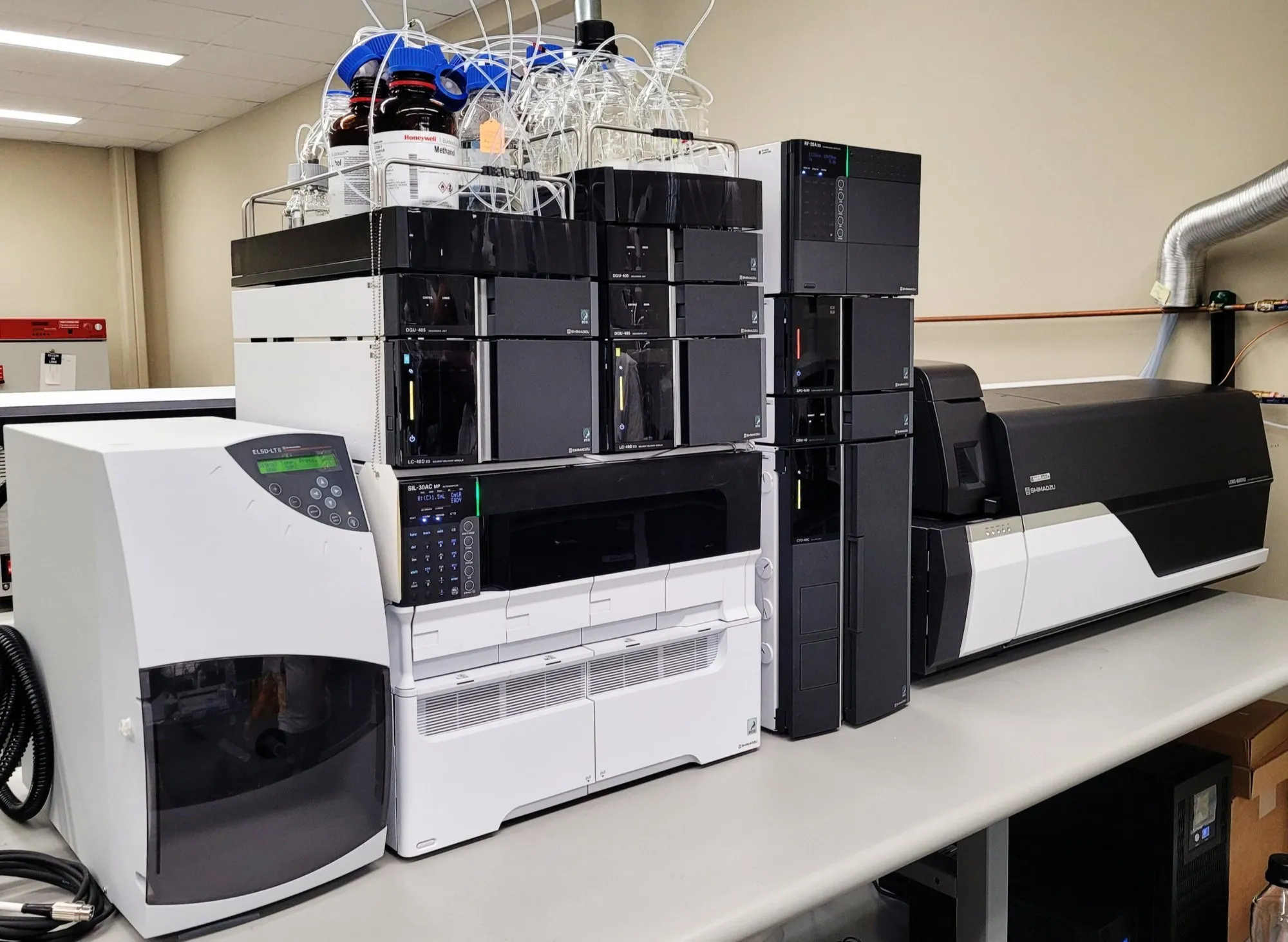

Global food supply chains face increasing exposure to trace-level contaminants affecting public health. Regulatory authorities such as the U.S. Food and Drug Administration (FDA), Environmental Protection Agency (EPA), and the United States Department of Agriculture enforce strict limits on chemical residues. Accurate identification requires highly sensitive and selective methods for complex matrices.
LC-MS Testing helps in precise detection and quantitative analysis of contaminants at trace levels, strengthening reliability in regulated bioanalysis and supporting compliance with food safety standards across the supply chain.
How LC-MS Supports Contaminant Detection in Food?
Liquid chromatography-mass spectrometry (LC-MS) combines two analytical techniques to improve detection accuracy and specificity. Liquid chromatography separates compounds present in a sample matrix, while mass spectrometry identifies them based on mass-to-charge (m/z) ratios. This integrated approach enables simultaneous detection of multiple substances within a single analytical run. The method offers high sensitivity, allowing identification of contaminants at trace levels within complex food matrices. Such analytical precision supports regulatory thresholds defined by the FDA and aligns with GLP-compliant workflows that ensure data integrity and reproducibility in food safety analysis.
Detection of Pesticides and Veterinary Drug Residues
Chemical residues from agricultural practices remain a key concern in food safety monitoring. Analytical methods are used to identify and quantify these compounds across various food categories.
- Laboratories detect pesticide residues in fruits, vegetables, and grains to ensure compliance with maximum residue limits.
- Analysts identify veterinary drugs, including antibiotics and hormones, in meat and dairy products.
- Monitoring supports adherence to regulatory requirements and reduces long-term exposure to chemical residues.
These analyses often rely on validated workflows within a controlled LC-MS Laboratory, where calibrated systems ensure reproducibility and accuracy across residue testing.
Identification of Mycotoxins in Food Products
Mycotoxins are toxic compounds produced by fungi that can contaminate food during storage or processing. These substances require accurate detection due to their potential impact on human health.
- Analytical systems identify mycotoxins such as Aflatoxins and Ochratoxins in cereals and nuts.
- Testing focuses on high-risk food products prone to fungal contamination.
- Quantification supports compliance with established safety thresholds.
Detection workflows are generally performed using a validated LC-MS assay, which supports precise quantification and ensures consistency across different sample matrices.
Must Read: In Vitro Cell Toxicity Assay Models for Early-Stage Drug Screening
Detection of Food Adulterants and Unauthorized Additives
Food adulteration involves the presence of undeclared or restricted substances that compromise product integrity. Analytical workflows support the identification of such inconsistencies within complex processed food products.
- Detection methods identify synthetic or undeclared compounds present in processed foods.
- Monitoring ensures that permitted additives remain within approved regulatory limits.
- Analytical verification confirms that labeled ingredients align with the actual composition.
Testing is commonly conducted in a certified LC-MS Lab, where validated methods and controlled workflows support accurate identification and reproducible quantification of adulterants across complex formulations.
Monitoring Environmental and Industrial Contaminants
Environmental exposure introduces contaminants into food through soil, water, and processing systems. Analytical detection methods track these substances across different stages of the supply chain within complex matrices.
- Analysts identify industrial chemicals entering food through contaminated environmental sources.
- Detection systems isolate persistent organic pollutants during processing and storage.
- Monitoring tracks chemical residues from raw material sourcing to final product distribution.
These applications are often supported by specialized LC-MS Services, which enable laboratories to handle diverse contaminant profiles with high sensitivity and reproducibility across multiple food categories.
Multi-Residue Analysis in a Single Run
Modern analytical platforms enable the detection of multiple contaminants within a single workflow. This capability improves efficiency in high-volume testing environments.
- Simultaneous detection of multiple chemical classes within a single sample.
- Reduction in overall analysis time while maintaining analytical accuracy.
- Increased laboratory throughput for large-scale food safety programs.
Such capabilities are integrated within broader Bioanalytical Lab Services, where high-throughput LC-MS systems support consistent, reproducible testing across large sample volumes.
Importance of Validated Testing Environments
Reliable analytical outcomes depend on controlled laboratory conditions and validated procedures. Laboratories operating under FDA-audited environments follow strict calibration protocols and maintain assay validation standards. GLP-compliant workflows ensure that analytical methods produce reproducible and accurate results across different testing conditions. Alignment with ICH guidelines further supports consistency in method performance and documentation. These practices are essential for maintaining data integrity and ensuring that food safety testing meets established regulatory expectations.
Challenges in LC-MS-Based Food Testing
Food samples contain complex biological matrices that may interfere with the accurate detection of contaminants. This complexity introduces several analytical challenges.
- Matrix interference may affect sensitivity and detection accuracy.
- Sample preparation requires careful optimization to isolate target compounds.
- Assay validation requires experienced personnel and consistent procedural control.
Addressing these challenges supports accurate data generation and ensures compliance with regulatory expectations in food testing environments.
Conclusion
Accurate identification of contaminants remains essential for maintaining food safety standards. Analytical methods that support precise detection and quantification help ensure compliance with regulatory frameworks and reduce risks across the supply chain. LC-MS testing provides the sensitivity required to detect trace-level contaminants in complex food matrices. Its application across pesticide monitoring, mycotoxin detection, and adulterant identification supports consistent quality control. Validated analytical workflows, supported by GLP-compliant practices, strengthen reliability and ensure that food products meet established safety requirements across regulated environments.




























Sign in to leave a comment.