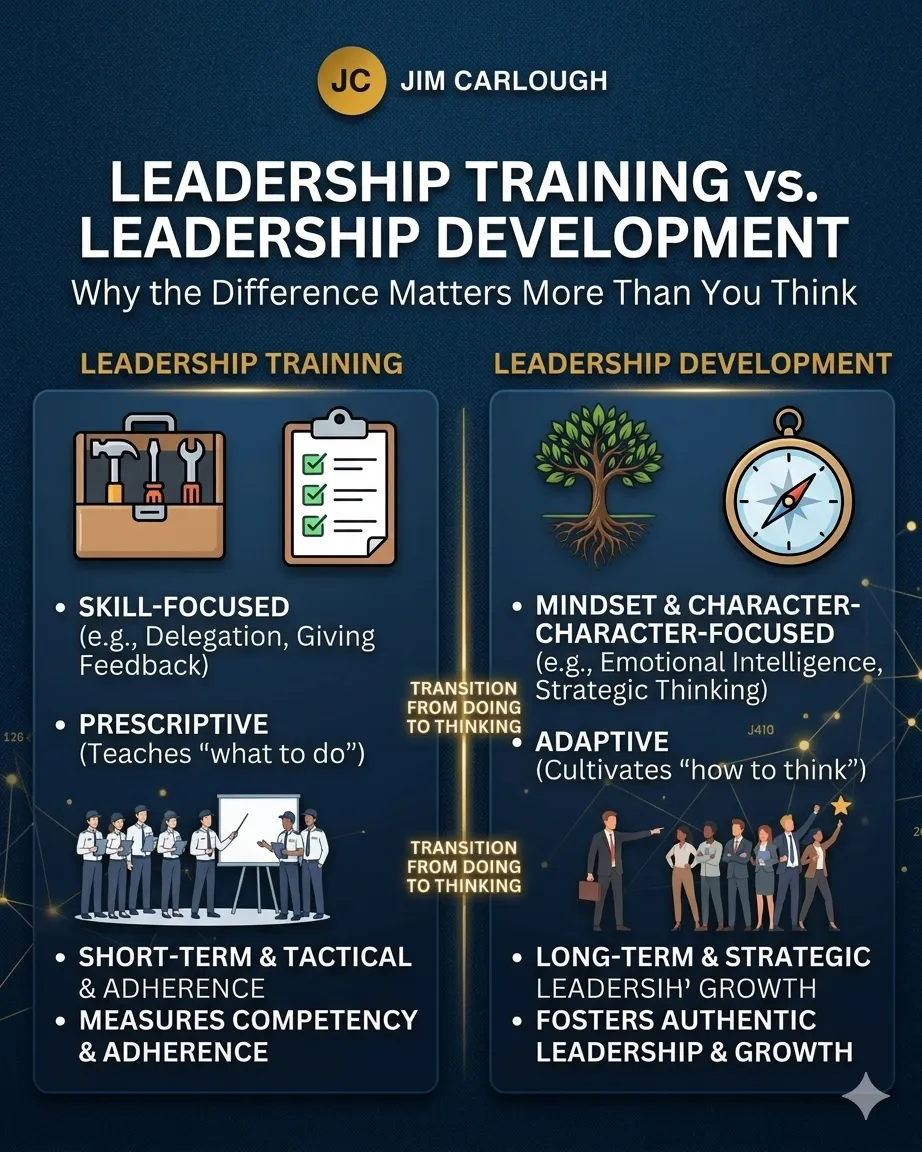

Most organizations treat leadership training and leadership development as interchangeable. They’re not. And the confusion between the two is quietly undermining the effectiveness of billions of dollars spent on leadership programs every year.
I’ve watched this play out at every level of organizational leadership. Companies invest in a leadership training workshop, check a box, and then wonder why nothing changed. The answer is almost always the same: training teaches people what to do. Development changes who they are. You can’t build lasting leadership capability with just one of those.
Let’s get clear on the distinction—and then talk about how to actually use both.
Training builds the tools. Development builds the person who uses them wisely.
What Leadership Training Actually Is
Leadership training is skill-focused, structured, and designed to produce measurable outcomes in a defined timeframe. It answers questions like:
- How do I deliver a performance review?
- How do I facilitate a difficult conversation?
- How do I delegate without micromanaging?
- How do I build a high-performing team structure?
A good leadership training workshop equips participants with frameworks, tools, and techniques they can apply immediately. It’s practical, concrete, and—when done well—immediately useful.
Team leadership training programs are particularly effective when organizations are facing immediate performance gaps. New managers stepping into formal roles, teams struggling with collaboration breakdowns, or departments navigating rapid change all benefit from targeted skill development.
What Leadership Development Actually Is
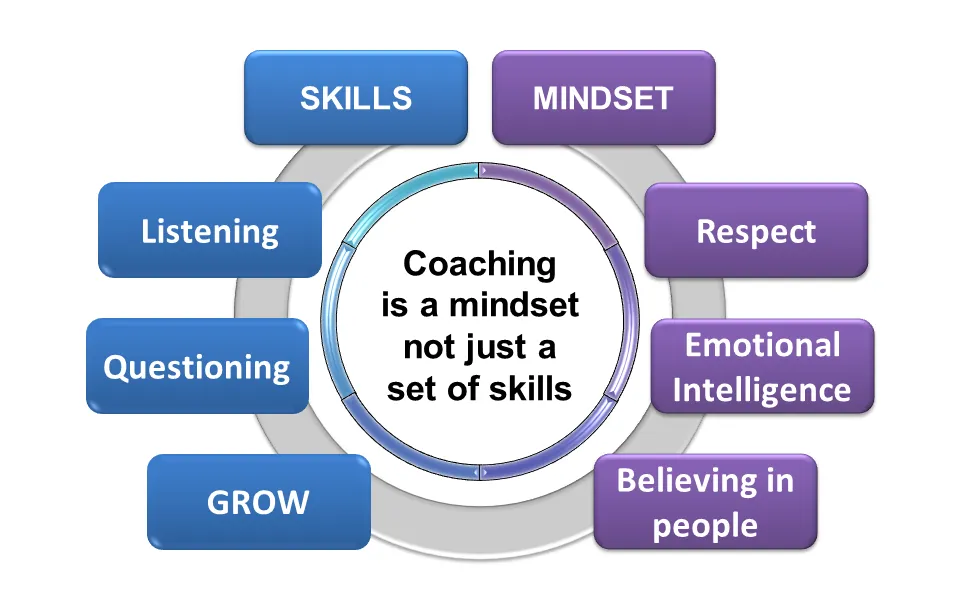
Leadership development is a different animal entirely. It’s not about acquiring skills—it’s about building the identity, judgment, and character from which effective leadership naturally emerges.
Development explores questions training doesn’t touch:
- Who am I as a leader?
- What do I stand for when it gets hard?
- How do my blind spots limit my team?
- What kind of leader do I want to be remembered as?
This is deeper work. It unfolds over months, not days. It requires coaching, reflection, real-world challenge, and the willingness to be honest about the gap between who you are and who you need to become.
Development shapes how leaders think, decide, and relate to the people they lead. That’s why the impact lasts—and why organizations that skip it tend to find themselves rebuilding leadership pipelines every few years.
The Core Distinction
Here’s the simplest way I’ve ever heard it put, and I’ve spent 30 years trying to sharpen this point:
Training improves performance. Development transforms the performer.
A leadership training workshop can teach a manager to communicate more effectively in a feedback conversation. Leadership development explores why that manager avoids conflict in the first place—and then dismantles the belief system that’s been driving the avoidance.
Training is what leaders do. Development is who leaders are. Both matter. But they can’t substitute for each other.
When Your Organization Needs Training
Reach for training when:
- Managers are new to their roles and need a fast foundation
- Specific skill deficits are visibly affecting team performance
- You’re implementing new processes that require leadership behavior changes
- Communication or conflict resolution is breaking down in identifiable ways
- You need measurable, near-term results
Team leadership training in these scenarios provides immediate traction. It gives leaders language, tools, and confidence for situations they’re navigating right now. Don’t underestimate its value when applied correctly.
When Your Organization Needs Development
Invest in development when:
- You’re building a leadership pipeline for the next 3–5 years
- Technically excellent managers aren’t translating their expertise into people leadership
- Senior leaders are struggling with strategic influence, not just operational execution
- Succession planning is uncertain or fragile
- Culture change requires leaders who lead differently from the inside out
This is where a single leadership training workshop falls short. Development requires time, consistency, and the kind of personalized coaching and reflection that fundamentally changes how leaders see themselves and their role.
The Compounding Effect of Both
The highest-performing leadership cultures I’ve seen don’t choose between training and development—they integrate both.
Think of it as a leadership architecture. Team leadership training provides the structure: the skills, tools, and techniques. Development provides the foundation: the identity, values, and mindset that determine how and when those tools get used.
A leader with strong skills but no identity anchor will revert under pressure. A leader with deep self-awareness but no practical tools will struggle to execute. You need both.
Organizations that combine structured skill-building with ongoing identity-based development create leaders who are both capable and resilient—leaders who grow stronger when the environment gets harder, not weaker.
How Leadership Development Shapes Culture
Here’s what most leadership training programs miss: culture is downstream of identity. When you develop leaders who know who they are—who lead from values rather than just protocols—culture change follows naturally.
Employees don’t follow frameworks. They follow people. And people follow leaders who seem to know exactly who they are and where they’re going.
Authentic leadership—the kind that builds trust, drives retention, and creates the kind of workplace people don’t want to leave—isn’t taught in a training room. It’s developed over time through intentional self-work, honest feedback, and the courage to keep growing.
Preparing Leaders for What’s Coming
The pace of change in today’s workplace is accelerating. AI is reshaping how work gets done. Hybrid environments have permanently altered how teams function. Talent expectations have shifted dramatically.
The leaders who will thrive in this environment won’t just be skilled—they’ll be adaptable. They’ll be clear about their values in the middle of disruption. They’ll know how to build trust virtually, make decisions with incomplete information, and develop the people around them continuously.
A leadership training workshop gives leaders better tools for today’s challenges. Leadership development prepares them for tomorrow’s challenges—including the ones we haven’t seen yet.
The Bottom Line
Stop treating leadership training and leadership development as the same investment with a different price tag. They serve different purposes, produce different outcomes, and are most powerful when used together intentionally.
Training is a sprint. Development is the marathon. The organizations that win are the ones training for both.
Your best leaders are already in your building. The question is whether you’re building them—or just training them.
About Jim Carlough
Jim Carlough is The Leadership Identity Architect—keynote speaker, executive coach, and bestselling author of The Six Pillars of Effective Leadership. His Six Pillars Executive Leadership Accelerator helps organizations develop leaders from the inside out. Learn more at jimcarlough.com.
























Sign in to leave a comment.