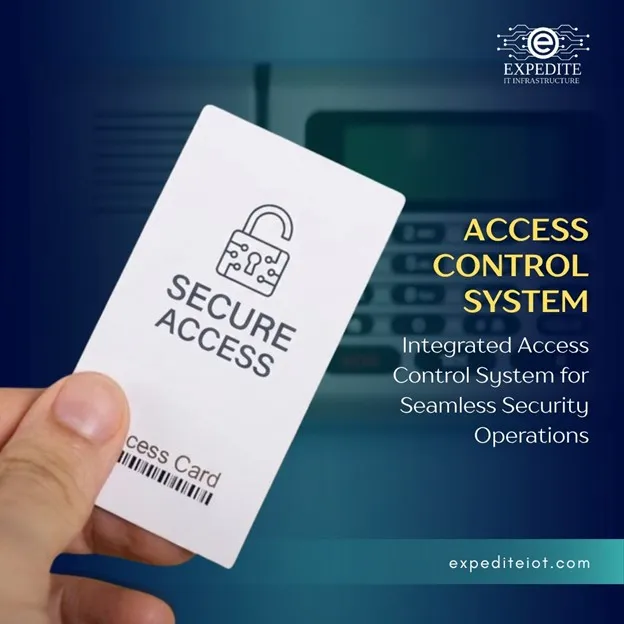

An enterprise-grade Access Control System is the backbone of physical security for every serious organisation operating in Qatar today. As the country accelerates its National Vision 2030 infrastructure programme - from Lusail City mega-developments to Hamad International Airport expansions and Doha's growing financial district - the demand for intelligent, scalable, and regulation-compliant access control has never been higher. Expedite IoT delivers Qatar's most comprehensive portfolio of access control technology, engineered for the Gulf's unique security environment and backed by proven regional expertise.
This guide explores every dimension of modern access control deployment in Qatar: the technologies available, the sectors that need them most, the regulatory landscape, and how Expedite IoT's proven methodology translates into measurable security outcomes for organisations across Doha and beyond.
1. Why Qatar Organisations Are Prioritising Access Control in 2025
Qatar's transformation into a global business, energy, and events hub has introduced security challenges that manual guards and mechanical locks simply cannot address. The post-FIFA World Cup 2022 legacy has left behind world-class stadiums, hospitality infrastructure, and transport networks - all requiring intelligent, audit-ready Security Access Control frameworks that meet international standards while satisfying Qatar's Ministry of Interior (MOI) and Ashghal (Public Works Authority) requirements.
Simultaneously, Qatar's free zones - including Qatar Financial Centre (QFC), Ras Laffan Industrial City, and Mesaieed Industrial City - mandate controlled-access protocols for critical national infrastructure. For energy companies, financial institutions, government ministries, and hospitality groups, the cost of an unauthorised intrusion extends far beyond immediate security consequences: it includes regulatory penalties, reputational damage, and potential disruption to operations that serve the entire GCC.
Key Sectors Driving Access Control Demand in Qatar
- Oil, Gas & Petrochemicals: Ras Laffan's LNG facilities and QatarEnergy infrastructure require multi-layer access zoning with audit trails for every personnel movement.
- Financial Services & QFC: Banks, investment firms, and fintech companies require server room and trading floor access controls that satisfy QFCRA audit standards.
- Government & Ministries: Qatar's e-Government transformation demands digital, credential-based access that eliminates key management risks and supports rapid personnel changes.
- Healthcare: Hamad Medical Corporation and private hospitals require zone-based access to pharmacies, ICUs, operating theatres, and data centres.
- Hospitality & Retail: Luxury hotels along the Corniche and mega-malls require guest access management, staff zoning, and back-of-house security integration.
- Education: Qatar University, Education City campuses, and international schools require visitor management, student access zoning, and after-hours security.
2. The Expedite IoT Access Control Technology Portfolio
2.1 Advanced Access Control System: Intelligence Beyond the Door
Standard lock-and-key or basic card-reader deployments no longer meet the security expectations of enterprise Qatar. An Advanced Access Control System integrates credential management, real-time event monitoring, anti-passback enforcement, time-and-attendance rules, visitor management, and multi-door interlocking - all managed from a centralised software platform. Expedite IoT deploys IP-based access control platforms from globally certified vendors, enabling organisations to manage thousands of doors, hundreds of access groups, and millions of credential transactions from a single web-based console. Role-based administration ensures that site security managers, IT teams, and HR departments each have precisely the system access they need - and no more.
2.2 Biometric Access Control System: Identity You Cannot Forge
Proximity cards and PIN codes share a fundamental vulnerability: they can be lost, stolen, or shared. A Biometric Access Control System eliminates credential fraud by binding access rights to the individual's unique physiological characteristics - fingerprint, iris pattern, palm vein geometry, or facial topology. For Qatar's high-security environments - LNG terminals, financial trading floors, government data centres - biometric authentication provides a forensically defensible audit trail: proof not just that a credential was presented, but that a specific individual was physically present. Expedite IoT integrates ISO 19794-compliant biometric readers with liveness detection, preventing spoofing attempts using photographs or replicated fingerprints.
2.3 Door Access Control: The First and Last Line of Defence
Every security perimeter begins and ends with a door. Door Access Control hardware - electromagnetic locks, electric strikes, motorised deadbolts, and turnstiles - must be selected and installed to match the physical threat model, fire-safety requirements, and traffic volume of each opening. Expedite IoT's hardware portfolio covers everything from a single secure server-room door to a 500-door enterprise campus deployment. All hardware is selected from UL-listed and EN 54-compliant product lines, ensuring compatibility with Qatar Civil Defence fire-safety requirements. Integration with video surveillance at every door entry point creates a complete, evidence-quality record of every access event.
2.4 Elevator Access Management: Controlling Vertical Movement
In Qatar's growing portfolio of high-rise towers - from West Bay skyscrapers to Lusail City commercial developments - physical security cannot stop at the lobby. Elevator Access Management restricts which floors each credential holder can access via lift, enforcing zone separation between tenant floors, executive levels, plant rooms, and car parks without requiring security personnel at every landing. Expedite IoT integrates access control directly with elevator controller systems from leading manufacturers including Otis, Schindler, Kone, and ThyssenKrupp - enabling per-floor, per-time-period, per-credential access rules that update instantly when personnel changes occur. Visitor credentials automatically expire after a single floor visit, eliminating tailgating risks in multi-tenanted towers.
2.5 Access Control Device: The Right Hardware for Every Application
No two access points are identical, and the Access Control Device specification must reflect the specific physical, environmental, and security requirements of each location. Expedite IoT's hardware portfolio spans compact RFID readers for internal office doors, ruggedized outdoor readers rated to IP68 for Qatar's harsh desert and coastal environments, multi-technology readers supporting both legacy 125 kHz and modern 13.56 MHz MIFARE and DESFire credentials, and high-security readers with built-in tamper detection and encrypted communication. Controller panels are selected for the appropriate door count, with battery backup ensuring access control remains operational during power outages - a critical consideration for Qatar's infrastructure sites.
2.6 Access Control Solutions: A Complete, Integrated Ecosystem
Expedite IoT's approach to Access Control Solutions goes far beyond supplying hardware and software. Our solutions integrate access control with video management systems (VMS), intrusion detection, visitor management kiosks, HR and payroll platforms, and building management systems (BMS) - creating a unified security ecosystem where every component reinforces the others. When an access violation occurs, the VMS automatically pulls up the camera feed for that door. When an employee is terminated in the HR system, their access credentials are revoked instantly across all sites. This level of integration transforms access control from a standalone security measure into an organisation-wide security intelligence platform.
3. Regional Expertise: Delivering Access Control Across Qatar
3.1 Access Control System Qatar: Nationwide Coverage
Expedite IoT's Access Control System Qatar practice covers the full spectrum of Qatari industries and geographies - from Doha's urban commercial core to Ras Laffan's remote industrial complex and Al Wakrah's expanding healthcare and residential districts. Our Qatar-based engineering team provides local project management, on-site commissioning, preventive maintenance, and 24/7 emergency support - with response times measured in hours, not days. All systems are designed to comply with Qatar's National Cybersecurity Framework (NCSA) for networked security infrastructure and MOI physical security guidelines for commercial and government facilities.
3.2 Access Control System Doha: Smart Security for the Capital
Doha's rapid urban transformation - new metro stations, the Msheireb Downtown Doha smart city development, expanded diplomatic quarters, and the booming West Bay financial district - creates constant demand for sophisticated, scalable access control infrastructure. An Access Control System Doha deployment must address multi-tenanted buildings with hundreds of different organisations sharing a single physical perimeter, smart city integration requirements mandated by Msheireb Properties and Qatari Diar, and the high-footfall environments of Doha's metro-linked commercial developments. Expedite IoT has delivered access control solutions across major Doha landmarks, government ministries, five-star hotels, and Qatar Foundation's Education City - each tailored to the specific operational and compliance requirements of the client.
4. Why Expedite IoT Is Qatar's Trusted Access Control Partner
Selecting an access control partner is a long-term strategic decision. The system will be embedded in your physical security infrastructure for a decade or more, referenced in your regulatory submissions, and relied upon every hour of every day. Expedite IoT earns and maintains client trust through four proven E-E-A-T pillars:
- Experience: Expedite IoT has successfully delivered 300+ access control projects across Qatar, Saudi Arabia, and Oman - ranging from a single-door server room installation to a 1,200-door oil and gas complex with biometric authentication at every checkpoint.
- Expertise: Our engineering team holds internationally recognised certifications including Lenel OnGuard System Engineer, Genetec Certified Professional, HID Global Partner certification, and physical security practitioner credentials (PSP). We understand both the technology and the security principles that underpin effective deployment.
- Authoritativeness: Expedite IoT is an authorised reseller and integration partner for globally recognised access control brands including Lenel (UTC), Software House (Tyco), Genetec, HID Global, ZKTeco, Suprema, and Honeywell - giving Qatar clients access to the world's best technology backed by local engineering support.
- Trustworthiness: All deployments are delivered with full as-built documentation, system administrator training in Arabic and English, and a structured warranty and annual maintenance contract (AMC) programme. Reference site visits to comparable Qatar installations are available upon request for all prospective clients.
5. Regulatory & Standards Compliance for Qatar Deployments
Expedite IoT designs every access control deployment to satisfy Qatar's applicable regulatory frameworks and international best practices:
- Qatar Ministry of Interior (MOI) physical security guidelines for commercial, government, and critical infrastructure facilities.
- Qatar National Cybersecurity Agency (NCSA) framework for networked physical security systems - ensuring encrypted communications, secure credential management, and audit-trail integrity.
- Qatar Financial Centre Regulatory Authority (QFCRA) requirements for financial sector physical security.
- IEC 60839-11 (Electronic Access Control Systems) and EN 50133 standards for hardware and software performance.
- ISO/IEC 27001 alignment for access control as a component of information security management.
- Qatar Civil Defence requirements (Civil Defence Law No. 9 of 2012) for fire-safe door hardware and emergency egress integration.
- OSDP (Open Supervised Device Protocol) v2 for encrypted, tamper-detected reader-to-controller communication - replacing legacy unencrypted Wiegand where security standards require it.
For clients in regulated industries - financial services, healthcare, oil and gas - Expedite IoT provides a full compliance documentation package including network architecture diagrams, data-flow maps, credential management policies, and evidence of hardware certification, ready for submission to Qatar regulatory bodies.
6. Business Case: The Measurable Value of Professional Access Control
Qatar organisations that invest in professional access control consistently report measurable returns across multiple dimensions:
- Security incident reduction: Clients report a 50–70% reduction in unauthorised access events and tailgating incidents within 12 months of deployment.
- Guard labour optimisation: Intelligent access control allows security staffing to be redistributed from routine door monitoring to higher-value patrol and response roles - delivering 20–35% guard cost savings.
- Insurance premium reduction: Several Qatar-based insurers recognise certified access control systems as a risk mitigation measure, offering premium reductions of 10–20% for covered facilities.
- Regulatory audit efficiency: Automated, timestamped access logs reduce pre-audit preparation time from days to hours and eliminate the risk of human-error gaps in manual records.
- HR cost reduction: Instant, automated credential revocation eliminates the risk - and the administrative burden - of physical key collection and lock-change procedures when staff depart.
Typical ROI breakeven for a mid-size Qatar enterprise deployment: 12–18 months, driven primarily by guard cost optimisation and incident reduction.
7. Implementation Methodology: From Assessment to Handover
Step 1 - Security Needs Assessment & Site Survey
Expedite IoT's certified security consultants conduct a comprehensive on-site assessment: mapping all access points, evaluating threat vectors, reviewing existing security infrastructure, and documenting regulatory obligations. A detailed scope-of-work, hardware bill of materials, and ROM budget estimate are delivered within five business days.
Step 2 - Solution Design & Engineering Review
Our architects produce a detailed solution design covering access point hardware, controller topology, network architecture, software platform configuration, and integration interfaces with VMS, HR, and BMS systems. All designs are reviewed by a senior certified security engineer before submission to the client.
Step 3 - Hardware Procurement & Factory Staging
Hardware is procured through authorised supply chains and staged at Expedite IoT's Doha facility - pre-configured, tested, and labelled - before delivery to site. This eliminates commissioning delays and ensures every device arrives ready to install.
Step 4 - Installation, Integration & Testing
On-site installation is managed by Expedite IoT's certified engineers with minimal disruption to client operations. Integration with third-party systems is configured and end-to-end tested. A formal Factory Acceptance Test (FAT) and Site Acceptance Test (SAT) process ensures every function performs to specification before handover.
Step 5 - Training, Documentation & Go-Live Support
System administrator and end-user training is delivered in Arabic and English. Full as-built documentation, user manuals, and emergency procedure guides are provided. A 30-day post-go-live hypercare period gives clients direct access to the project engineering team for any queries or adjustments.
Conclusion
Qatar's ambition - to build a world-class, knowledge-based economy by 2030 - demands world-class physical security infrastructure to match. A professionally deployed Access Control System is not a discretionary spend: it is the foundational layer of every serious organisation's security posture, protecting people, assets, and data while satisfying an increasingly stringent regulatory environment. From an Advanced Access Control System managing thousands of credentials across a Ras Laffan industrial complex, to a Biometric Access Control System securing a QFC financial trading floor, to Elevator Access Management controlling vertical movement in a Lusail tower - Expedite IoT has the certified expertise, proven technology partnerships, and Qatar-based delivery capability to make it happen.
FAQs
FAQ 1: What is the difference between a standard and an Advanced Access Control System?
A standard access control system manages who can open which doors using basic card or PIN credentials. An Advanced Access Control System goes significantly further: it enforces anti-passback (preventing credential sharing), manages time-based access rules, integrates with HR systems for automatic credential lifecycle management, provides real-time event dashboards with video verification, supports multi-site management from a single platform, and generates audit-ready compliance reports. For organisations operating in regulated Qatar industries - financial services, energy, healthcare - the advanced platform is the only viable option for meeting MOI and sector-specific security requirements.
FAQ 2: Is a Biometric Access Control System suitable for Qatar's outdoor environments?
Yes, when the correct hardware is specified. Expedite IoT selects Biometric Access Control System readers rated to IP65 or IP68 for outdoor Qatar deployments, with operating temperature ranges of -20 °C to +60 °C - well within the Gulf's ambient extremes. Outdoor biometric readers are also equipped with sun shields to prevent direct solar interference with optical sensors and anti-condensation heating for coastal humidity environments. All outdoor hardware is tested and approved for Qatar's climate conditions before project specification is finalised.
FAQ 3: How does Door Access Control integrate with Qatar Civil Defence fire safety requirements?
All Door Access Control hardware specified by Expedite IoT is selected to comply with Qatar Civil Defence Law No. 9 of 2012 and NFPA 101 Life Safety Code requirements. Electromagnetic locks and electric strikes are connected to the building fire alarm system via fail-safe wiring - automatically releasing all controlled doors upon fire alarm activation, ensuring unobstructed emergency egress. Access control software provides a dedicated fire-alarm override mode that logs the event, releases all affected doors, and generates a post-incident audit report. All designs are reviewed by a Civil Defence-accredited fire safety engineer as part of Expedite IoT's standard project process.
FAQ 4: Can Elevator Access Management work with our existing lift infrastructure in Doha?
In most cases, yes. Expedite IoT's Elevator Access Management solution integrates with existing elevator controller systems using relay interfaces and serial communication protocols - meaning a full lift replacement is rarely required. Our engineers conduct a pre-installation survey of the existing lift controller to confirm compatibility and design the integration accordingly. For newer lifts with IP-based controllers from Otis, Schindler, Kone, or ThyssenKrupp, native integration APIs are available for a cleaner, more feature-rich implementation. In cases where older controllers cannot be integrated, we recommend controller upgrade paths that minimise building disruption.
FAQ 5: What ongoing support does Expedite IoT provide for Access Control Solutions in Qatar?
Expedite IoT offers a structured Annual Maintenance Contract (AMC) programme for all Access Control Solutions deployed in Qatar. AMC coverage includes scheduled preventive maintenance visits (quarterly or biannual), 24/7 emergency technical support with a guaranteed four-hour on-site response SLA for critical faults, software licence management and version upgrades, credential database health checks, and annual system security reviews aligned to the Qatar NCSA framework. For clients operating across multiple Qatar sites - from Access Control System Doha city-centre offices to Access Control System Qatar industrial campuses - a single AMC contract covers the entire estate under one service-level agreement, simplifying vendor management and ensuring consistent service quality across all locations.
Advanced Access Control System


























Sign in to leave a comment.