
Introduction
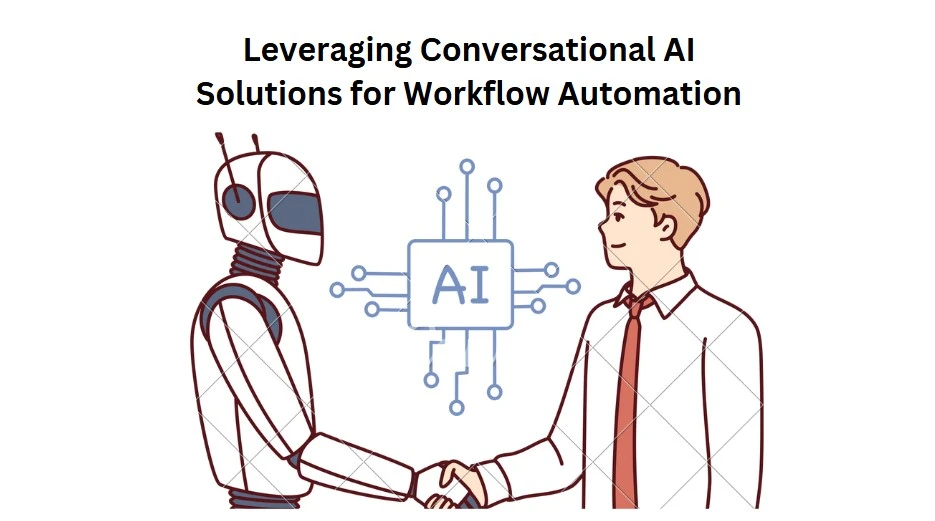
Businesses rely on streamlined workflows for maximum efficiency. However, manual steps—like data entry, form submission, or basic troubleshooting—can bottleneck operations and frustrate staff. Conversational AI solutions offer an automated approach to handling repetitive tasks through natural-sounding interactions. This blog explores how AI chatbots and virtual assistants automate workflows, boosting productivity and reducing operational costs.
1. Why Conversational AI for Workflow Automation?
Text-based interfaces, supported by natural language processing, enable employees or customers to trigger processes without navigating complex GUIs. Instead of clicking multiple menus or forms, a user might simply say: “File a leave request for next Friday.” The AI agent interprets the intent, collects necessary info, and logs it in relevant systems.
2. Potential Applications
- HR & Employee Services: Assist staff with leave applications, benefits queries, or onboarding tasks.
- IT Help Desk: AI handles password resets, ticket creation, and status checks for common issues.
- Sales Order Processing: Agents can capture order details verbally or via chat, pushing them into CRM for immediate follow-up.
3. Key Components of an Automated Conversational System
- NLP Engine: Interprets user inputs and identifies tasks.
- Workflow Engine: Maps recognized intents to the correct process (e.g., generating a leave request form).
- Backend Integrations: Ties into HR software, CRMs, or IT ticketing systems for data updates.
- Analytics & Dashboards: Monitors usage patterns, error rates, and completion times to refine the solution.
4. Benefits of Workflow Automation Using AI
- Reduced Human Labor: Mundane tasks get offloaded to AI, so employees focus on high-value activities.
- Faster Task Completion: Automated actions run 24/7, bypassing queue backlogs.
- Consistent Execution: AI ensures each step is followed accurately, minimizing rework due to human error.
- Scalability & Adaptability: As business scales or modifies processes, AI models can be retrained or updated accordingly.
5. Real-World Example: A Mid-Sized Retail Company
A retailer that deals with frequent HR queries—like shift swaps, payroll requests, and training sign-ups—implements conversational AI. Employees type or speak queries to the bot, which retrieves relevant policies or executes forms. The result: HR staff see fewer tickets, employees get faster resolutions, and the system logs every interaction for compliance.
6. Best Practices for Implementation
- Process Mapping: Identify high-volume, low-complexity tasks well-suited for automation first.
- User-Friendly Interface: Clear instructions and fallback options for complex or out-of-scope queries.
- Iterative Rollouts: Pilot with a small user group, refine the system, then expand usage.
- Continuous Maintenance: Keep knowledge bases updated to reflect policy changes or new workflows.
7. Overcoming Challenges
- Complex or Ambiguous Queries: AI might struggle with multi-part instructions. Ongoing model training mitigates this.
- Integration Complexities: Legacy systems might require special adapters or middleware for smooth data exchange.
- Adoption Concerns: Staff or customers may be unsure about trusting AI for tasks historically performed by humans.
8. Future of Conversational AI in Workflow Automation
Expect more advanced language models that handle multi-turn dialogues spanning different domains—like HR, finance, or logistics—without extensive reprogramming. Voice-enabled tasks might become mainstream in warehouses or labs. Coupled with real-time data analytics, these advanced systems will allow for even more dynamic, AI-driven operations.
Conclusion
Conversational AI solutions act as invaluable aids for automating routine workflows. Whether applied to HR processes, IT support, or sales order management, they speed up tasks and reduce friction. With thoughtful implementation—covering integration, user experience, and ongoing model refinements—conversational AI can transform operations into a more streamlined, cost-effective machine. This isn’t just about automating simple tasks; it’s about reimagining how employees and customers interact with enterprise processes in a digital-first world.


























Sign in to leave a comment.