

Introduction
Lighting is usually the first thing people think of when they hear "smart home automation," and for good reason. It's visible, immediate, and genuinely changes how a home feels day to day.
But most homeowners jump straight to buying smart bulbs without understanding the three concepts that actually make lighting control useful: scenes, zones, and scheduling. Get these right, and lighting feels effortless. Get them wrong, and you end up with a system that's technically "smart" but frustrating to actually use.
Here's a clear breakdown of how each concept works, and how they fit together.
Why Lighting Is the Starting Point for Most Home Automation Projects
Lighting tends to be the entry point into home automation for a simple reason: it's the easiest improvement to notice immediately.
Unlike climate control or security, which often work quietly in the background, lighting changes are visible the moment they happen, making it a natural first step for homeowners exploring automation.
This is also why lighting control is worth understanding properly, since it often sets the tone for how the rest of a home automation system gets designed.
Understanding Zones: The Foundation of Lighting Control
Before scenes or scheduling make sense, it helps to understand zones, since everything else is built around them.
What a Lighting Zone Actually Is
A zone is a defined area of your home where lighting can be controlled independently from the rest of the property. This could be:
- A single room, like a bedroom or kitchen
- A section within a larger room, such as task lighting versus ambient lighting
- An outdoor area, like a garden or driveway
- A functional space, like a home cinema room
Why Zoning Matters
Without zones, lighting control is limited to blunt, all-or-nothing switching. With properly defined zones, you can dim a living room while keeping a hallway fully lit or adjust outdoor lighting without touching anything indoors.
For larger properties, especially villa automation projects, zoning becomes essential rather than optional, simply due to the number of distinct areas involved.
Understanding Scenes: Multiple Zones Working Together
If zones are the building blocks, scenes are how those blocks come together to create a specific mood or function.
What a Lighting Scene Does
A scene is a pre-set combination of lighting levels across multiple zones, triggered by a single command. Instead of manually adjusting five different lights, one scene adjusts them all simultaneously to a predefined setting.
Common Scene Examples
- "Evening" scene — dims interior lighting while brightening exterior pathways
- "Movie night" scene — lowers cinema room lighting to a preset level while dimming adjacent hallway lights
- "Away" scene — activates randomized lighting patterns to simulate occupancy for security purposes
- "Morning" scene — gradually increases bedroom and kitchen lighting on a staggered schedule
Why Scenes Matter More Than People Expect
Scenes are where home automation actually starts feeling automated, rather than just remotely controlled. Instead of thinking about individual lights, you think about what you're doing, and the lighting adjusts accordingly.
Understanding Scheduling: When Automation Runs Without You
Scheduling adds the time-based layer that makes lighting control feel genuinely hands-off, rather than something you still have to trigger manually every time.
Types of Scheduling in Lighting Control
- Fixed schedules — lights turn on or off at set times, useful for predictable routines
- Sunrise/sunset-based scheduling — lighting adjusts based on actual daylight changes rather than a fixed clock time
- Occupancy-based scheduling — lighting responds to motion or presence detection rather than a strict schedule
- Conditional scheduling — lighting adjusts based on other factors, like weather or security system status
Why Sunset-Based Scheduling Often Works Better Than Fixed Times
Fixed schedules don't account for seasonal daylight changes, meaning a 6 PM lighting schedule feels early in summer and late in winter. Sunset-based scheduling adjusts automatically, which tends to feel far more natural over time.
How Zones, Scenes, and Scheduling Work Together
These three elements aren't separate features, they're layered on top of each other to create a complete lighting control system.
| Element | Role | Example |
| Zones | Defines what can be controlled independently | Living room, garden, driveway |
| Scenes | Combines zones into a coordinated setting | "Evening" scene across multiple zones |
| Scheduling | Determines when scenes or zones activate automatically | Sunset-triggered evening scene |
A well-designed system uses all three together: zones give you control granularity, scenes give you coordinated outcomes, and scheduling removes the need for manual triggering altogether.
Where KNX Automation Fits Into Lighting Control
Not all home automation systems handle zones and scenes with the same reliability, especially as complexity increases.
Why KNX Performs Well for Complex Lighting Setups
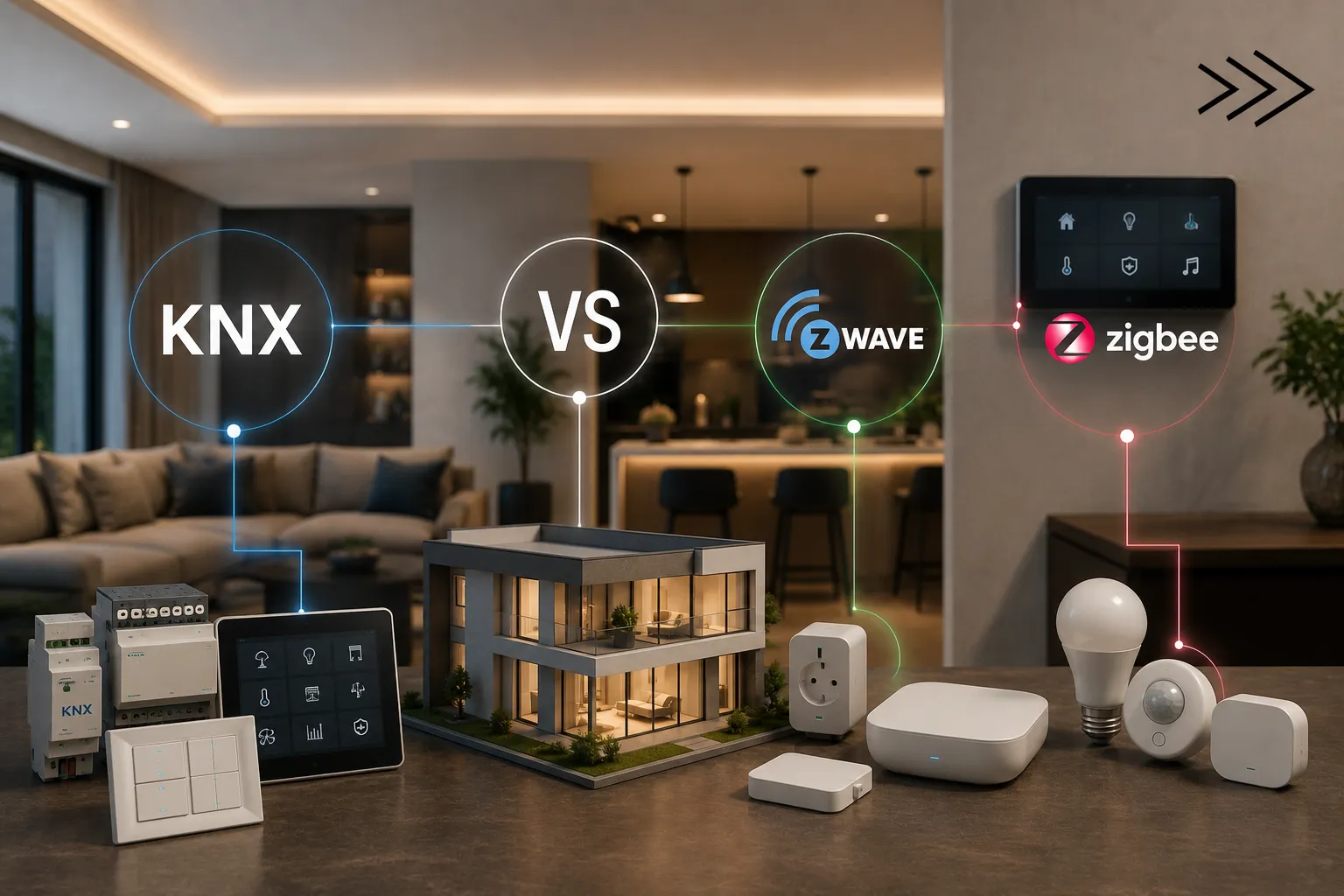
KNX automation's wired architecture allows for precise, independent zone control without the lag or inconsistency that can occur in larger wireless setups, particularly across bigger properties.
For villa automation projects with dozens of lighting zones, this reliability becomes especially noticeable, since scenes need to trigger consistently across the entire property, not just nearby rooms.
If you're planning a lighting system with more than a handful of zones, it's worth discussing wired versus wireless options early, since retrofitting a more reliable system later is considerably more disruptive.
Lighting Control and Security: An Often-Overlooked Connection
Lighting isn't purely aesthetic; it plays a meaningful role in home security as well.
Practical Security Applications
- Motion-triggered outdoor lighting paired with CCTV installation for better nighttime visibility
- "Away" scenes that simulate occupancy patterns while a property is unoccupied
- Automatic lighting activation tied to security sensor triggers, rather than requiring manual response
This kind of integration is where lighting control moves beyond convenience and becomes a functional part of a home's overall security setup.
Common Mistakes When Setting Up Lighting Control
- Treating every light as its own zone, creating unnecessary complexity
- Designing scenes without considering how zones interact with each other
- Relying entirely on fixed schedules instead of sunset-based or occupancy-based triggers
- Skipping proper zone planning before installation, leading to costly reconfiguration later
- Choosing a wireless system for a large property without considering long-term reliability
Conclusion
Lighting control might seem like the simplest part of smart home automation, but zones, scenes, and scheduling working together properly is what separates a genuinely useful system from one that just feels like remote-controlled switches.
Zones define what can be controlled, scenes coordinate multiple zones into meaningful settings, and scheduling removes the need for manual input altogether. For larger properties, particularly villa automation projects, pairing this structure with reliable infrastructure like KNX automation makes a noticeable difference in day-to-day consistency.
Whether you're starting with a single room or planning a full-property lighting system, understanding these fundamentals first leads to far better results than jumping straight into buying devices.
Planning Your Lighting Control System
If you're ready to move beyond basic smart bulbs and want a properly zoned, scene-based lighting system, planning it right from the start makes all the difference.
Get in touch for a free consultation on designing a lighting control system tailored to your property, from a single room to a full villa automation project.
Frequently Asked Questions
What is the difference between a lighting zone and a lighting scene? A zone is an independently controllable area, while a scene is a pre-set combination of lighting levels across multiple zones, triggered together.
Is sunset-based scheduling better than fixed-time scheduling? Generally yes, since it adjusts automatically for seasonal daylight changes, unlike fixed schedules that can feel too early or too late depending on the time of year.
Why is KNX automation recommended for larger lighting setups? KNX's wired architecture handles complex, multi-zone lighting more reliably than wireless systems, especially across larger properties like villas.
Can lighting control be integrated with home security? Yes, motion-triggered lighting and "away" scenes are commonly paired with CCTV installation and security sensors for better protection.
Do I need a large number of zones for effective lighting control? Not necessarily. Zones should reflect how you actually use different spaces, not be created for every individual light fixture.



























Sign in to leave a comment.