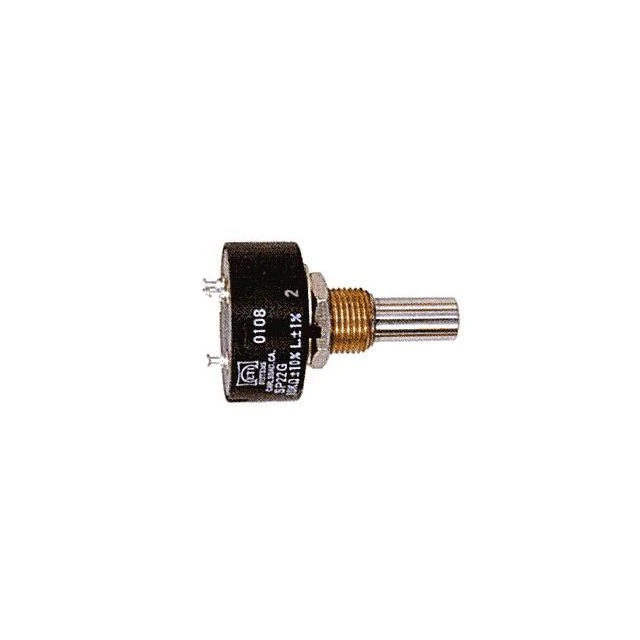

Potentiometers, often called "pots," are indispensable components in industrial applications where precise control of electrical resistance is required. Among the various types of potentiometers available, "single turn potentiometers" stand out for their simplicity and efficiency in providing accurate control.
This article focuses on the world of single turn potentiometers, exploring their features, applications, and advantages.
Understanding Single-Turn Potentiometers
A single-turn potentiometer is a variable resistor with a single rotation (360 degrees) of the shaft to adjust resistance. It consists of a resistive element and a wiper that moves along the resistive track, allowing for the adjustment of the output voltage or current.
Unlike multi-turn potentiometers requiring multiple rotations to achieve the desired resistance, single-turn potentiometers offer a more straightforward control mechanism.
Features of Single Turn Potentiometers
1. Simplicity
Single-turn potentiometers are known for their simplicity. They have a single rotational range, making them easy to operate and integrate into various industrial systems.
2. Precision
These potentiometers provide precise control due to their linear resistance taper, ensuring accurate adjustments of voltage or current.
3. Cost-Effectiveness
Single-turn potentiometers are cost-effective compared to their multi-turn counterparts, making them a preferred choice for applications that don't require extensive rotations.
4. Durability
They are designed for rugged industrial environments, with options for extended temperature ranges and resistance to environmental factors such as dust and moisture.
Applications in Industrial Settings
Single turn potentiometers find extensive use in industrial applications, where precision control is paramount.
Here are some key areas where they excel:
1. Motor Control
Industrial machinery often relies on precise motor control. Single-turn potentiometers are used to adjust motor speed and position accurately.
2. Calibration
These potentiometers play a important role in calibration equipment, ensuring the accuracy of various measuring devices and sensors.
3. Audio Equipment
In audio applications, single-turn potentiometers fine-tune volume and tone control in amplifiers, mixers, and equalizers.
4. Temperature Control
Maintaining temperature within industrial processes is vital. Potentiometers are used in temperature control systems to regulate heaters and coolers.
5. Process Control
Single turn potentiometers help control variables such as pressure, flow rate, and voltage in industrial processes, ensuring optimal performance and safety.
Advantages of Single-Turn Potentiometers
1. Cost-Efficiency
As mentioned earlier, single turn potentiometers are more cost-effective than multi-turn versions, making them a preferred choice for applications with unnecessary extensive rotations.
2. Compact Design
Their single-turn design allows for a more compact and space-saving form factor, which is important in applications with limited space.
3. Easy Integration
Due to their simplicity, these potentiometers are easy to integrate into existing systems, reducing installation time and costs.
4. Durability
Single-turn potentiometers are built to withstand harsh industrial conditions, ensuring long-term reliability.
5. Precise Control
Their linear resistance taper provides precise control, making them ideal for applications demanding accuracy.
Key Takeaways
Single-turn potentiometers are versatile components in industrial settings, offering precise control, cost-efficiency, and durability. Their simplicity, compact design, and ease of integration make them indispensable in motor control, calibration, audio equipment, temperature control, and process control.
When selecting a potentiometer for an industrial application such as with ETI Systems, consider the specific requirements and whether single-turn potentiometers align with the desired level of control. When cost-effectiveness, compactness, and ease of use are paramount, single-turn potentiometers are an excellent choice.
These components bridge the gap between control and precision in industrial systems, ensuring that machinery and processes operate optimally. Whether fine-tuning a motor's speed, calibrating measuring instruments, or adjusting audio equipment, single-turn potentiometers offer the reliability and accuracy needed in today's industrial landscape.


























Sign in to leave a comment.