
A maintenance technician is preparing to service a motor-driven conveyor. The disconnect is switched off, but the job is not necessarily safe. Another employee could restore power, a pneumatic line could remain pressurized, or mechanical energy could still be stored in the equipment.
This is where lockout tagout devices become part of the energy-control process.
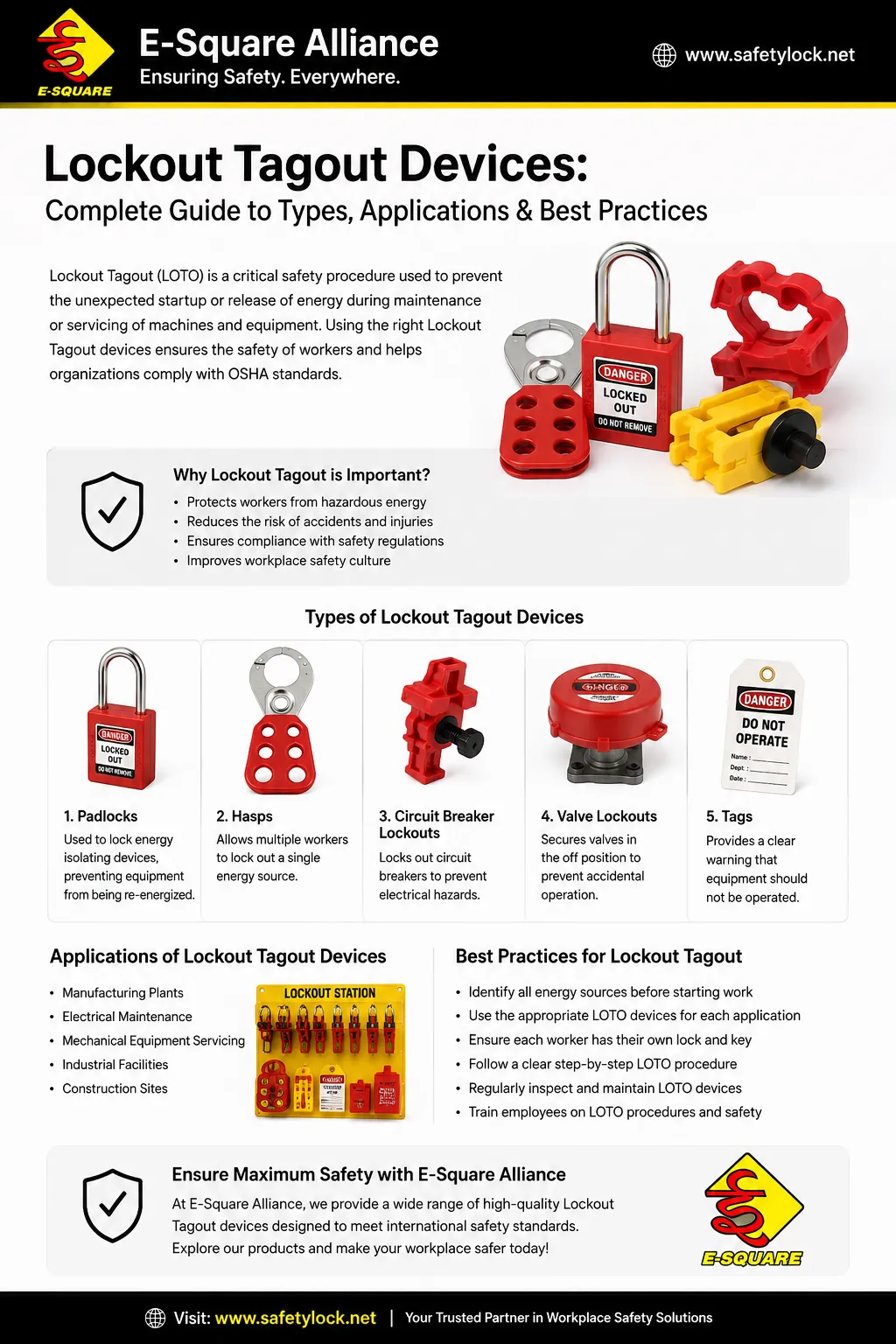
LOTO devices are physical tools used to secure energy-isolating devices and communicate that equipment must not be operated while servicing or maintenance is underway. Depending on the equipment, they can include safety padlocks, hasps, valve lockouts, circuit breaker lockouts, cable lockout devices, tags, plug lockouts, and group lockout boxes.
OSHA’s Control of Hazardous Energy standard, 29 CFR 1910.147, addresses servicing and maintenance situations where unexpected energization, startup, or release of stored energy could injure employees. The standard establishes minimum requirements for controlling that hazardous energy.
The important point is that a LOTO device is not a standalone safety solution. It is one component of an energy-control program that should address isolation, lockout, tagging, stored energy, verification, maintenance, and controlled restoration.
What Are Lockout Tagout Devices?
Lockout tagout devices are physical devices used to prevent the operation or energization of equipment during servicing and maintenance and to identify that an energy-control procedure is in progress.
A lockout device uses a physical means of securing an energy-isolating device in a safe position. A tagout device provides a prominent warning that the equipment or energy-isolating device must not be operated.
OSHA defines a lockout device as a device that uses a positive means, such as a key or combination lock, to hold an energy-isolating device in a safe position and prevent energization. A tagout device is a prominent warning device attached to an energy-isolating device according to an established procedure.
In practical terms, the device selected depends on the isolation point.
For example:
- A circuit breaker may require a circuit breaker lockout.
- A ball valve may require a valve lockout.
- A group of workers may use a lockout hasp or group lockout box.
- A plug-connected machine may require a suitable plug lockout where applicable.
- A complex mechanical system may require a cable lockout.
- A personal safety padlock may secure the applied lockout device.
The objective is always the same: prevent unexpected operation while workers are exposed to hazardous energy.
Why Are Lockout Tagout Devices Important?
Industrial equipment can contain multiple forms of energy. Turning off the main electrical switch may not eliminate hydraulic pressure, compressed air, gravity, heat, spring tension, or mechanical movement.
OSHA’s LOTO standard applies to servicing and maintenance where unexpected energization, startup, or release of stored energy could cause injury.
Consider a hydraulic press undergoing maintenance. The electrical supply may be isolated, but pressure could remain in the hydraulic system. If that stored energy is not properly identified, isolated, released, or otherwise controlled, the equipment may still present a hazard.
Effective LOTO therefore involves more than putting a padlock on a switch.
A sound energy-control process considers:
- The source of hazardous energy
- The location of each energy-isolating device
- Primary and secondary energy sources
- Stored or residual energy
- Appropriate lockout devices
- Personal locks and tags
- Verification of isolation
- Equipment-specific procedures
- Controlled restoration of energy
OSHA requires employers to establish an energy-control program that includes procedures, employee training, and periodic inspections.
Types of Lockout Tagout Devices
Different machines require different isolation methods. The following LOTO devices represent common categories used in industrial energy-control programs.
Lockout Safety Padlocks
Lockout safety padlocks are personal locking devices used to secure lockout equipment in its safe position.
Unlike ordinary facility padlocks, LOTO padlocks are typically standardized and identifiable within the organization’s energy-control program. The lock should clearly identify the employee who applied it where required by the applicable procedure.
A maintenance technician might use a personal lock to secure an electrical disconnect after the equipment has been shut down and isolated.
Typical application: Electrical disconnects, isolation points, lockout hasps, and group lockout arrangements.
Selection considerations:
- Key control
- Identification
- Durability
- Environmental conditions
- Standardization
- Compatibility with the lockout device
OSHA requires lockout/tagout devices to be standardized, substantial, and identifiable to the employee applying them.
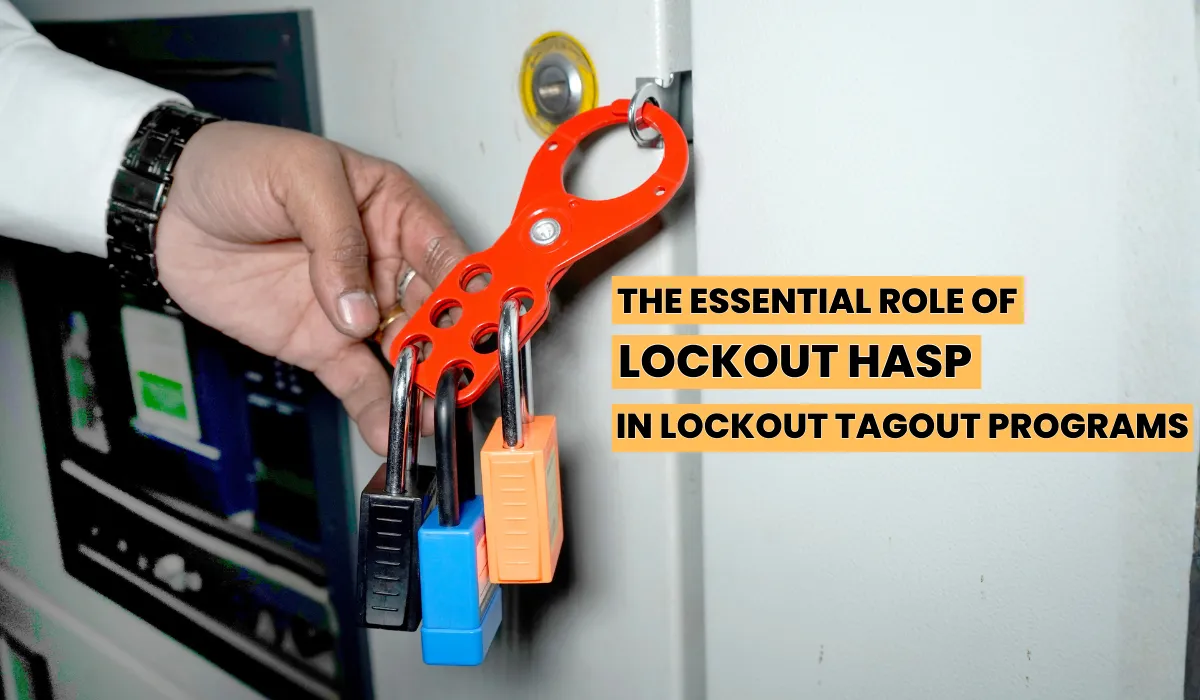
Lockout Hasps
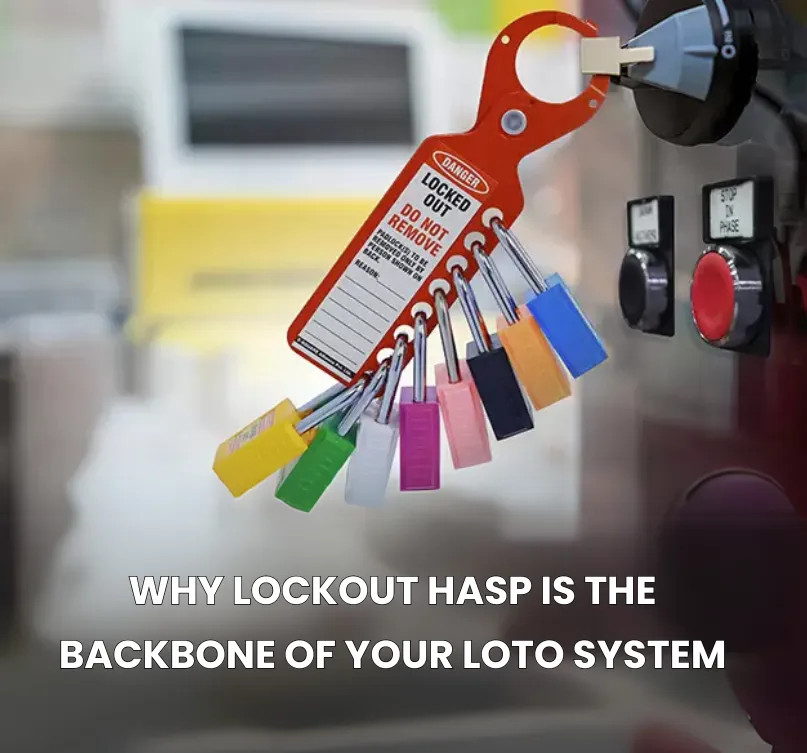
A lockout tagout hasp allows multiple workers to apply their personal locks to a single energy-isolation point.
For example, if four maintenance employees are working on the same machine, a hasp can allow each employee to apply a personal lock. The equipment remains under lockout until the workers have completed their tasks and their individual locks have been removed according to the site’s procedure.
Hasps are particularly useful for group maintenance activities.
Typical application: Electrical disconnects, control switches, valves, and other isolation points where multiple employees need individual control.
Selection considerations:
- Number of locking holes
- Shackle compatibility
- Material and corrosion resistance
- Available clearance
- Environmental exposure
- Facility standardization
A hasp should be viewed as part of a group-lockout procedure rather than simply as an accessory.
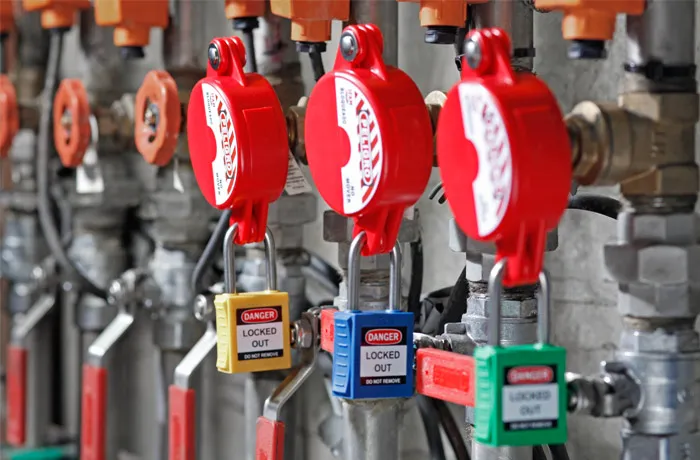
Valve Lockout Devices
Valve lockout devices are designed to prevent operation of valves that control hazardous energy or process flow.
Common examples include ball valves, butterfly valves, gate valves, and other valve configurations. The correct device depends heavily on the valve design, handle geometry, operating position, and available clearance.
A maintenance team servicing a chemical-processing line, for example, may need to isolate process flow before beginning work. The valve lockout helps prevent unauthorized operation of the isolated valve.
Selection considerations:
- Valve type
- Handle dimensions
- Operating configuration
- Available space
- Material compatibility
- Temperature and environmental conditions
A valve lockout should never be selected solely because its name matches the valve category. Physical compatibility must be evaluated.
Circuit Breaker Lockouts
A circuit breaker lockout is designed to prevent operation of a specific circuit breaker during maintenance.
Circuit breakers differ in shape, dimensions, operating mechanisms, and mounting arrangements. Therefore, the correct breaker lockout must fit the specific breaker design.
For example, an electrical maintenance technician may need to isolate a breaker feeding a conveyor motor before servicing the motor. A compatible breaker lockout can secure the operating mechanism against unauthorized operation.
Selection considerations:
- Breaker manufacturer and model
- Breaker configuration
- Single- or multi-pole arrangement
- Lockout attachment method
- Available clearance
- Required padlock compatibility
A breaker lockout does not replace electrical safe-work procedures or verification requirements.
Cable Lockout Devices
Cable lockout devices use a flexible cable to secure multiple energy-isolating points or equipment configurations where a conventional rigid lockout device may not fit.
They can be useful for machinery with multiple isolation points or unusual physical arrangements.
For instance, a machine may have several valves and disconnects located in different positions. A cable system may allow the organization to incorporate multiple points into an established energy-control procedure.
Selection considerations:
- Cable length
- Cable material
- Number and arrangement of isolation points
- Environmental exposure
- Required visibility
- Compatibility with padlocks
Cable lockout devices are especially useful when the isolation arrangement does not lend itself to a single purpose-built device.
Electrical Lockout Devices
Electrical lockout devices are designed to control electrical energy at appropriate isolation points.
This category can include circuit breaker lockouts, electrical disconnect lockouts, plug lockouts, and related devices.
The correct device depends on the electrical equipment being isolated. The key question is not simply “Which electrical lockout should we buy?” but rather:
What is the actual energy-isolating device, and what physical mechanism can securely prevent its operation?
That distinction helps maintenance teams avoid choosing equipment based only on appearance or product category.
Plug Lockout Devices
Plug lockouts can be used with appropriate cord-and-plug-connected equipment where the energy-control procedure requires physical control of the plug.
OSHA’s standard contains a specific exception for certain cord-and-plug equipment where the plug is disconnected from the energy source and remains under the exclusive control of the employee performing servicing or maintenance.
Organizations should evaluate the specific equipment and circumstances before determining whether this exception applies.
Where a plug lockout is appropriate, the device should securely prevent the plug from being connected to the energy source.
Pneumatic Lockout Devices
Pneumatic systems can contain hazardous energy even after equipment has stopped operating.
A pneumatic lockout may be used to secure an appropriate isolation point associated with compressed air.
For example, a packaging machine may use compressed air to drive cylinders. Simply turning off the machine’s control panel does not necessarily establish a safe zero-energy condition. The energy-control procedure may require isolation of the pneumatic supply and control of residual pressure.
The appropriate device depends on the actual pneumatic isolation point and equipment configuration.
Lockout Tags
Lockout tags communicate that equipment or an energy-isolating device must not be operated.
Tags are an important part of the communication side of an energy-control procedure. They should be durable, standardized, and clearly identifiable according to the organization’s procedure.
OSHA specifies requirements for tagout devices, including durability and identification, and requires warning language such as “Do Not Start,” “Do Not Energize,” or “Do Not Operate.”
A tag should not be treated as a substitute for physical isolation when lockout is required and feasible.
Group Lockout Boxes
A group lockout box can help manage complex maintenance activities involving multiple employees and multiple energy sources.
A common approach is to place keys from isolation-point locks inside a controlled lockbox. Each authorized employee then applies a personal lock to the group lockbox according to the facility’s written procedure.
This arrangement can be useful during major shutdowns, equipment overhauls, or maintenance projects involving several workers.
Group lockout requires careful planning. The procedure should clearly establish who controls the isolation, how personal protection is maintained, and how locks are removed.
Lockout Tagout Stations
A lockout tagout station provides a centralized location for commonly used LOTO equipment.
A well-organized station can make devices easier to locate and can support standardization across a facility.
Depending on the site’s needs, a station may contain:
- Safety padlocks
- Hasps
- Tags
- Cable lockout devices
- Valve lockouts
- Breaker lockouts
- Replacement supplies
- Equipment identification materials
Accessibility matters. If workers cannot quickly locate the appropriate device, the energy-control process can become harder to execute consistently.
Lockout Tagout Kits
A lockout tagout kit combines commonly required LOTO equipment for a particular application, employee, machine type, or work area.
A kit can be useful when an organization wants a standardized set of devices rather than individual items distributed separately.
However, a generic kit should not be assumed to cover every energy source in a facility.
The correct kit should be based on the site’s equipment inventory, energy sources, isolation points, procedures, and workforce requirements.
Lockout Tagout Devices by Energy Source
| Energy Source | Common Equipment | Suitable LOTO Devices | Key Consideration |
|---|---|---|---|
| Electrical | Motors, panels, disconnects | Circuit breaker lockouts, electrical lockouts, padlocks | Identify the correct energy-isolating device |
| Mechanical | Conveyors, presses, rotating equipment | Hasps, cable lockouts, mechanical isolation devices | Control movement and stored mechanical energy |
| Hydraulic | Presses, lifts, hydraulic systems | Valve lockouts, mechanical isolation devices | Address pressure and residual energy |
| Pneumatic | Cylinders, actuators, air tools | Pneumatic isolation devices, valve lockouts | Release or control residual pressure |
| Thermal | Furnaces, steam systems, heated equipment | Appropriate isolation devices and procedures | Consider heat and residual thermal energy |
| Chemical | Process lines, tanks, chemical systems | Valve lockouts and other isolation devices | Follow equipment-specific procedures |
| Stored Energy | Springs, capacitors, elevated components | Appropriate isolation/restraint devices | Identify, release, restrain, or otherwise control stored energy |
The table is a planning aid, not a substitute for an equipment-specific energy-control procedure.
How to Choose the Right Lockout Tagout Device
Choosing LOTO equipment should begin with the machine rather than the product catalog.
Use this decision framework.
1. Identify the Energy Source
Determine whether the equipment contains electrical, mechanical, hydraulic, pneumatic, thermal, chemical, gravitational, or other hazardous energy.
2. Identify the Energy-Isolating Device
Find the physical device that can isolate the energy source. This may be a disconnect, circuit breaker, valve, or another isolation mechanism.
3. Evaluate the Equipment Design
Measure or inspect the isolation point.
Ask:
- Does the lockout physically fit?
- Is there enough clearance?
- Can the device be secured without modification?
- Can the operating mechanism still move after installation?
4. Consider the Number of Workers
If several authorized employees will work on the same equipment, consider a hasp or group lockout arrangement consistent with the site’s procedure.
5. Evaluate the Environment
Consider:
- Temperature
- Moisture
- Dust
- Chemicals
- Corrosion
- Outdoor exposure
- Visibility
6. Standardize Where Practical
Standardized equipment can make training, inspections, inventory management, and recognition easier.
OSHA requires lockout/tagout devices to meet specified characteristics, including standardization, durability, and identification.
How Lockout Tagout Devices Are Used in the Workplace
LOTO devices should be integrated into a defined energy-control procedure.
A typical sequence is:
1. Identify Hazardous Energy
Determine every energy source associated with the equipment.
2. Notify Affected Employees
Inform employees who operate or work around the equipment that servicing will take place.
3. Shut Down the Equipment
Use the normal shutdown procedure.
4. Isolate Energy Sources
Operate the appropriate energy-isolating devices.
5. Apply Lockout Devices
Install the appropriate lockout equipment so the isolation point remains in a safe position.
6. Apply Personal Locks and Tags
Authorized employees apply their personal protection according to the facility’s procedure.
7. Release or Control Stored Energy
Drain pressure, discharge electrical energy where applicable, block moving parts, lower elevated components, or otherwise control residual energy according to the equipment-specific procedure.
8. Verify Isolation
Verification is a critical step. The authorized employee should confirm that the equipment has been isolated and rendered inoperative according to the established procedure.
9. Perform Maintenance
Only after the required controls have been established should the maintenance activity proceed.
10. Restore Energy Under a Controlled Procedure
Before returning equipment to service, employees should follow the site’s documented restoration process.
OSHA Appendix A provides a typical minimal lockout procedure and notes that more complex systems may require more comprehensive procedures.
Isolation -Lockout -Tagging - Verification - Maintenance - Restoration
One useful way to understand LOTO is as a chain of controls:
Isolation: Separate the equipment from its energy source.
Lockout: Physically secure the energy-isolating device.
Tagging: Clearly identify the lockout and communicate the prohibition against operation.
Verification: Confirm that the equipment is isolated and cannot operate as expected under the established procedure.
Maintenance: Perform the authorized work while hazardous energy remains controlled.
Restoration: Follow the documented process for removing controls and returning equipment to service.
Skipping one of these stages can undermine the effectiveness of the overall energy-control process.
Common LOTO Device Selection Mistakes
Choosing a Device That Does Not Fit
A lockout device that does not properly secure the isolation point is not an effective solution.
Using a Generic Device When a Purpose-Designed Device Is Needed
A universal-looking product is not automatically suitable for every valve, breaker, or disconnect.
Ignoring Stored Energy
Workers may focus on electrical power while overlooking pressure, gravity, springs, heat, rotating components, or other residual energy.
Using Damaged Devices
Cracked, worn, corroded, or otherwise damaged LOTO equipment should be evaluated and replaced according to the organization’s program.
Poor Identification
If workers cannot determine who applied a personal lock or what the tag communicates, the system becomes harder to manage.
Inadequate Group Lockout Arrangements
Multiple workers require a procedure that preserves individual control and protection.
Failing to Verify Isolation
Applying a lock is not the same as proving that the equipment has reached the required safe state.
Treating the Device as the Entire LOTO Program
This is perhaps the biggest mistake.
A lockout device is a tool. The broader system includes procedures, training, inspections, equipment-specific information, and management controls.
Best Practices for Managing LOTO Devices
A well-managed LOTO inventory should be treated as part of the facility’s safety system.
Standardize Equipment
Where practical, establish consistent types of locks, tags, hasps, and other LOTO equipment.
Train Employees
Employees who perform servicing and maintenance need training appropriate to their responsibilities and exposure to hazardous energy. OSHA identifies training as a core component of the energy-control program.
Inspect Devices Regularly
Look for damage, wear, corrosion, missing components, illegible identification, or other problems.
Maintain an Inventory
Know which LOTO devices are available, where they are stored, and which equipment or procedures they support.
Keep Devices Accessible
Workers should be able to locate appropriate equipment without unnecessary delays.
Use Equipment-Specific Procedures
A complex machine should not be managed using assumptions based only on a generic LOTO checklist.
Review Procedures Periodically
OSHA’s standard includes periodic inspection requirements as part of the energy-control program.
Replace Damaged Equipment
Do not allow damaged or unsuitable equipment to remain in service simply because it is already part of the inventory.
LOTO Devices for Different Industries
Manufacturing
Manufacturing facilities commonly deal with motors, conveyors, presses, robotic systems, electrical panels, hydraulic equipment, and pneumatic systems. LOTO programs may therefore require a broad range of electrical and mechanical isolation devices.
Automotive
Automotive production and maintenance environments can involve conveyors, presses, welding equipment, robots, hydraulic systems, and automated machinery. Equipment-specific isolation procedures are particularly important where several energy sources interact.
Power Generation
Power-generation environments can involve electrical, mechanical, thermal, hydraulic, and other energy sources. Isolation procedures should reflect the specific equipment and applicable regulations.
Chemical Processing
Chemical facilities may need to control valves, process lines, pumps, electrical equipment, pressure, and other hazardous energy or process conditions.
Pharmaceutical
Pharmaceutical manufacturing may involve complex production equipment, electrical systems, compressed air, pumps, mixers, and other machinery requiring controlled maintenance.
Food and Beverage
Processing and packaging machinery can contain electrical, pneumatic, mechanical, thermal, and other energy sources. Sanitation and maintenance activities may require different equipment-specific procedures.
Steel
Steel facilities can contain heavy mechanical equipment, hydraulic systems, electrical equipment, conveyors, furnaces, and other high-energy machinery.
Utilities and Warehousing
Utilities and industrial warehouses may use conveyors, compactors, electrical systems, HVAC equipment, material-handling equipment, and other machinery requiring energy isolation during maintenance.
The appropriate LOTO equipment should always be selected according to the actual equipment, hazards, isolation points, and applicable energy-control procedure rather than industry name alone.
Lockout Tagout Device Checklist
Use the following checklist when evaluating a LOTO program or preparing equipment for maintenance:
- All hazardous energy sources have been identified.
- Primary energy sources have been identified.
- Secondary or stored energy sources have been considered.
- Energy-isolating devices have been identified.
- Appropriate lockout devices are available.
- Personal safety padlocks are available.
- Tags are available and identifiable.
- Hasps or group lockout equipment are available where required.
- Equipment-specific procedures are documented where required.
- Authorized employees have received appropriate training.
- Isolation can be physically verified.
- Damaged LOTO equipment is removed from service.
- Devices are accessible to authorized employees.
- Inventory is maintained.
- Procedures are periodically reviewed.
- Periodic inspections are performed as required.
- Controlled restoration procedures are established.
This checklist is a practical management aid and should not replace the requirements of the applicable OSHA standard or the employer’s written energy-control procedures.
Conclusion
The right lockout tagout devices can make an energy-control procedure easier to execute, more consistent, and easier for workers to recognize. But the device itself is only one part of the process.
Effective LOTO starts with identifying hazardous energy and determining how each energy source can be isolated. From there, the organization must select compatible lockout equipment, apply personal locks and tags, address stored energy, verify isolation, perform the maintenance safely, and follow a controlled restoration procedure.
For maintenance managers, EHS professionals, plant engineers, and safety officers, the best approach is to select LOTO equipment based on the actual machinery and isolation points—not simply on product names.
A strong program combines appropriate lockout tagout equipment, equipment-specific procedures, employee training, inspections, and disciplined execution.
Before implementing or modifying an energy-control program, review the applicable OSHA requirements and evaluate the specific hazards and equipment present at your facility. OSHA's current hazardous-energy resources and 29 CFR 1910.147 should be treated as the primary regulatory references for applicable U.S. general-industry operations.



























Sign in to leave a comment.