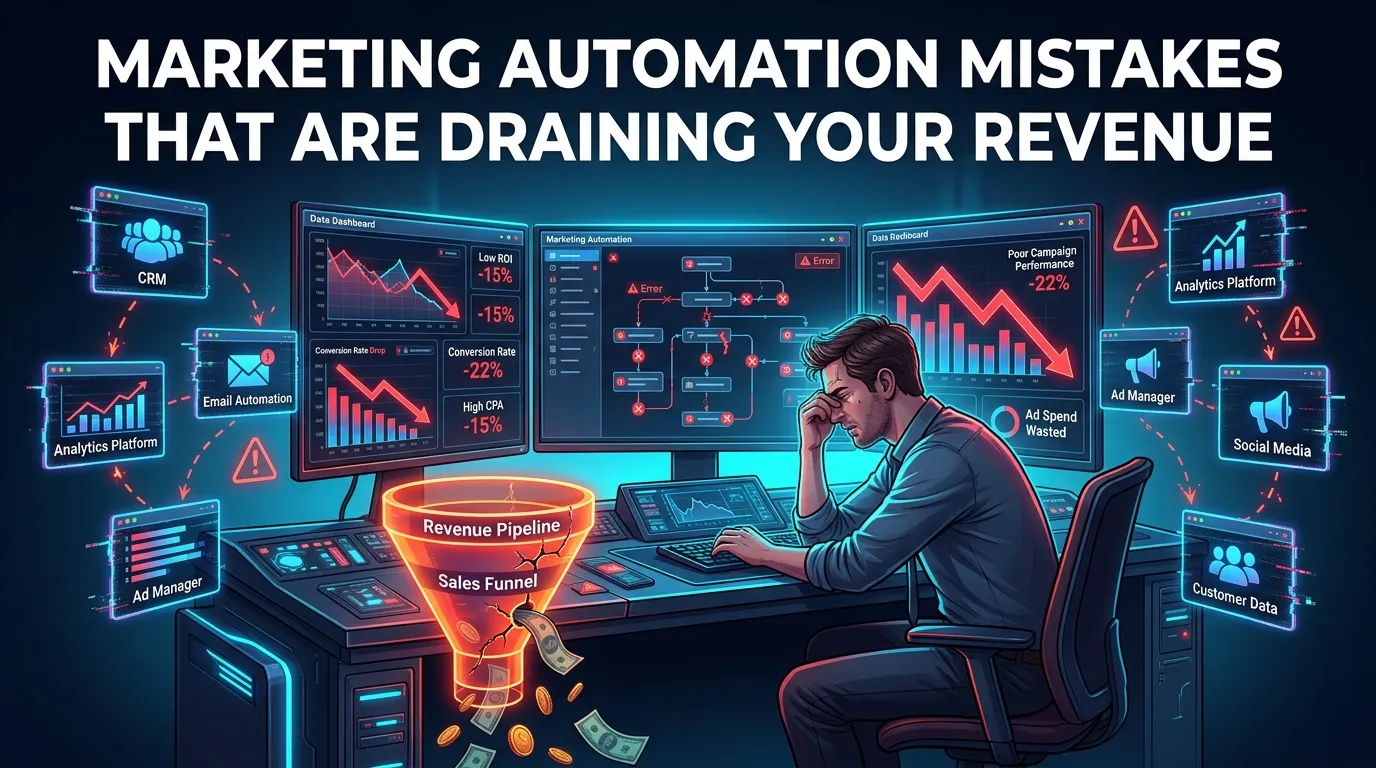

Adoption of marketing automation continues to grow, yet a large proportion of businesses report that returns fall short of expectations. The tools are capable. The problem tends to be in how they are applied. From data management to content relevance to workflow discipline, the factors that determine whether automation earns its investment are largely operational. Taking stock of where things currently stand, including the most overlooked automation pitfalls, gives businesses a clearer view of where to direct their effort.
The following seven failure points appear most frequently, and each one has a practical path forward.
Top Mistakes Marketing Automation ROI
1. Fragmented Data Limits What Automation Can Do
Marketing automation is only as effective as the data it draws on. When customer information is spread across disconnected systems, the platform works from an incomplete view. Emails go out to people who recently complained. Offers are made to customers who have already purchased. Segments drift from reality because no single system holds the full picture.
Bringing data together is foundational. Businesses that build on a genuinely connected omnichannel customer data infrastructure give their automation the context it needs to send relevant messages at the right time, rather than messages that are merely scheduled.
2. Lead Scoring That Fails to Separate Intent from Interest
Interest and intent are not the same thing. A contact who downloaded a guide is not the same as one who visited the pricing page three times in a week. Without a scoring model that distinguishes between the two, automation pushes everyone toward sales at the same pace, creating volume without quality.
Effective scoring models are built around:
- Behavioural signals that indicate progression through the buying journey
- Content engagement that reflects active research rather than passive browsing
- Profile characteristics that confirm a contact fits the target customer profile
When both teams contribute to defining the scoring criteria, handoffs happen at the right moment and sales effort is concentrated where it is most likely to result in revenue.
3. Restricting Automation to Email While Buyers Spread Across Channels
Email is a strong channel, but it is not where every buyer can be reached at every stage. Customers interact with brands across search, social, mobile, and in-app experiences before and after an email lands in their inbox. Automation that extends into cross-channel marketing execution reaches customers in more of the moments that shape their decisions, rather than waiting for them to open an email.
Improving what email automation already does is a strong place to start. Businesses that have not yet explored email workflow optimisation strategies often find meaningful gains available before expanding to additional channels.
4. Complexity That Exceeds the Team's Ability to Manage It
Automation systems grow complex quickly. Journey mapping, integration logic, segmentation rules, and attribution models each require specific knowledge to build and maintain. When organisations deploy more than their internal capabilities can support, the result is a system that works imperfectly, misreports results, and becomes increasingly difficult to audit or improve.
Engaging qualified marketing automation experts brings the structural knowledge needed to build systems that are both technically sound and operationally manageable. Good implementation reduces the cost of future maintenance and creates a platform that can grow with the business.
5. Automation Running in Situations That Call for Human Involvement
There are contact scenarios where automation should yield to direct human engagement. An unresolved service issue, an active negotiation, or a relationship that is being managed by a specific account owner are all situations where automated messaging introduces the wrong tone or the wrong message at the wrong moment.
Suppression logic and workflow pause conditions handle this when designed into the system from the beginning. In longer B2B sales cycles where trust and timing are especially sensitive, the ability to pause automation intelligently is as important as the automation itself.
6. Automation Left Unchanged as the Business Evolves
Automation built for one market condition does not automatically adapt when conditions change. Messaging that resonated with buyers six months ago may now miss the mark. Scoring thresholds calibrated for an earlier stage of the business may no longer reflect what high-intent actually looks like today. Workflows that once served the customer journey may have drifted out of step with how customers now move through it.
Treating automation as something that needs regular maintenance, not just an initial build, is what keeps it performing. Scheduled reviews of content, scoring logic, timing, and routing turn automation into an asset that improves with use rather than one that quietly deteriorates.
7. Content That Lacks Relevance to the Person Receiving It
Workflow design and content quality are separate problems. A well-timed message built on strong segmentation still underperforms if the content does not speak to the person receiving it. Buyers at different stages need different things: strategic framing when they are evaluating options, technical depth when they are assessing fit, and social proof when they are close to a decision.
Mapping content to persona and stage is what closes the gap between delivery and conversion. Businesses operating in eCommerce can see how this content-channel alignment works across the full lifecycle in the omnichannel automation blueprint for eCommerce teams, which covers how to connect the right message with the right customer at every touchpoint.
Turning Automation Into a Reliable Growth Driver
Businesses that apply automation to lead nurturing in a structured way report up to 451% more qualified leads. Those leads close at higher values, averaging 47% larger purchase sizes than contacts who were not nurtured. These outcomes are well within reach, but they require more than deploying a platform. They depend on how the system is built and how consistently it is managed.
The characteristics of automation that compounds over time are:
- Clear business goals that precede any workflow or technology decision
- Consolidated data that gives automation accurate, real-time context
- Journey design based on how buyers actually behave, not how the business imagines they do
- Reporting that connects automation activity directly to revenue outcomes
- A maintenance cadence that keeps content, scoring, and logic current
- Access to the expertise needed to build, adapt, and scale the system responsibly
Research consistently places the return on marketing automation investment at around $5.44 per dollar spent. Reaching that level is a function of execution quality, not platform selection.
Taking the Next Step
The seven mistakes outlined here are not uncommon, and none of them is insurmountable. Most businesses do not need to rebuild from scratch. They need to identify which of these gaps is most affecting performance, address it with intention, and continue from there. Each improvement creates the conditions for the next one to have greater impact.
For businesses ready to approach automation more systematically, the omnichannel marketing automation guide for growth-focused teams brings together the strategy, channel frameworks, and operational guidance needed to build automation that performs consistently across every customer touchpoint.































Sign in to leave a comment.