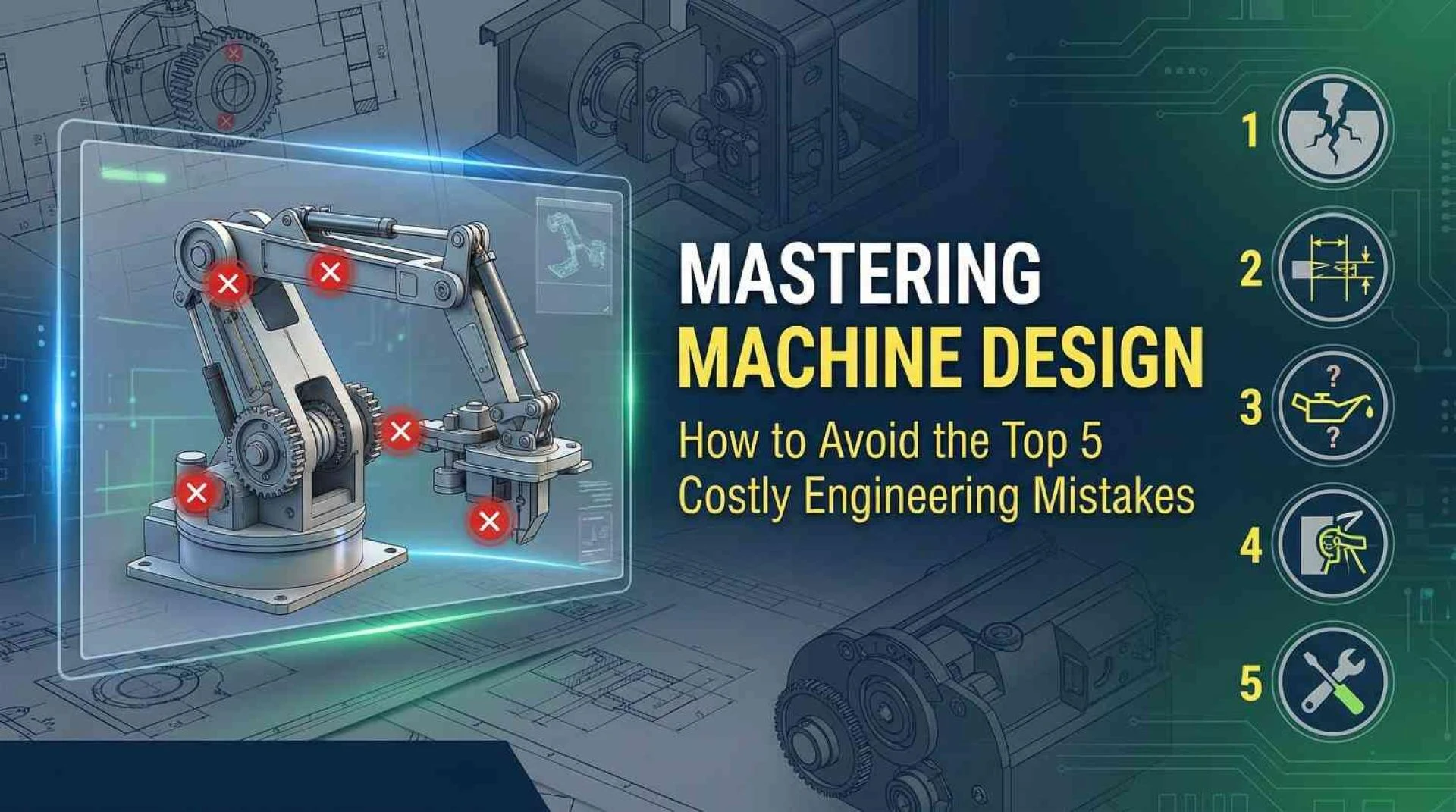

In the world of mechanical engineering, the CAD screen is where profitability is determined. While the design phase may only account for a small fraction of a project's initial timeline, it locks in up to 80% of the product's final manufacturing and lifecycle costs.
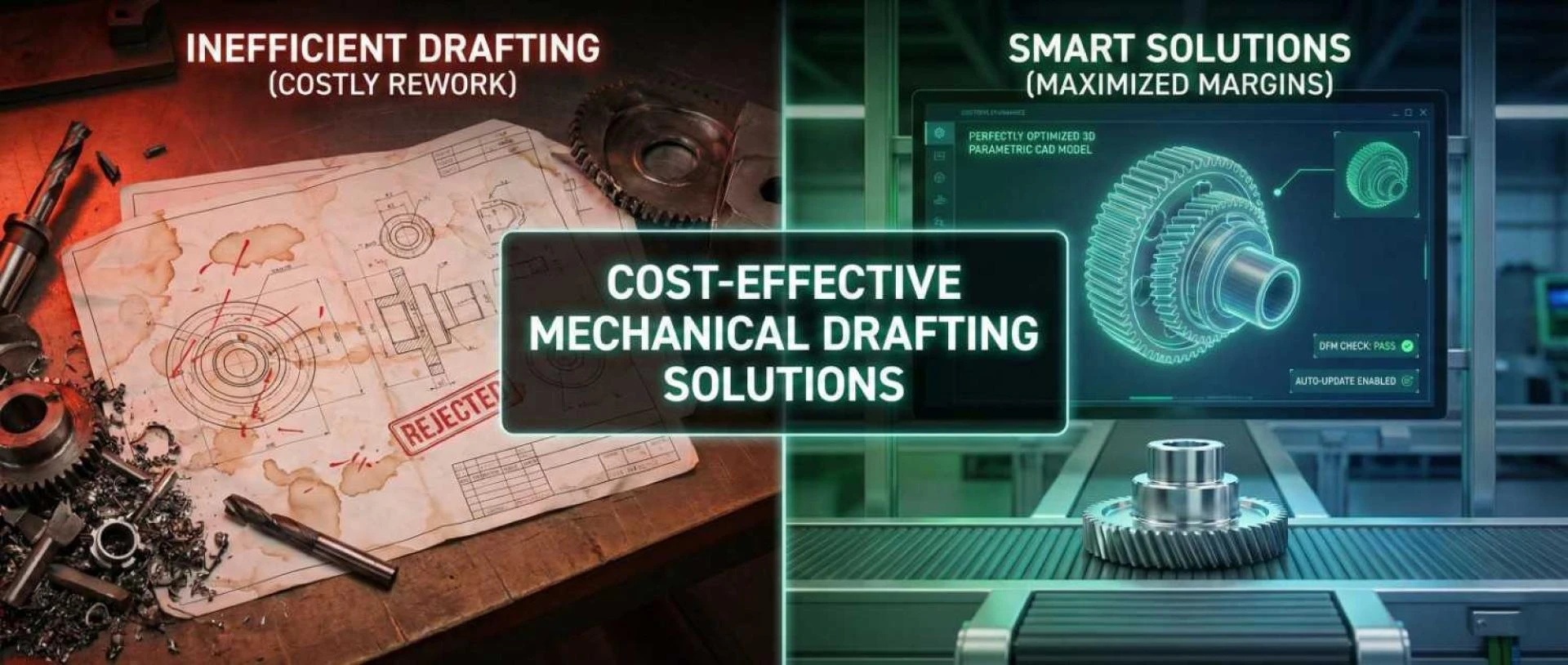
When a machine moves from digital space to the physical factory floor, the cost of rectifying an error skyrockets. A tolerance issue that takes three clicks to fix in SolidWorks can cost thousands of dollars in scrapped tooling, delayed production schedules, and field failures once metal is cut.
To help engineering teams protect their margins and deliver robust products, we have outlined the most critical pitfalls in the industry. For a deep dive into these concepts, you can refer to our comprehensive guide: Avoid These 5 Common Mistakes in Machine Design.
Here is an overview of the five traps every mechanical designer must avoid.
1. The "Default" Material Selection
The most pervasive error in modern engineering is treating material selection as a simple dropdown menu choice. Selecting generic "Steel" or "Aluminum" based solely on yield strength ignores the complex reality of how materials behave in real-world environments.
The Mistake: Failing to account for fatigue limits, galvanic corrosion, or the material's manufacturability (e.g., choosing an unwieldable aluminum alloy for a welded frame).
The Fix: Implement a rigorous "Life-Cycle Material Audit." Engineers must evaluate the operating environment (temperature, humidity, chemical exposure) and the intended manufacturing process before finalizing the bill of materials.
2. The "Tight Tolerance" Trap
There is a natural tendency among junior engineers to associate "precision" with "quality." This leads to one of the most expensive habits in manufacturing: over-tolerancing.
The Mistake: Applying ultra-tight tolerances (e.g., ±0.005mm) to every dimension on a print, regardless of whether that feature interacts with a mating part. This forces machine shops to use expensive secondary operations, such as reaming or grinding, thereby exponentially increasing the piece price.
The Fix: Adopt functional tolerancing and Geometric Dimensioning and Tolerancing (GD&T). Apply strict controls only to bearing journals, mating surfaces, and alignment pins. For everything else, utilize generous block tolerances to speed up production and reduce scrap rates.
3. Underestimating Dynamic Loads (The Illusion of Static Safety)
It is relatively simple to calculate the stress on a steel beam supporting a stationary weight. However, industrial machinery is rarely stationary.
The Mistake: Designing a machine based purely on static loads while ignoring the dynamic forces of vibration, thermal cycling, and sudden shock impacts. This leads to microscopic fatigue cracks at stress-concentration points (such as sharp internal corners), resulting in sudden, catastrophic failure.
The Fix: Move beyond hand calculations and leverage Finite Element Analysis (FEA). Simulate real-world conditions, including emergency stops and startup torques. Most importantly, eliminate "stress risers" by adding appropriate fillet radii to sharp internal corners, doubling or tripling the part's fatigue life.
4. Taking Maintainability for Granted
A machine is not finished when it leaves the assembly line; it is finished when it is running on the client's floor and can be safely serviced by a technician.
The Mistake: Designing "impossible assemblies." This occurs when a routinely replaced wear part (like a belt or filter) requires the technician to dismantle half the machine to access it, turning a 10-minute job into a 4-hour production halt.
The Fix: Priorities Mean Time To Repair (MTTR) as a primary design metric. Utilize CAD mannequins and digital hand tools to ensure proper wrench clearance around every fastener. Adopt a modular design approach so sub-assemblies can be quickly swapped out and repaired offline.
5. Emphasizing Function Over Safety
In the rush to make machines faster, lighter, and more efficient, safety features are too often relegated to the final phase of the project, a few physical guards bolted on right before shipping.
The Mistake: Treating operator safety as an accessory rather than a core design foundation. This leads to ergonomic hazards, by passable safety switches, and massive legal liabilities.
The Fix: Implement the "Hierarchy of Hazard Control." First, try to eliminate the hazard (e.g., by using automated feeds instead of manual loading). If that isn't possible, utilize robust engineering controls, such as fail-safe electronic interlocks that immediately cut power and apply mechanical brakes if a guard door is opened.
Engineering for the Real World
Avoiding these five mistakes requires a shift in perspective. It demands that engineers look beyond the screen and consider the entire lifecycle of the machine, from the machinist cutting raw steel to the operator running it daily to the technician replacing a bearing five years later.
By integrating Design for Manufacturing (DFM), respecting material science, and prioritizing human-centric safety, you don't just avoid costly errors; you build a reputation for engineering excellence.
Are your engineering workflows optimized for production? Make sure you aren't leaving money on the drawing board. Read the full, in-depth breakdown of these strategies in our main article: Avoid These 5 Common Mistakes in Machine Design.

























Sign in to leave a comment.