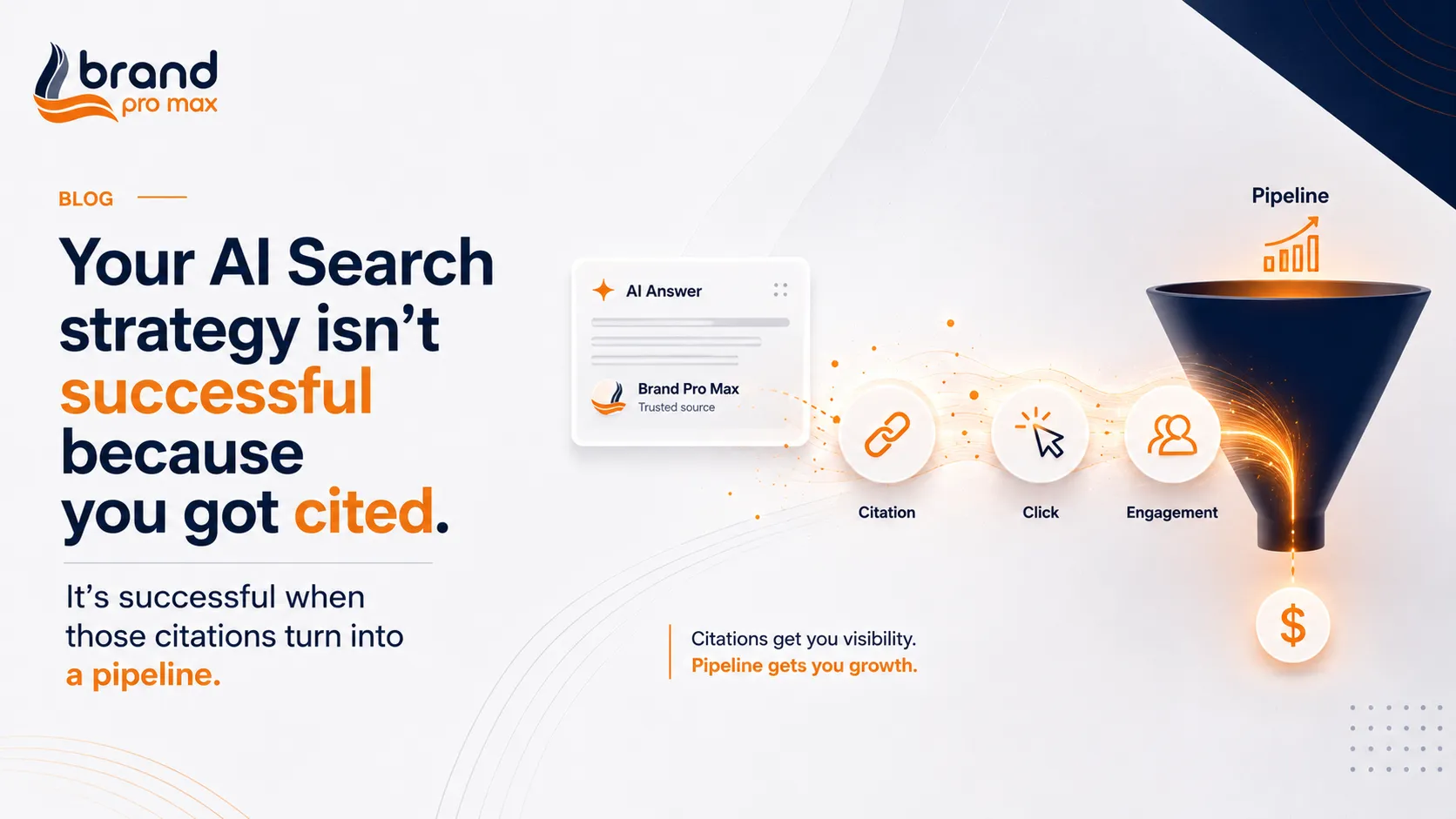

Someone could find your brand on ChatGPT, check out solutions on Gemini, and days later find themselves on your website after a branded search on Google. The traditional attribution doesn’t capture that path because the first interaction is generally within an AI platform.
This is a new problem for marketing teams. How can you measure the return of a channel that doesn’t necessarily lead to a click?
The solution is to follow the appropriate signs. AI Search’s ROI is more than rankings and traffic. It measures how AI visibility affects brand discovery, quality leads, and business growth.
What Does AI Search ROI Mean?
AI Search ROI analyzes the value your organization gets from being present on AI search platforms like ChatGPT, Gemini, Claude, Perplexity, and Google’s AI Overviews.
Traditional SEO shows you what position you are in, how much traffic you are getting, and what sites people are visiting. AI Search ROI solves a new question: Is your AI search presence really driving business? It looks at indications such as AI mentions, branded searches, helped conversions, and pipeline development to identify the impact AI plays in getting customers to your brand.
Consider how people search today. Someone could be looking for solutions and find your business on ChatGPT. They may not visit your website immediately. A few days later, they Google your brand, check out your site and schedule a demo.
Most analytics tools will provide credit to the branded search. But the customer didn’t find you on Google. AI led them to your organization first, and that initial experience helped nudge them toward becoming a customer.
Also Read: Content Marketing ROI: The Gap Between Tracking and Results
What Should You Measure?
AI Search ROI is a combination of visibility, brand demand, and business impact. Looking at one indicator in isolation rarely indicates how AI search helps to grow.
- AI citations frequency
AI citation frequency is how often ChatGPT, Gemini, Claude, Perplexity, and AI Overviews cite your brand when addressing relevant questions. Consistent citations indicate higher retrieval of confidence and build authority around your primary topics.
- Prompt coverage
Prompt coverage is a measure of the variety of relevant AI prompts that your brand is included in. Ranking highly for a particular term isn’t so much a mark of topical authority, as being broadly covered across commercial, comparison and informative queries.
- Branded demand
Many people discover a business via AI and then seek the brand afterwards. AI search often leads to growth in branded searches, branded impressions, and direct visits as a consequence of enhanced brand memory.
- Entity visibility
Entity visibility is the consistency that artificial intelligence systems use to identify your brand with certain items, services, industries, or expertise. Strong entity recognition increases the chance of AI citations in the future.
- Supported conversions
AI search often affects the buying experience before any other marketing channel is credited. Assisted conversions assist uncover the commercial benefit AI delivers before the ultimate conversion occurs.
- Pipeline contributions
The best metric of AI Search ROI, at the end of the day, is business effect. AI-driven discovery gives a much sharper picture than traffic alone of qualified opportunities, sales pipeline, and income.
How to Measure AI Search ROI
AI Search ROI doesn't come from a single report. It requires a measurement framework that combines AI visibility, search data, and commercial outcomes.
Create a prompt library
Build a library of prompts that reflect how prospects research your category. Include informational, comparison, problem-aware, and commercial queries, then test them consistently across ChatGPT, Gemini, Claude, Perplexity, and AI Overviews.
Pro Tip: Prioritize prompts that influence buying decisions, such as "best...", "top...", "vs...", "alternative to...", and "software for...". These queries often reveal the strongest commercial visibility.
Measure Share of Model
Measure how often your brand appears across your prompt library compared with your competitors. This new metric, often called Share of Model, helps you understand how visible you are in AI-generated responses instead of just traditional search rankings.
Pro Tip: Don’t simply track mentions. Keep a log of where your brand is mentioned, how it’s described, and which competitors appear when you do. That context often reveals positioning opportunities.
Track Branded Demand Signals
Review branded impressions, branded clicks, and branded queries in Google Search Console. AI recommendations frequently trigger a branded search before someone visits your website or books a demo.
Pro Tip: Track branded demand and AI citation trends monthly. If both are headed in the same direction, it’s a good sign that AI search is helping to increase awareness of your brand.
Combine your CRM and attribution data
Analyze CRM data, assisted conversion reports and first-touch responses to identify prospects who discovered your business through AI before entering your sales funnel.
Pro Tip: Incorporate a simple field within your lead form or sales qualification process: "How did you first hear about us?" You will often discover AI-assisted journeys that analytics platforms cannot.
Measure business impact
The strongest proof of AI Search ROI comes from business outcomes. Review AI visibility alongside qualified pipeline, SQLs, deal velocity, customer acquisition cost, and revenue influenced over time.
Pro Tip: Build an executive dashboard that pulls together AI citations, branded demand, pipeline growth, and influenced revenue. Leadership teams respond much better to business metrics than visibility metrics alone.
Must Read: Local SEO Best Practices to Boost Visibility in AI Search Results
What Makes AI Search ROI Hard to Measure?
AI Search ROI is not challenging because the measurements are not there. It is hard since the customer journey has evolved, but the attribution models haven’t for the most part.
AI creates invisible touchpoints
Someone might find your company using ChatGPT, come back via a branded Google search, and convert a week later. Traditional metrics sometimes give credit to the final click, and the AI interaction goes undetected.
Customer journeys take place on multiple platforms
Buyers rarely rely on a single source. They migrate from AI platforms, to search engines, to review sites, LinkedIn, and your website before making a selection. AI typically drives that journey, but it’s not the ultimate point of contact.
AI platforms offer limited reporting
This is not like Google Analytics or Search Console, where you get the detailed dashboard for impressions, citations, or click-through rates. Businesses have to integrate multiple data sources to understand performance.
Brand impact comes before revenue
AI search can increase brand memory long before it drives measurable income. Branded demand, quality discussions, and sales pipeline typically move ahead of concluded deals that reflect the entire benefit.
How Brand Pro Max Measures AI Search ROI
Measuring ROI of AI search is more than just measuring visibility. Brand Pro Max links AI discovery to business performance to help brands understand how AI search contributes to pipeline and revenue.
- AI Visibility Analysis: We monitor AI citations, prompt coverage, and entity visibility on ChatGPT, Gemini, Claude, Perplexity, AI Overviews and more to identify where your brand is being mentioned.
- Prompt Intelligence: Our team creates commercial prompt libraries that mirror actual buyer behavior and then tracks your visibility across high-intent query classes.
- Attribution and Performance Tracking: We connect AI-driven discovery to branded demand, qualified leads and influenced revenue using Search Console, analytics platforms, CRM data and sales insights.
Continuous Optimization: AI Search is changing. We explore how people find your content, improve your strategy on what you share, strengthen your brand, and increase your expertise to help you get seen longer.
Want to know the business value of your AI Search strategy? Brand Pro Max measures what counts and converts AI visibility into measurable growth. Contact us today.

























Sign in to leave a comment.