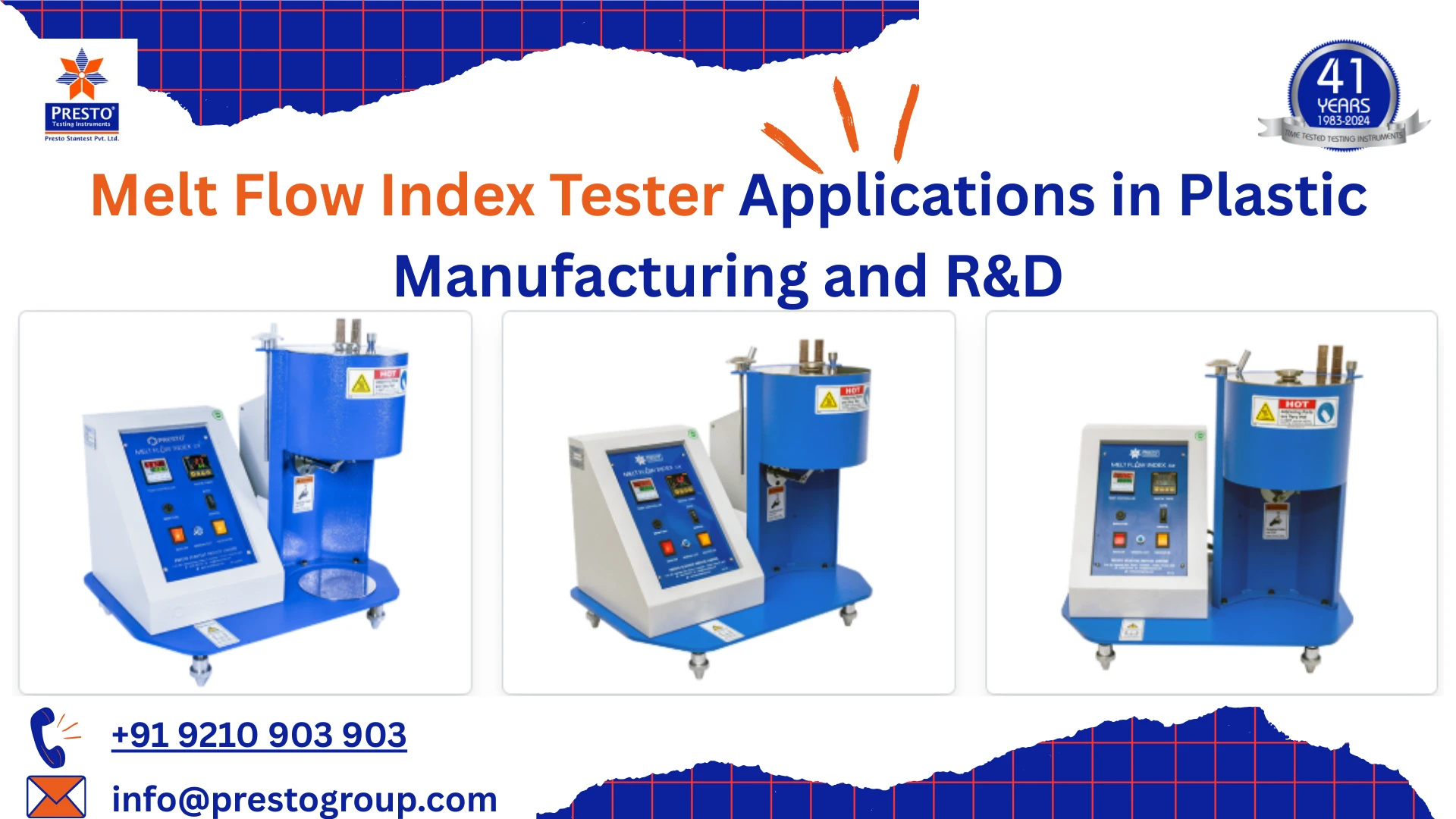

The plastics industry is one of the fastest-growing sectors in the world, with applications ranging from packaging and automotive to medical devices and consumer goods. To ensure high performance and consistency of plastic materials, it is crucial to understand how they behave under specific processing conditions. One of the most important tools for this purpose is the Melt Flow Index Tester (MFI Tester).
The Melt Flow Index Tester measures the flow properties of thermoplastic polymers, helping manufacturers and researchers determine the suitability of a material for extrusion, molding, or recycling. From plastic production plants to advanced research labs, this instrument plays a key role in maintaining quality and driving innovation.
In this blog, we will explore the applications of melt flow index testers in plastic manufacturing and R&D, the role of reliable manufacturers, and how the melt flow index tester price varies depending on features and requirements.
What is a Melt Flow Index Tester?
A Melt Flow Index Tester is a laboratory instrument designed to measure the ease of flow of melted thermoplastic polymers under controlled conditions of heat and pressure.
The test, known as the Melt Flow Index (MFI) test, is performed by heating the sample material to a specific temperature, applying a standard weight (load), and recording the amount of polymer that flows through a capillary in 10 minutes.
The result is expressed in grams per 10 minutes (g/10 min), which helps manufacturers compare different materials and select the right grade of polymer for their applications.
Applications of Melt Flow Index Tester in Plastic Manufacturing
1. Quality Control of Raw Materials
Manufacturers receive polymers in bulk from suppliers, and their consistency directly affects production. An MFI tester ensures that the supplied raw material meets the required flow properties before processing. For instance, in injection molding, a polymer with the wrong MFI value can cause defects such as warping or incomplete filling of molds.
2. Injection Molding Industry
Injection molding requires polymers with specific flow rates for smooth filling of molds. The melt flow index tester helps determine whether the chosen material has the appropriate viscosity. Materials with high MFI values flow more easily, making them suitable for thin-walled components, while lower MFI values are better for structural parts requiring strength.
3. Extrusion and Blow Molding
In extrusion processes (pipes, films, sheets) and blow molding (bottles, containers), polymers need to maintain uniform flow. Variations in MFI can lead to irregular thickness, weak spots, or breakage. Testing ensures smooth production and reduces material wastage.
4. Plastic Packaging Industry
The packaging sector demands lightweight yet strong plastics. By measuring MFI, manufacturers can select the right grade of polyethylene, polypropylene, or other polymers for making films, containers, and flexible packaging.
5. Automotive Components
Plastics are widely used in dashboards, bumpers, trims, and interior panels. The MFI tester ensures that polymers used in these parts have the correct flow rate for durability and dimensional stability.
6. Medical and Healthcare Devices
Medical equipment such as syringes, tubing, and disposable containers require polymers with precise flow properties. MFI testing ensures biocompatible materials are consistent and reliable in production.
7. Recycling of Plastics
One of the fastest-growing applications of MFI testers is in the recycling industry. Recycled plastics often contain mixed grades, leading to inconsistent properties. An MFI test helps recyclers evaluate and grade reprocessed plastics, ensuring they are fit for new applications.
Applications of Melt Flow Index Tester in R&D
1. Development of New Polymers
Research labs often experiment with polymer blends or composites to improve strength, flexibility, or thermal stability. An MFI tester provides vital data about the material’s flow properties, helping scientists optimize formulations.
2. Testing Additives and Fillers
Plastic compounds often contain fillers, stabilizers, or colorants. These additives can alter melt flow characteristics. R&D teams use melt flow index testers to study how different additives affect viscosity and processability.
3. Polymer Comparison Studies
When selecting a material for a new application, researchers compare different polymers by testing their MFI values. This helps in selecting the most suitable material for cost efficiency and performance.
4. Recycling Research
In sustainable R&D projects, researchers study how different recycling methods affect polymer quality. Melt flow index testing provides a quick and reliable way to evaluate the usability of recycled materials in high-quality applications.
5. Predicting Processing Behavior
By analyzing MFI values, R&D experts can predict how a polymer will behave in injection molding, extrusion, or blow molding. This reduces trial-and-error costs during scale-up.
Key Benefits of Using Melt Flow Index Tester
- Ensures consistency in polymer quality.
- Reduces production defects and rejections.
- Helps in cost-saving by selecting the right grade of material.
- Supports innovation in polymer research and development.
- Plays a vital role in plastic recycling by grading reprocessed polymers.
Melt Flow Index Tester Manufacturers
Choosing the right melt flow index tester manufacturer is essential for accurate and reliable testing. Some well-known global and Indian manufacturers include:
- Presto Group (India) – Leading manufacturer of polymer and plastic testing instruments.
- Instron – Renowned worldwide for material testing systems.
- Tinius Olsen – Specializes in advanced testing machines.
- Qualitest – Known for high-quality, cost-effective testing instruments.
- Labthink – Offers precision polymer testing equipment globally.
When selecting a manufacturer, consider factors such as calibration support, spare part availability, user training, and after-sales service.
Melt Flow Index Tester Price: Factors to Consider
The melt flow index tester price can vary based on:
- Type of Tester – Manual, semi-automatic, or fully automatic.
- Temperature Range and Accuracy – Advanced digital models cost more.
- Features – Auto-cutting, digital display, and data storage increase cost.
- Compliance – Machines following ASTM D1238, ISO 1133 standards are priced higher.
- Manufacturer Reputation – Reliable brands may be more expensive but offer better durability.
Final Insights
The Melt Flow Index Tester is a vital tool for both plastic manufacturing and R&D. From ensuring raw material quality in packaging and automotive to testing new formulations in research labs, the applications of this instrument are diverse and indispensable.
By investing in a reliable melt flow index tester manufacturer and evaluating the right melt flow index tester price, industries can achieve better product consistency, reduce production errors, and support innovation.
As plastic demand continues to grow and sustainability becomes a priority, MFI testers will remain at the heart of quality control and polymer research.
📞 Call Us Today
Looking for a reliable Melt Flow Index Tester for your lab or production unit?
📲 Call: +91 9210 903 903 | 📧 Email: [email protected]

























Sign in to leave a comment.