
The architecture, construction, and engineering industry has witnessed significant changes, from traditional to digital. This paradigm shift has resulted in accurate, precise outcomes for complex construction processes, while maintaining tight deadlines. While traditional methods are no longer beneficial for architects and engineers, BIM modeling services are the pillar of modern architectural project success.
In any architecture and construction project, one of the most crucial aspects is to make the building safe and functional, and to create the most comfortable livable environment. In the early days of construction, the manual work approach was time-consuming, prone to significant errors, wasteful of materials, and led to increased project costs and greater complexity.
Thanks to advances in technology and innovation in the AEC realm, BIM modeling services have become the new standard, easing the construction process, reducing errors, and creating a safe and livable environment. To ensure the infrastructure is functional, mechanical, electrical, plumbing, and fire safety are the key factors.
Combining all the disciplines together requires keen attention to detail to avoid any clashes and maintain safety. As a matter of fact, in the digital era, MEP BIM modeling services have become a go-to approach for architects, designers, engineers, and other professionals involved in the construction project.
Maintaining time efficiency, accuracy, and safety in architectural projects is critical to the success of the project. Intelligent 3D modeling integrated with MEPF disciplines enables AEC professionals to plan, design, and execute projects with precision. Each discipline in the project plays a vital role in ensuring the building is properly functional and creating a livable environment. MEPF is complex and requires specialized tools and technology for implementing MEP BIM modeling. However, let’s understand MEP modeling in detail and why it is crucial for any construction project.
Understanding MEP BIM Services in Detail
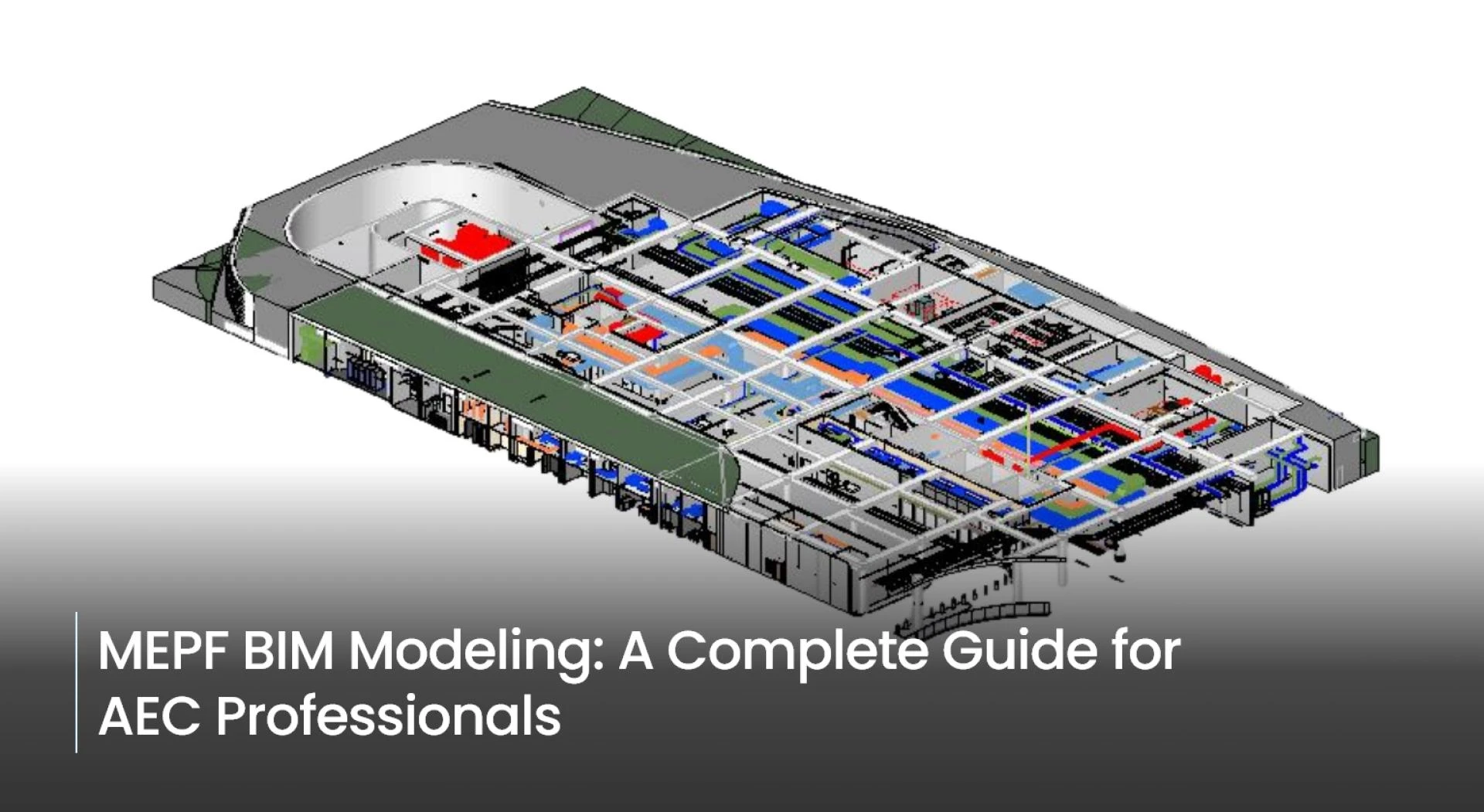
MEPF stands for mechanical, electrical, plumbing, and fire protection, which are crucial aspects of a construction project. In recent years, MEPF systems integrated into 3D BIM models have enhanced efficiency, collaboration, accuracy, and overall project performance. Integrated with BIM, MEPF BIM services involve digital representation of the physical and functional characteristics of the infrastructure. The data-rich 3D model provides precise information on the components and systems, enabling AEC professionals to make informed decisions. From HVAC BIM services to fire protection BIM modeling, every discipline of the MEPF is represented in the model, enabling detection and resolution of conflicts at the early stages of modeling. This helps save time, reduce costs, and ensure project accuracy and safety. The following are the disciplines with their key components:
- Mechanical system: heating, ventilation, air conditioning
- Electrical system: lighting, power distribution, fire alarms
- Plumbing system: water supply, drainage, gas piping
- Fire protection: sprinklers, smoke and heat detectors, water-based suppression
These are the disciplines and their components that play a critical role in a construction project, ensuring safety and a comfortable environment. As a matter of fact, BIM modeling for MEPF systems not only showcases the digital aspect of the system but also provides significant information to support informed decision-making. The 3D model is further used for on-site construction, minimizing groundwork errors and increasing efficiency and accuracy. While MEPF BIM services and coordination among different disciplines are pivotal, they involve a few major steps for precise outcomes. Explore the 5-step MEP modeling workflow and how coordination is evident.
The 5-Step MEP Coordination Services Workflow
As discussed briefly, MEP BIM modeling is crucial and evident; clashes and conflicts are common. This is why it is necessary to resolve the conflict, ensuring that all systems function and operate efficiently. It is important to maintain harmony and coordination among all MEPF components to ensure the building is functional, energy-efficient, and provides a comfortable environment for occupants.
With MEPF BIM modeling, MEP engineers and other professionals have the insights to deliver curated, effective designs without increasing overall cost. Moreover, effective coordination is about more than just finding clashes; it’s about resolving them before a single pipe is installed on-site.
Step 1: BIM Execution Plan (BEP) & Templates
Establish the project standards, naming conventions, and shared coordinates. Loading the correct MEP templates ensures that parameters such as flow rates and voltages are consistent.
Step 2: Model Federation
Instead of one massive file, disciplines work in separate models that are "linked" into a Federated Model. This keeps files manageable and maintains discipline-specific ownership.
Step 3: Automated Clash Detection
Using tools like Navisworks Manage or Autodesk Construction Cloud, teams run "clash tests" to identify:
- Hard Clashes: Physical overlaps (e.g., a duct passing through a structural beam).
- Soft Clashes: Clearance violations (e.g., lack of access space for maintenance).
Step 4: Resolution & Optimization
During weekly coordination meetings, the BIM Coordinator assigns "clash owners." Solutions often involve rerouting plumbing, resizing ducts, or adjusting ceiling heights in real-time.
Step 5: Construction-Ready Deliverables
Once the model is "clash-free," it is used to generate accurate shop drawings, Bill of Quantities (BOQ), and fabrication schedules.
These are the key steps to ensure MEP coordination and harmony. AEC professionals leverage not only MEP BIM services but also MEP coordination services to enable quick clash detection, resolution, and maintain harmony across all disciplines. Without MEP BIM modeling, AEC experts may fail to curate a seamless BIM model, and faults may only be identified during on-site construction, leading to costly delays and wasted resources.
This requires expertise and the use of the latest technology for efficient results. While any AEC firm is piled with a variety of tasks and marketing strategies for a project, outsourcing to a MEP BIM company is one of the most comprehensive and holistic approaches. Discover the benefits of outsourcing MEPF BIM modeling for AEC firms.
MEPF BIM Outsourcing Service Benefits
MEPF systems are the heart of any infrastructure. Without proper air ventilation, water flow, evenly distributed electrical power, and more, the building cannot function. To create a livable and comfortable environment, partnering with a renowned BIM company that offers MEPF BIM services is a holistic approach. Third-party sources ensure efficiency, accuracy, and precision in the BIM model. Using the latest technology, a team of industry experts delivers precision, enabling better communication, coordination, and informed decision-making. Outsourcing MEP BIM service brings various benefits, as follows;
- Cost effective
- Dedicated resources
- Quick turnaround
- Accuracy and efficiency
- Tailored solutions
Final Thoughts
MEP BIM modeling is a crucial aspect of any construction project that demands efficiency and precision to maintain harmony in the disciplines. This allows AEC professionals to accelerate the process and minimize the construction process on the ground.

























Sign in to leave a comment.