


Organizations are increasingly moving away from fragmented data environments where information is distributed across databases, cloud platforms, spreadsheets, data warehouses, and separate analytics tools. As data volumes increase and business teams demand faster insights, managing disconnected systems can create integration challenges, duplicated effort, inconsistent reporting, and higher operational complexity.
Microsoft Fabric brings data engineering, data integration, data warehousing, data science, real-time intelligence, and business intelligence into a unified environment. This approach can help organizations create a connected foundation for managing, analyzing, and using enterprise data.
However, Microsoft Fabric adoption is not simply a technology deployment. Organizations need to align business objectives, architecture, governance, security, user readiness, and implementation planning. A structured approach allows businesses to start with practical use cases, measure results, address challenges, and gradually scale the platform.
Organizations looking to align their broader Microsoft technology environment can benefit from Microsoft consulting services when planning a coordinated transformation strategy.
What Does Microsoft Fabric Adoption Involve?
Microsoft Fabric adoption involves more than creating workspaces or moving data into a new platform. It requires organizations to evaluate their current data environment, identify business priorities, prepare technical and business teams, and establish governance practices.
The process starts with understanding existing databases, applications, cloud platforms, data warehouses, reporting systems, and integration workflows. Organizations need to identify where data originates, how it moves, who manages it, and where existing processes create delays or duplication.
Different teams also play different roles in adoption. Data engineers may manage ingestion and transformation, analysts may develop models and reports, business teams may consume insights, while IT and security teams manage access, infrastructure, and compliance.
When evaluating analytics requirements, comparing Power BI vs Databricks AI/BI can help teams understand how different analytics approaches may fit into their broader data strategy.
A Step-by-Step Roadmap for Microsoft Fabric Adoption
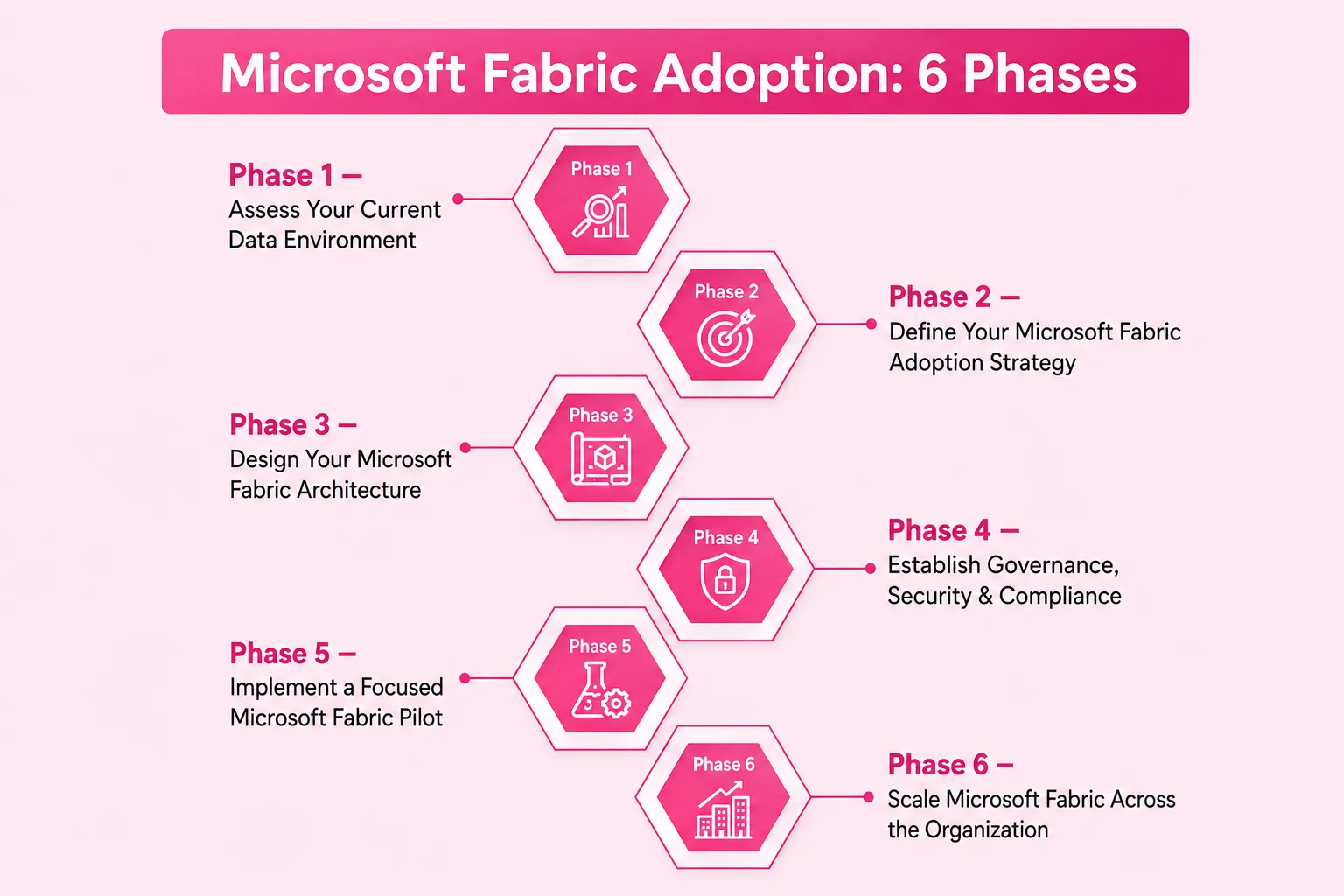
A structured adoption roadmap helps organizations move from initial assessment to implementation and eventually organization-wide scale. Instead of attempting a large-scale deployment immediately, organizations can progress through six practical phases.
Phase 1 — Assess Your Current Data Environment
Evaluate existing data sources, platforms, databases, and analytics workflows to understand the current environment. Identify data silos, integration gaps, duplicate processes, and reporting bottlenecks. Assess data quality, governance maturity, and existing technical capabilities. This assessment creates a clear baseline for planning the Fabric adoption journey.
Phase 2 — Define Your Microsoft Fabric Adoption Strategy
Define clear business objectives and determine what the organization expects to achieve with Microsoft Fabric. Identify and prioritize high-value use cases based on business impact, feasibility, and available resources. Establish KPIs, timelines, responsibilities, and expected outcomes. A focused strategy helps align technical implementation with business priorities.
Phase 3 — Design Your Microsoft Fabric Architecture
Plan the Fabric environment, workspace structure, data flows, and workload requirements based on organizational needs. Determine how OneLake and Fabric workloads will support data ingestion, transformation, analytics, and reporting. Address security, scalability, integration, and performance requirements during the design stage. A strong architecture creates a reliable foundation for future growth.
For organizations with significant reporting and analytics requirements, Power BI consulting services can support analytics planning and implementation alongside a broader Fabric strategy.
Phase 4 — Establish Governance, Security & Compliance
Define workspace access, user roles, permissions, data ownership, and governance standards before expanding Fabric usage. Establish processes for data quality, lineage, classification, and lifecycle management. Security and compliance requirements should be incorporated into the architecture from the beginning. This ensures users can access trusted data while maintaining organizational controls.
Phase 5 — Implement a Focused Microsoft Fabric Pilot
Select a high-value business use case that can demonstrate Fabric's practical value within a manageable scope. Build and test the pilot using relevant data sources, workloads, security controls, and reporting requirements. Measure performance against predefined KPIs and collect feedback from users. Use the results to refine the implementation approach before broader deployment.
Phase 6 — Scale Microsoft Fabric Across the Organization
Expand successful pilot use cases across departments while standardizing development, deployment, security, and governance practices. Establish repeatable processes for managing workspaces, workloads, and data assets. Continuously monitor capacity, performance, usage, and costs as adoption increases. The goal is to create a scalable and sustainable Fabric environment across the organization.
Driving Microsoft Fabric User Adoption
A strong business intelligence strategy can also be supported by understanding the benefits of Power BI when developing reporting and analytics capabilities alongside Fabric.
Training Teams and Building Internal Expertise
Provide role-based training for data engineers, analysts, developers, administrators, and business users. Training should focus on practical Fabric workflows and real organizational use cases. Building internal expertise reduces dependency on external support and helps teams use Fabric more effectively.
Establishing Change Management Practices
Fabric adoption can change existing reporting, data management, and analytics processes. A structured change management approach helps employees understand the reasons for these changes and adapt to new workflows. Clear communication, stakeholder involvement, and ongoing support can improve adoption.
Encouraging Self-Service Analytics
Organizations should enable business users to access trusted data and create their own insights within defined governance boundaries. Standardized datasets, documentation, semantic models, and reusable analytics assets can support self-service while maintaining data quality and security.
Creating Internal Fabric Champions
Internal Fabric champions can help accelerate adoption across teams. These employees can support colleagues, share successful use cases, collect user feedback, and promote best practices. A champion network also creates a connection between business users, technical teams, and leadership.
Common Microsoft Fabric Adoption Challenges
Although Fabric provides a unified data environment, organizations may still encounter technical, organizational, and operational challenges during adoption.
Data Integration and Migration Issues
Existing systems may use different architectures, data formats, integration methods, and storage technologies. Connecting or migrating these systems can require careful planning and testing. A phased approach can reduce disruption and allow teams to address compatibility issues progressively.
Data Quality and Governance Challenges
Centralizing data does not automatically make it reliable. Duplicate records, inconsistent definitions, incomplete datasets, and unclear ownership can affect analytical outcomes. Establishing data-quality standards, ownership models, and governance processes early can improve trust in the platform.
Organizations can also consider Microsoft Power Platform benefits when evaluating how analytics, applications, automation, and business processes can work together within the wider Microsoft ecosystem.
Skills and Training Gaps
Teams may not initially have sufficient experience with modern data engineering, analytics, or Fabric workloads. Organizations should identify skills gaps early and provide structured training, documentation, and hands-on project experience.
Security and Compliance Concerns
Centralizing data increases the importance of access control, classification, monitoring, and regulatory compliance. Security requirements should therefore be addressed during architecture and governance planning rather than after implementation.
Capacity and Cost Management
As Fabric usage expands, capacity consumption and workload performance need to be monitored continuously. Organizations should review resource usage, optimize workloads, and establish operational controls to maintain performance and manage costs.
Measuring Microsoft Fabric Adoption Success
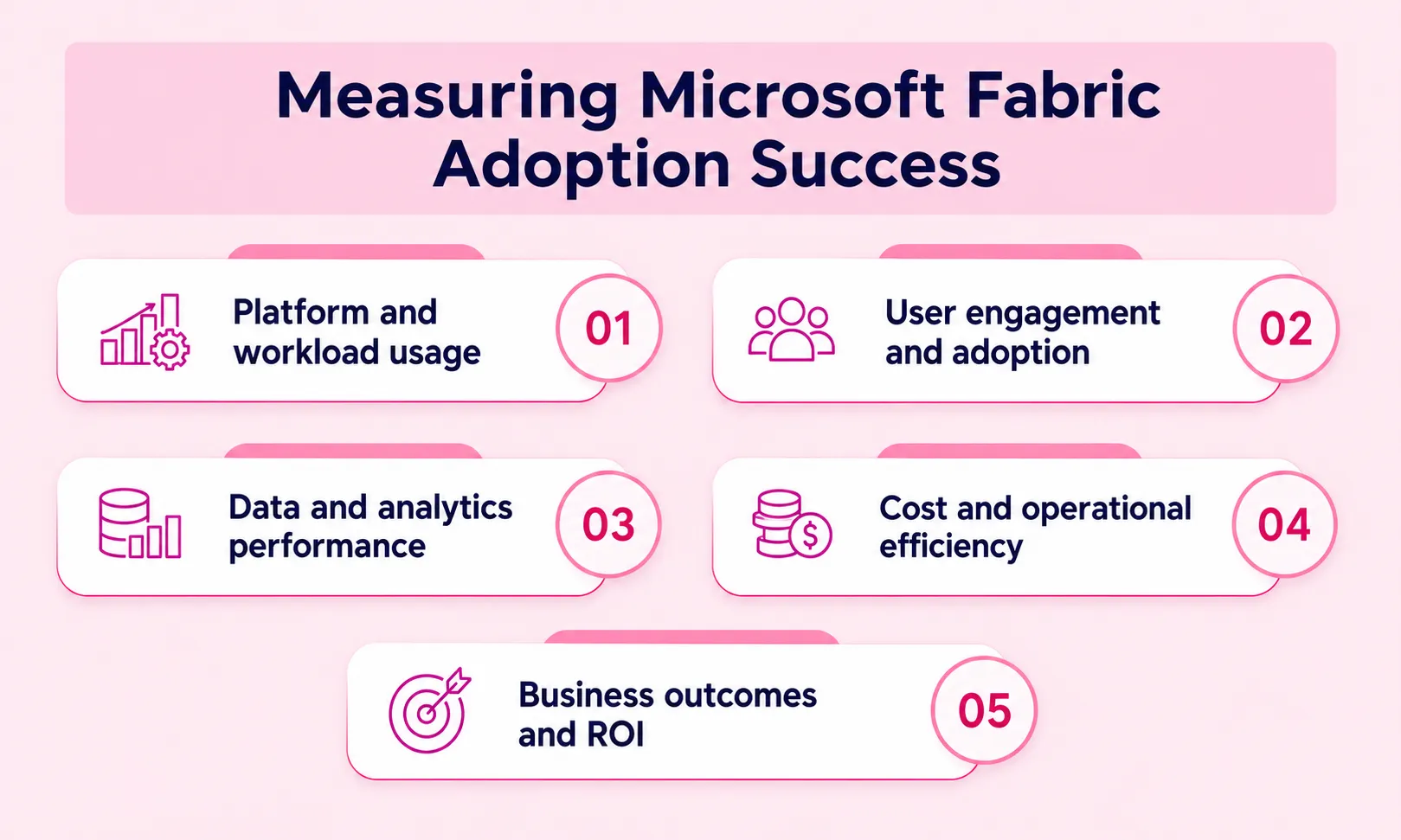
Organizations should establish measurable indicators to understand whether their Fabric adoption program is delivering technical, operational, and business value.
Platform and Workload Usage
Track active users, workspaces, reports, pipelines, datasets, and other relevant platform activities. These metrics can show whether Fabric usage is expanding beyond the initial implementation team.
User Engagement and Adoption
Measure how frequently teams use Fabric-based analytics assets and whether business users are becoming more self-sufficient. Increasing engagement can indicate that Fabric is becoming part of everyday decision-making.
Data and Analytics Performance
Evaluate report responsiveness, data refresh times, pipeline performance, workload reliability, and data availability. These indicators help identify technical issues that may affect user experience.
Cost and Operational Efficiency
Monitor capacity consumption, platform costs, manual reporting effort, and duplicated data operations. Reducing unnecessary data movement and repetitive processes can contribute to improved operational efficiency.
Business Outcomes and ROI
The most important measures are business outcomes. Organizations should assess whether Fabric improves decision-making, reduces reporting effort, accelerates analysis, increases data visibility, or enables new business capabilities.
Connecting analytics insights with automated business processes can also be valuable. For example, Power Automate integration with Power BI demonstrates how analytics can become part of broader operational workflows.
Best Practices for Successful Microsoft Fabric Adoption
Start With Clear Business Objectives
Begin with defined business problems and measurable objectives rather than adopting Fabric solely because of its available capabilities. Clear goals help teams determine which workloads and use cases deserve priority.
Prioritize High-Value Use Cases
Select use cases that provide meaningful business value while remaining practical to implement. Early successes can demonstrate the platform's potential and provide lessons for future initiatives.
Follow a Phased Implementation Approach
A phased approach helps reduce risk and creates clear checkpoints for assessment, strategy, architecture, governance, piloting, and scaling. Organizations can refine their approach based on lessons from each stage.
Establish Governance From the Beginning
Access controls, data ownership, security, compliance, data quality, and lifecycle management should be incorporated from the beginning. Governance becomes increasingly important as more teams and workloads are added.
Continuously Monitor and Optimize
Fabric adoption should be treated as an ongoing program. Organizations should regularly review usage, performance, capacity, costs, governance, user engagement, and business outcomes.
When organizations are also connecting applications, automation, analytics, and business workflows, Power Platform consulting services can help align these capabilities with the wider Microsoft technology strategy.
Conclusion
Microsoft Fabric adoption is a strategic journey that requires organizations to address technology, people, processes, governance, and business objectives together. A successful approach begins with understanding the current data environment and defining clear priorities before moving into architecture, governance, implementation, and scaling.
The six-phase adoption model provides a practical path from assessment to organization-wide deployment. Starting with focused use cases allows organizations to validate results, address challenges, build internal expertise, and establish repeatable practices before expanding Fabric across departments.
As adoption matures, the focus should move beyond individual workloads toward a sustainable enterprise data environment. With strong governance, skilled teams, measurable outcomes, and continuous optimization, Microsoft Fabric can provide a scalable foundation for modern analytics and support broader data and AI transformation initiatives.






















Sign in to leave a comment.