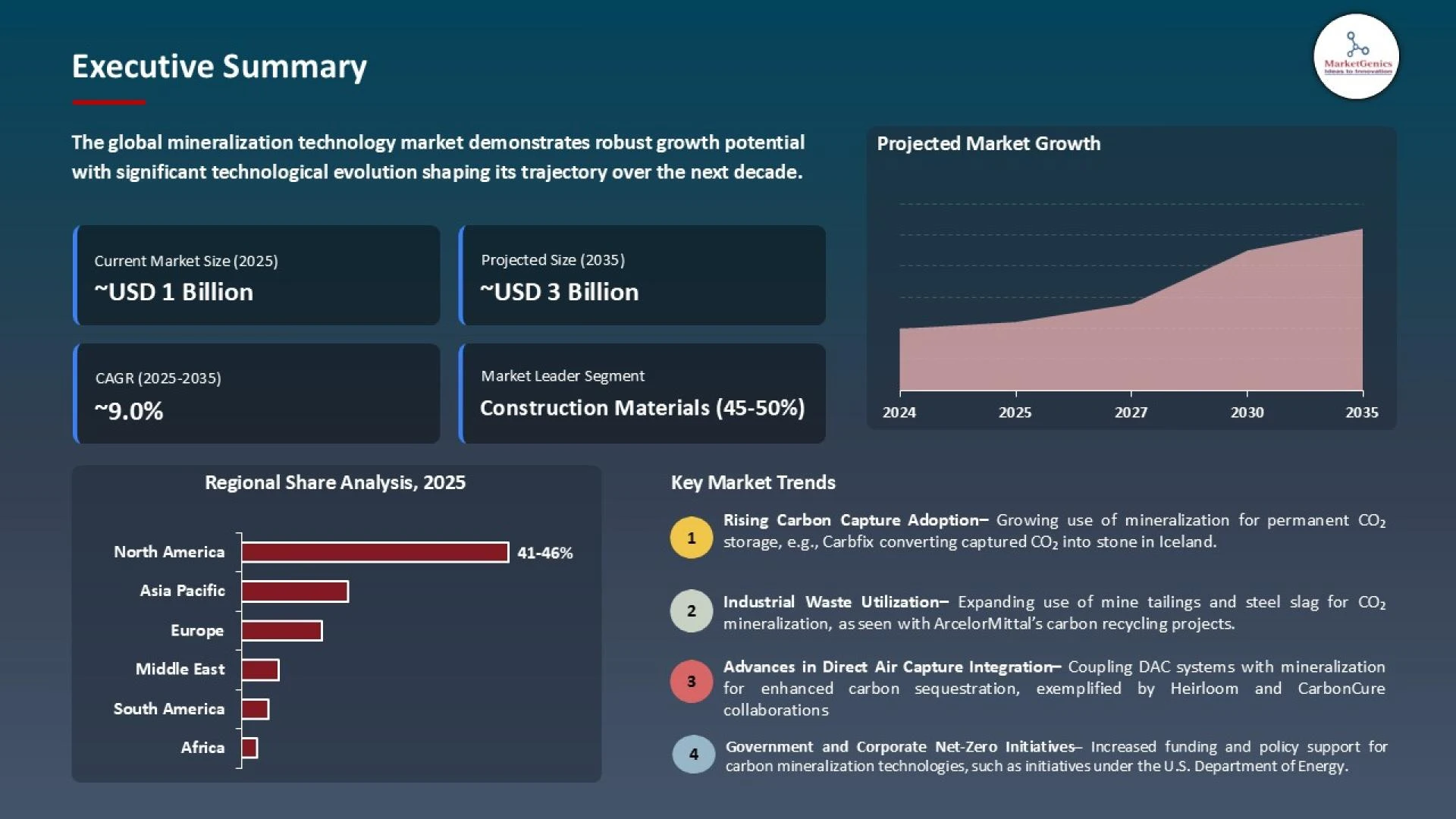

The mineralization technology market is on a remarkable growth trajectory — estimated at USD 1.3 billion in 2025 and projected to reach approximately USD 3 billion by 2035, registering a CAGR of 9.2% during the forecast period. This rapid expansion reflects a global shift toward carbon capture, utilization, and storage (CCUS) technologies as industries accelerate their net-zero emissions ambitions.
What Is Mineralization Technology?
At its core, mineralization technology involves converting captured carbon dioxide (CO₂) into stable mineral compounds — a process that permanently stores carbon while producing valuable materials such as construction aggregates, cement additives, and advanced composites. This approach not only helps reduce industrial emissions but also turns waste streams into economically viable resources.
To know more about the Mineralization Technology Market- Download our Sample Report
Why Is the Market Growing So Fast?
Several global forces are driving demand:
- Net-Zero Commitments: Governments and corporations worldwide are aligning with 2050 net-zero targets, creating a surge in carbon removal investments.
- Industrial Decarbonization: Hard-to-abate sectors like cement, steel, and mining are increasingly adopting mineralization as a long-term CO₂ management solution.
- Technological Innovation: Advancements in biological, chemical, and hybrid mineralization processes are improving scalability, cost-effectiveness, and performance.
- Regulatory Support: Policies such as the U.S. Inflation Reduction Act and the EU Green Deal are encouraging carbon storage and low-carbon construction materials through tax credits and subsidies.
Construction Materials Lead the Market
The construction materials segment accounts for nearly 47% of the total market share, fueled by infrastructure investments, urbanization, and the global shift toward sustainable building materials. Technologies like CarbonCure and Blue Planet are transforming CO₂ emissions into concrete and aggregates, helping builders reduce their carbon footprint without compromising quality or strength.
As Brent Constants, Founder & CEO of Blue Planet, highlighted:
“We’re pleased to have the technical and commercial support of Marathon Petroleum as we scale our low and negative embodied carbon building materials globally.”
Regional Insights: North America Leads the Charge
North America dominates the global mineralization technology market, driven by strong research and development initiatives, sustainability-driven regulations, and large-scale commercial pilots. Projects such as Fortera’s ReCarb facility in California — which cuts cement emissions by 70% — illustrate how carbon mineralization is transitioning from lab-scale innovation to industrial reality.
Innovation Spotlight: Integration with Air Capture
A key trend reshaping the market is the integration of Direct Air Capture (DAC) with mineralization technologies. Companies like Clarity Tech and 44.01 are pioneering hybrid facilities that directly capture CO₂ from the air and store it permanently as rock. In 2025, Sirona Technologies and Cella launched Project Jacaranda in Kenya’s Great Rift Valley, combining DAC and solar energy to achieve one of the world’s fastest carbon capture deployments — a strong signal that innovation in this space is accelerating globally.
Market Landscape and Competitive Dynamics
The mineralization technology ecosystem remains moderately consolidated, with leading players such as:
- CarbonCure Technologies
- Carbfix
- Blue Planet Ltd.
- MCi Carbon
- Climeworks AG
- Carbon Engineering Ltd.
These companies are driving commercialization through partnerships, R&D, and government-backed pilot programs. Strategic investments — like Mitsubishi UBE Cement Corporation’s USD 5 million stake in MCi Carbon — indicate rising confidence from major industrial players in mineralization’s potential to decarbonize the built environment.
Opportunities Ahead
The future of the mineralization technology market looks promising, with an estimated USD 2 billion in new opportunities emerging by 2035. Key growth areas include:
- Synthetic aggregates and green cement
- Direct Air Capture (DAC) integration
- Enhanced weathering and CO₂ additives
- AI-driven automation in mineralization processes
Moreover, as measurement, reporting, and verification (MRV) frameworks become standardized, investor confidence is expected to strengthen — opening access to carbon credit markets and climate finance.
The Bottom Line
Despite the EV revolution, the Mineralization technology market trend is no longer an experimental concept — it’s becoming a core pillar of global decarbonization strategies. With advancements in process engineering, strong policy support, and increasing private investments, this market is well-positioned to redefine how industries capture, utilize, and store carbon at scale.
By 2035, the transformation from USD 1.3 billion to USD 3 billion will represent more than just market growth — it will signify a turning point in humanity’s quest to build a carbon-neutral industrial future.


























Sign in to leave a comment.