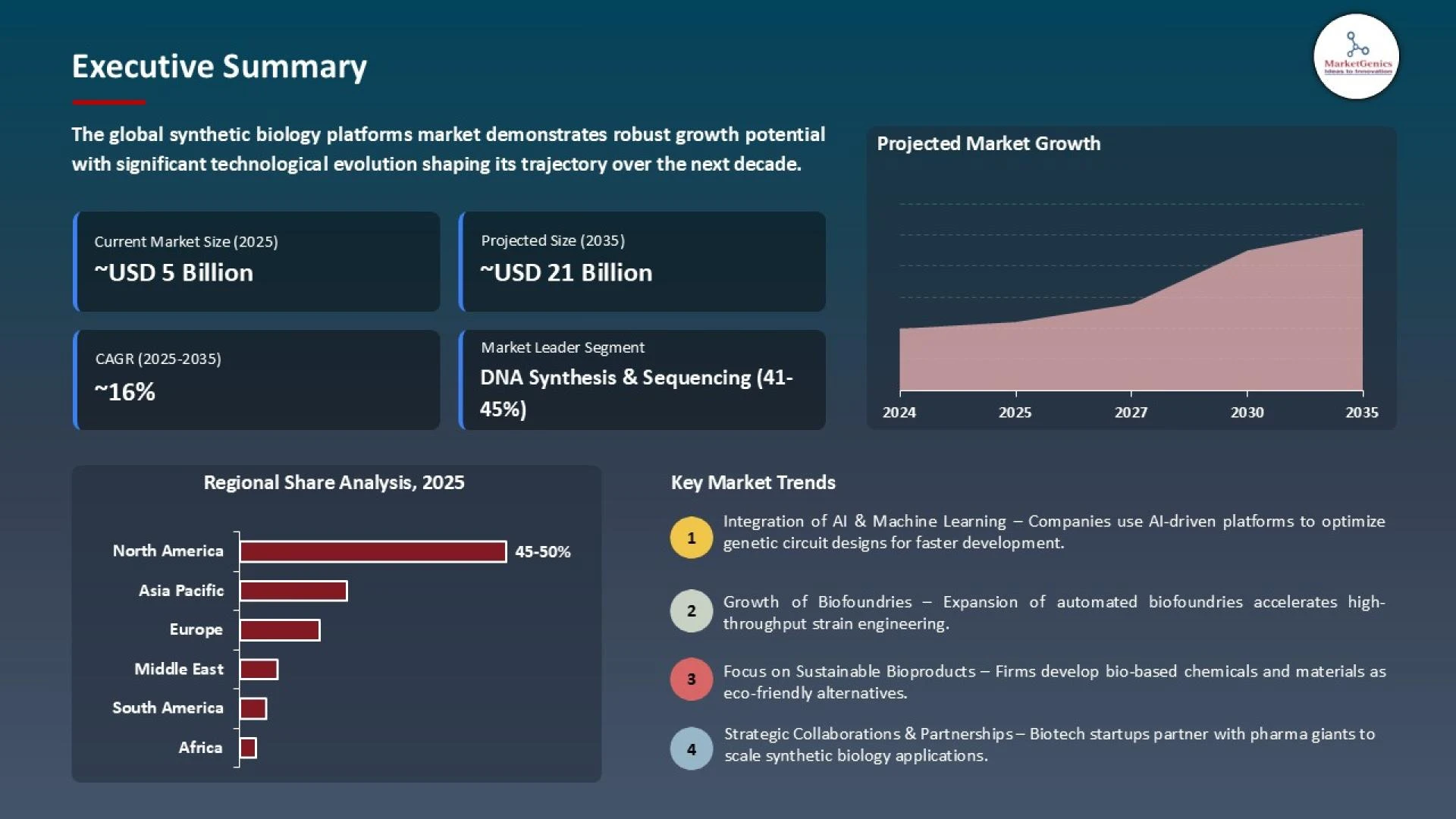

The global Synthetic Biology Platforms Market is witnessing a major transformation, driven by the fusion of AI, automation, and advanced genome engineering technologies. Estimated at USD 4.8 billion in 2025, the market is forecast to reach USD 20.6 billion by 2035, expanding at a CAGR of 15.7% over the forecast period. This growth marks the rise of a new bioeconomy, where biology and digital technology intersect to reshape healthcare, agriculture, and industrial manufacturing.
Understanding Synthetic Biology Platforms
Synthetic biology platforms are integrated systems of software, hardware, and bioinformatics tools that enable researchers to design, build, and test genetic components, organisms, and biological systems. These platforms are becoming the backbone of biomanufacturing, genetic engineering, and drug discovery, allowing scientists to create custom DNA sequences, synthetic organisms, and novel biomolecules faster and more accurately than ever before.
The growing use of AI-driven design tools, cloud-based biofoundries, and automated DNA synthesis systems is transforming biotechnology from an experimental science into an engineering discipline—one that is data-driven, scalable, and highly efficient.
DNA Synthesis and Sequencing: The Core Growth Driver
Among the technology segments, DNA synthesis and sequencing dominates the synthetic biology platforms market, holding nearly 45% market share in 2025. The segment’s growth is fueled by the increasing demand for custom gene synthesis, precision sequencing, and AI-powered bioengineering applications across pharma, industrial biotech, and agriculture.
Recent innovations are reshaping this space. For instance, Twist Bioscience’s Automated Gene Synthesis 2.0 system utilizes predictive algorithms and robotics to improve accuracy and reduce turnaround time by over 40%. Similarly, Ribbon Bio’s MiroSynth DNA molecules, launched in 2025, enable large-scale, high-precision DNA production for next-generation biotechnology.
As AI-assisted protein modeling and cloud-linked DNA synthesis become mainstream, synthetic biology platforms are making it easier to develop cell therapies, enzyme-based biofuels, and bio-based materials, fostering a more sustainable and circular economy.
AI-Driven Innovation: The Future of Synthetic Biology
The integration of artificial intelligence is redefining synthetic biology R&D. AI models now simulate metabolic pathways, design new proteins, and optimize experimental workflows—reducing both cost and time.
In June 2025, Ainnocence launched BioSynthAI, a platform combining generative AI and molecular simulation to enhance enzyme design and metabolic engineering. Similarly, Latent Labs introduced a generative-AI system for biomolecule design that leverages machine learning and robotics to accelerate discovery in therapeutics and industrial enzymes.
These developments underscore a key market trend: AI is transforming biology from a trial-and-error process into a predictive science. This shift allows biotech companies to move from concept to commercialization faster, fueling innovation in drug development, industrial bioprocessing, and sustainable biomaterials.
Regional Outlook: North America Leads Global Growth
North America remains at the forefront of the global synthetic biology platforms market. The region benefits from robust R&D infrastructure, biotech investments, and the presence of leading players such as Thermo Fisher Scientific, Ginkgo Bioworks, and Twist Bioscience.
Government initiatives supporting AI in life sciences, gene synthesis research, and sustainable biomanufacturing have further accelerated growth. Universities, startups, and major corporations are collaborating through bio foundries and innovation hubs to democratize access to genetic design tools and automated laboratory systems.
With strong regulatory support and venture capital funding, North America is expected to contribute a significant portion of the USD 16 billion market opportunity created by 2035.
To know more about Synthetic Biology Platforms Market: Download our Sample Report
Market Dynamics: Challenges and Emerging Opportunities
Key Drivers
- Rapid integration of AI and automation in bioengineering.
- Increasing demand for personalized medicine and gene therapies.
- Expansion of biomanufacturing and sustainable bio-based materials.
- Strong government and private sector investments in biotechnology.
Challenges
While growth prospects are strong, the industry faces regulatory and ethical challenges related to gene editing, data privacy, and biosecurity. Many countries still lack comprehensive frameworks for biosafety and ethical oversight, creating hurdles for commercialization and public acceptance.
Emerging Opportunities
The future of synthetic biology lies in personalized medicine, cell therapy, and precision agriculture. Technologies such as CRISPR, multi-omics integration, and AI-guided genome editing are paving the way for tailor-made therapies and sustainable industrial processes. Partnerships like Synthego’s CRISPR Discovery Partners are accelerating the translation of synthetic biology breakthroughs into clinical solutions.
Competitive Landscape and Future Outlook
The market’s top five players account for over 30% of global share, but the ecosystem is expanding rapidly. Companies such as Merck KGaA, GenScript Biotech, Synthego, and Zymergen are pushing the frontiers of automated strain engineering, cloud-based design, and synthetic DNA synthesis.
By 2035, the global synthetic biology platforms market will not only represent a USD 20.6 billion industry, but also a foundation for future bioeconomies. AI-integrated, cloud-connected biofoundries will enable faster, safer, and more sustainable innovation across industries—from pharmaceuticals to agriculture.
As Ben Lamm, CEO of Colossal Biosciences, noted, “We’ve proven our ability to recreate complex genetic combinations that took nature millions of years to design.” This milestone reflects a broader truth: synthetic biology is no longer science fiction—it’s shaping the next industrial revolution.
Closing Thoughts
The next decade will define how humanity engineers biology for sustainability, health, and innovation. With advances in AI, automation, and synthetic genomics, the synthetic biology platforms market trend is poised to become a key pillar of the 21st-century bioeconomy—driving growth, transforming industries, and rewriting the boundaries of what’s biologically possible.





























Sign in to leave a comment.