
Powering the Future: Solid-State & Next-Gen Battery Chemistries Market Set to Reach USD 5.9 Billion by 2035
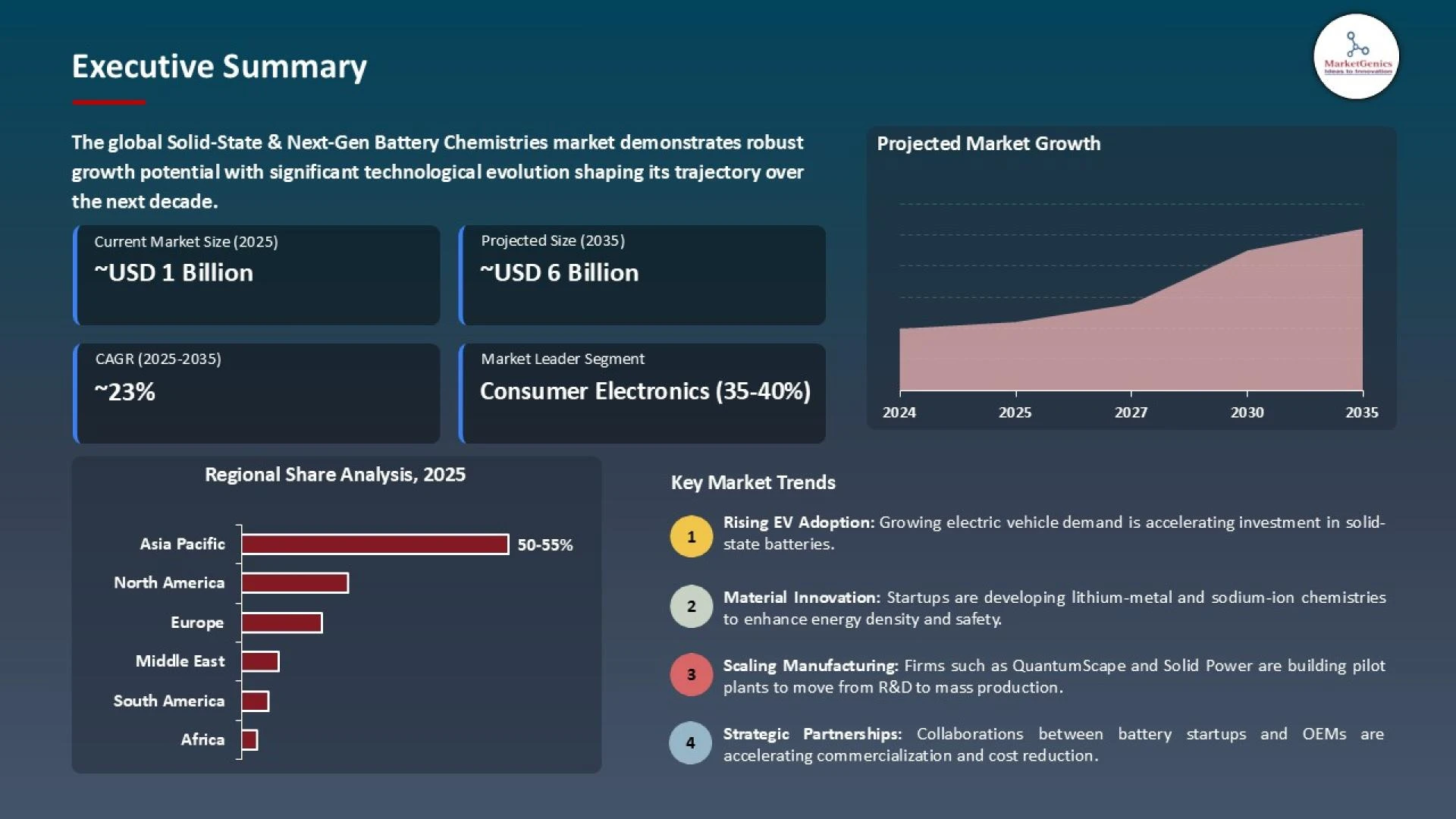
The Solid-state and next-generation battery chemistries market is entering a transformative decade — redefining how we power electric vehicles (EVs), consumer electronics, renewable energy systems, and advanced industrial equipment. According to MarketGenics, the market is valued at USD 0.8 billion in 2025 and is projected to reach USD 5.9 billion by 2035, registering a remarkable CAGR of 22.4% during the forecast period.
This rapid expansion is driven by accelerating innovation in battery materials, energy density, safety standards, and manufacturing technologies, as industries worldwide transition toward sustainability, electrification, and digitalization.
Market Overview
The solid-state & next-gen battery chemistries market represents one of the fastest-growing segments of the global energy storage landscape. These advanced batteries — including solid-state, lithium-sulfur (Li-S), lithium-air (Li-Air), sodium-ion, magnesium-ion, graphene-based, and silicon-anode batteries — are designed to overcome the limitations of traditional lithium-ion systems.
With rising demand for high-performance, safe, and sustainable energy storage solutions, industries are investing heavily in R&D, pilot-scale production, and large-scale commercialization. Governments across Asia, Europe, and North America are also providing policy support, subsidies, and R&D funding to accelerate innovation.
To know more about solid-state & next-gen battery chemistries market - download our sample report
Key Growth Drivers
- Electrification of Transportation: The global shift toward electric vehicles (EVs) is one of the primary catalysts. According to the International Energy Agency (IEA), electric car sales surpassed 17 million in 2024, accounting for 20% of all new vehicle sales. Solid-state batteries offer greater energy density, faster charging, and improved safety, making them ideal for next-generation EVs.
- Energy Storage Systems (ESS): As renewable power sources like solar and wind gain traction, demand for high-capacity, long-duration batteries continues to surge. Solid-state batteries and sodium-ion chemistries offer stable, scalable, and safer alternatives for grid storage applications.
- Consumer Electronics Evolution: The consumer electronics segment dominates with around 39% market share, fueled by demand for lightweight, compact, and durable energy solutions in smartphones, wearables, and laptops. Companies like TDK Corporation and ION Storage Systems are leading the charge with next-gen solid-state microbatteries.
- Government Initiatives & R&D Investments: Programs such as Japan’s Battery Supply Assurance Program (US$660M) and South Korea’s next-gen polymer-based solid-state battery initiative are accelerating commercial development. In Europe, partnerships like Stellantis–CEA and Volkswagen–QuantumScape are advancing early commercialization.
Technological Innovations Transforming the Market
Innovation lies at the core of this industry’s growth. Several cutting-edge developments are reshaping the solid-state & next-gen battery ecosystem:
- AI-Powered Battery Lifecycle Prediction: Companies like TWAICE are developing AI-based models to predict the aging and performance of non-lithium batteries such as sodium-ion, helping optimize deployment strategies and reduce costs.
- Material Advancements: Use of sulfide-based solid electrolytes and graphene-enhanced anodes are improving energy density, thermal stability, and charge retention. For instance, Huawei’s new sulphide-based solid-state battery patent claims to enable EV ranges up to 3,000 km with ultra-fast charging capabilities.
- New Product Launches & Partnerships:
Regional Insights
Asia Pacific remains the global leader, supported by strong manufacturing ecosystems in China, Japan, South Korea, and India. The region benefits from deep integration between battery producers, EV OEMs, and component suppliers, combined with favorable government incentives.
- Japan aims to commercialize all-solid-state batteries by 2030.
- South Korea has committed over USD 130 million in R&D by 2028.
- China’s new GB 38031-2025 standard enforces stricter safety requirements, encouraging adoption of advanced chemistries.
Europe and North America are following closely, with companies like QuantumScape, Solid Power, and Sila Nanotechnologies pioneering large-scale deployments and partnerships with major automakers.
Challenges and Restraints
Despite immense potential, the market faces notable challenges:
- Manufacturing Scalability: Many next-gen chemistries require delicate fabrication techniques, such as thin-film deposition or dry electrode manufacturing, which are not yet cost-competitive at scale.
- Material Availability: Limited supply and purity of solid electrolytes, lithium metal, and specialized compounds present production bottlenecks.
- Standardization Gaps: Global harmonization of safety and transport standards for solid-state materials is still evolving.
Strategic collaboration between material scientists, OEMs, and policymakers will be key to overcoming these challenges and achieving mass-market adoption.
Future Opportunities
The next decade will open significant new opportunities across:
- Decentralized Energy Storage Systems (ESS)
- Ultra-fast Charging Infrastructure
- Wearable and Implantable Medical Devices
- High-Performance Consumer Electronics
- Sustainable Aviation and Maritime Applications
As R&D transitions into large-scale commercialization, solid-state and next-gen batteries will play a central role in the global clean energy transition, enabling safer, longer-lasting, and more efficient power solutions.
Closing thoughts
The solid-state & next-gen battery chemistries market trend is no longer a distant innovation — it’s a rapidly maturing ecosystem powering the next era of mobility, electronics, and energy systems. With a projected 22.4% CAGR and global market value of USD 5.9 billion by 2035, this sector offers immense potential for investors, manufacturers, and technology leaders.
As MarketGenics research highlights, firms that invest early in advanced battery R&D, supply chain integration, and strategic collaborations are set to capture the lion’s share of future growth.
The next frontier in energy storage innovation has arrived — and it’s solid.

























Sign in to leave a comment.