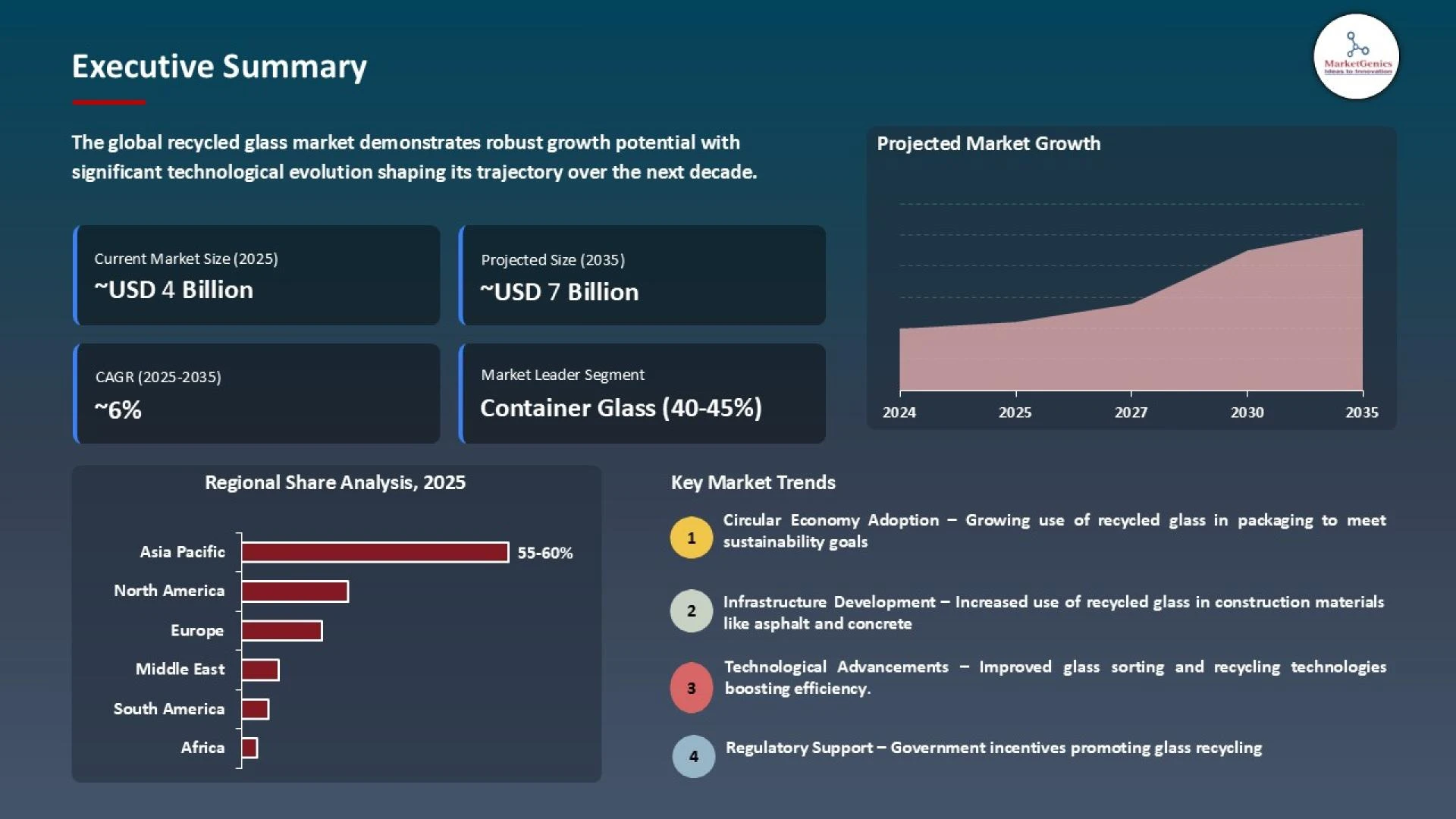

The global recycled glass market is witnessing a steady and promising growth trajectory — valued at approximately USD 3.9 billion in 2025 and projected to reach USD 6.7 billion by 2035, registering a CAGR of 5.7% during the forecast period. As sustainability becomes a strategic business imperative, recycled glass is emerging as one of the most efficient and eco-friendly materials across industries — from packaging and construction to pharmaceuticals and smart infrastructure.
The Shift Toward Circular Manufacturing
Across the world, industries are moving beyond the traditional “take, make, dispose” model toward a circular economy, where materials are reused, repurposed, and regenerated. Glass stands out as a leading example — infinitely recyclable without losing purity or quality.
Governments and corporations alike are recognizing this potential. In Europe, strict waste management policies have increased the recycling rate of glass significantly, while in the U.S., several states have introduced incentives to promote post-consumer recycled glass (PCR) content in manufacturing. For instance, Oregon’s administrative law mandates that glass food and beverage containers manufactured within 750 miles of the border must contain at least 50% recycled materials — a strong push for sustainability through regulation.
To know more about Recycled Glass Market- Download Our Sample Report
Market Structure and Segment Insights
According to the latest MarketGenics report, container glass holds the largest share — nearly 43% of the global recycled glass market. This dominance is largely driven by the food and beverage industry, where glass bottles and jars remain popular for their non-reactive nature, premium look, and ability to be recycled in a closed-loop system.
Recycled glass is processed into various forms such as:
- Cullet – used for container manufacturing and fiberglass production.
- Crushed glass – widely used in construction materials, road aggregates, and landscaping.
- Glass powder – increasingly applied in paints, coatings, and concrete additives.
The Asia Pacific region leads the global market, backed by rapid urbanization, growing waste management infrastructure, and rising investments in recycling technologies. Countries like China, India, Japan, and Australia are playing pivotal roles by integrating recycled materials into their national sustainability frameworks. For example, Australia’s new glass recycling factory in Penrith, opened in 2024, is among the most energy-efficient facilities in the world.
Growth Drivers and Emerging Opportunities
The growth of the recycled glass market is driven by three strong factors:
- Rising Environmental Awareness – Consumers are demanding sustainable packaging and green construction materials, pushing manufacturers to adopt recycled content in their products.
- Technological Advancements – Innovations like MOGRA (Mobile Glass Recycling Asset) by O-I enable mobile processing of used glass, even in regions with limited recycling infrastructure.
- Government Support and Policies – Increasing funding for waste management, environmental standards, and circular initiatives are accelerating recycling rates globally.
Additionally, new applications of recycled glass are opening lucrative opportunities. Industries are exploring its use in smart roads, reflective paints, and decorative architectural materials. U.S. states are experimenting with “glassphalt” — an eco-friendly asphalt mixture infused with crushed recycled glass — to improve road durability and reduce environmental impact.
Industry Challenges: Limited Infrastructure and High Logistics Costs
Despite the promising outlook, the recycled glass industry faces several practical hurdles. Emerging economies like India, Indonesia, and Nigeria still have limited recycling facilities, and much of their recyclable glass ends up in landfills. In India, for example, high taxation on glass waste under the GST regime discourages smaller recyclers.
Transportation costs also pose a challenge. Glass is heavy and fragile, making it expensive to transport long distances, especially when the material’s market value remains relatively low. Building more localized recycling hubs is crucial to overcoming this barrier and ensuring economic viability.
Innovation and Product Development Trends
Recycled glass is no longer confined to traditional applications. Forward-thinking companies are turning waste into high-value materials.
- Verallia UK recently launched Vista, a premium packaging line made from 100% post-consumer recycled glass, catering to brands seeking luxury sustainability.
- SGD Pharma introduced medical-grade bottles containing 20% PCR glass, helping pharmaceutical firms reduce Scope 3 emissions.
- SWARCO Road Marking Systems launched SOLIDPLUS reflective glass beads, combining road safety enhancement with environmental benefits.
These innovations highlight a clear trend — recycled glass is evolving from a waste-management topic into a design and innovation material shaping the next generation of sustainable infrastructure.
Regional Leadership and Competitive Landscape
The global market remains fragmented but competitive, with top players like Owens-Illinois (O-I), Ardagh Group, Verallia, Vetropack, and Vitro S.A.B. de C.V. accounting for nearly 30% of global market share. Strategic partnerships are central to their growth strategies.
For example, Saint-Gobain Glass partnered with VEKA Recycling to develop a patented technology that separates toughened and annealed glass for reuse — a breakthrough in recycling efficiency. Similarly, Visy in Australia has doubled its glass recycling capacity, positioning itself as a sustainability leader in the Asia-Pacific region.
The Future Outlook: Sustainability as Strategy
The recycled glass market trend is expected to create a total opportunity of nearly USD 3 billion by 2035. Growth will be supported by infrastructure development, new product applications, and increasingly stringent environmental standards.
As smart cities, green buildings, and eco-packaging solutions gain momentum, recycled glass will continue to play a vital role in achieving global sustainability goals. The transition from waste to resource isn’t just a technological challenge — it’s a strategic opportunity for industries to align profitability with purpose.
Final Thoughts
Recycling glass isn’t just about managing waste — it’s about reimagining value creation. Every bottle, pane, and particle of glass that re-enters the production cycle reduces energy consumption, minimizes carbon emissions, and brings us one step closer to a truly circular economy.





























Sign in to leave a comment.