

A friend of mine - Priya, lives in a gated society in Pune - got her modular kitchen installed about two and a half years ago. Good brand, mid-premium range, the kind of kitchen that made her relatives ask questions when they visited. She was happy with it.
Then the drawer under the sink started swelling. The base of the cabinet - the part sitting closest to the floor in the wettest zone of the kitchen - had absorbed enough moisture to visibly deform. The bottom of one shutter near the sink developed a slight lift at the corner where the laminate had separated from the board beneath.
She called the dealer. The kitchen had a five-year warranty, she said. She had the paperwork.
The dealer came, looked, and produced the warranty document. The swelling, he explained, was caused by moisture. The warranty excluded damage caused by moisture exposure. The laminate lift was caused by improper cleaning - specifically, using a wet cloth on the shutter edge - which was also excluded.
Priya's five-year warranty covered neither of the two things that had actually gone wrong with her kitchen.
This story is not unusual. It is, in fact, a remarkably common version of the modular kitchen warranty experience in India. The warranty exists. The problems occur. And somewhere in the fine print there is language that places the actual failures outside the coverage.
This guide is about understanding what modular kitchen warranties actually cover - not what they sound like they cover - so that this conversation doesn't happen to you two and a half years after installation.

Why Modular Kitchen Warranties Are Confusing By Design
Before getting into specifics - it's worth understanding why kitchen warranty documents are structured the way they are.
A modular kitchen warranty is not a consumer protection document. It is a risk management document - written by legal teams to limit the manufacturer's and dealer's liability while creating the impression of comprehensive coverage. The headline number - "five-year warranty," "ten-year warranty" - is chosen for its marketing value. The fine print is chosen for its legal protective value.
These two objectives are not compatible, which is why the headline and the fine print so often tell different stories.
The kitchen industry is not uniquely cynical in this approach - most consumer product warranties work this way. But kitchens are particularly vulnerable to the gap between headline and reality because they exist in a moisture-rich, heat-heavy environment that makes many types of failure easy to attribute to "conditions of use" rather than product deficiency.
Understanding this going in allows you to ask the right questions before signing and to know what to document if something goes wrong after installation.
What Modular Kitchen Warranties Typically Cover
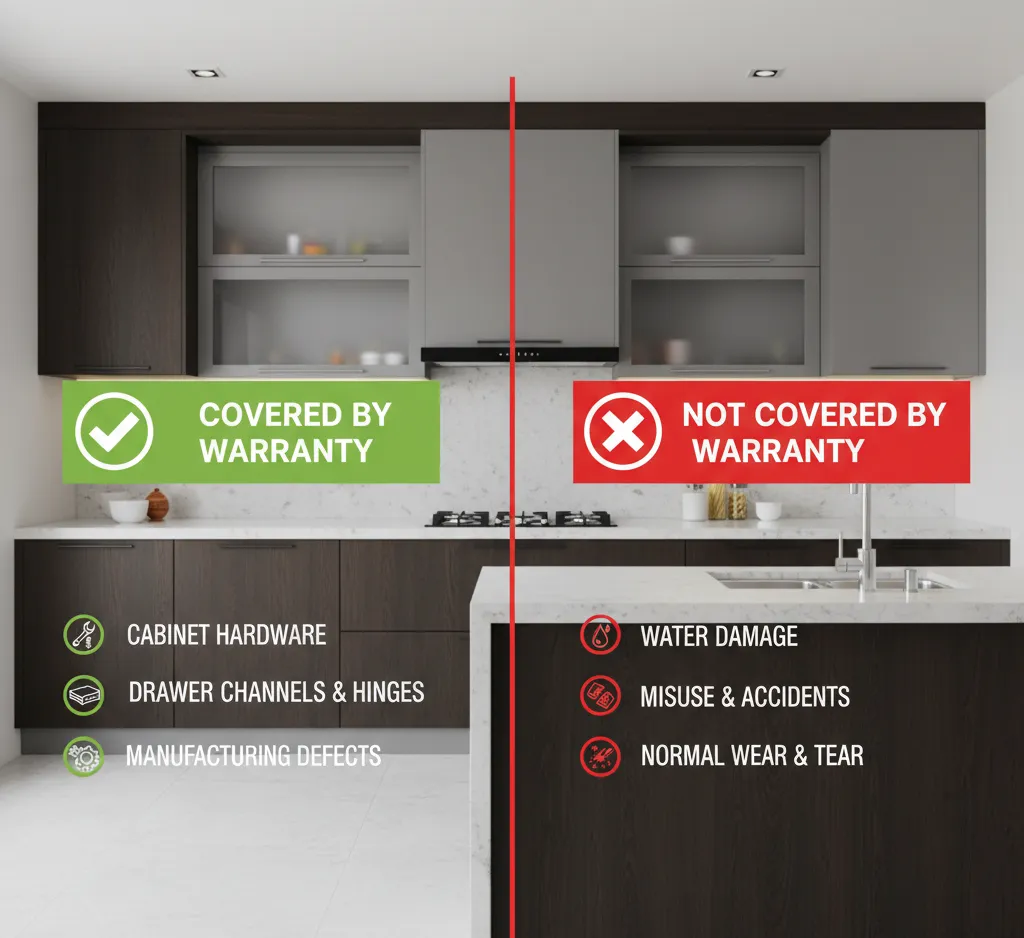
The honest scope of what most modular kitchen warranties actually cover - when you read past the headline and into the terms:
Manufacturing defects in the carcass and structure
If the carcass arrives from the factory with a defect - an incorrect dimension, a structural failure in the board, a joint that wasn't properly made - this is typically covered. The key word is manufacturing. The defect has to be present from the start, not developed over time through use.
In practice, manufacturing defects in the carcass are uncommon. They are caught at installation or within the first few months of use when the problem is visible and new. Claims made in year three for carcass problems are typically contested on the grounds that the damage occurred during use rather than being present at manufacture.
Hardware defects within the specified period
Hinge failure, drawer channel malfunction, soft-close mechanism failure - these are typically covered for one to two years from installation. The coverage is for mechanical failure of the hardware under normal use conditions.
Note the period - one to two years for hardware is standard, even in warranties that claim five or ten years for the kitchen overall. The ten-year headline number almost always applies to the structural components, not to the hardware that gets opened and closed hundreds of times a day.
Finish defects that are visible at installation
If the shutter has a surface defect - a bubble in the acrylic, an uneven finish in the lacquer, a colour inconsistency - that is visible at the time of installation, this is covered. The defect has to be documented at or very near the installation date to be clearly attributable to manufacturing rather than subsequent damage.
This is the reason the pre-payment inspection described in the previous article matters so much. A finish defect documented in writing before final payment is a manufacturing defect by definition. The same defect discovered three months later is open to interpretation.
What Modular Kitchen Warranties Typically Don't Cover
This is the section that matters. These are the exclusions that appear - in varying language - in most modular kitchen warranty documents in India.
Moisture damage
This is Priya's story. Moisture damage - swelling of carcass boards, warping of shelves, delamination of shutter edges - is excluded in most warranties on the grounds that moisture is a "condition of use" rather than a product defect.
The logic, from the manufacturer's perspective, is that the product was not designed to be submerged or exposed to standing water. The counter-argument - that a kitchen is by definition a moisture environment and a product sold for kitchen use should handle kitchen moisture - is not reflected in most warranty documents.
This exclusion is particularly significant because moisture damage is the most common type of modular kitchen failure in India. The carcass near the sink, the base cabinet under the sink, the area around the hob where steam condenses - these are the zones most likely to develop problems and most likely to be excluded from warranty coverage.
Damage from improper cleaning products
Most warranties specify that the kitchen should be cleaned with specific types of products - typically mild liquid cleaners, damp cloth, nothing abrasive or strongly acidic. Damage from bleach, harsh chemical cleaners, abrasive scrubbers, or any cleaning product not in the approved list is excluded.
In practice this exclusion is applied broadly. Laminate lift, surface dullness, finish degradation - these can all be attributed to cleaning products even when the real cause is material quality. The burden of proof - demonstrating that you used only approved cleaning products - is essentially impossible for the consumer.
Damage from heat
Countertop damage from hot vessels placed directly on the surface, shutter damage from heat generated by appliances, finish yellowing near the hob from heat exposure - these are typically excluded as damage from improper use.
The "use a trivet" instruction appears in most kitchen care manuals. Not using a trivet becomes grounds for denying a countertop damage claim even when the countertop material's heat sensitivity was not disclosed at the point of sale.
Normal wear and tear
Scratches, dents, surface dulling, hinge loosening after years of use, drawer channel noise - these are excluded as normal wear and wear. The definition of "normal" is applied by the manufacturer, not independently.
This exclusion creates a significant grey zone for hardware claims in years two and three. A hinge that stops working well after eighteen months of daily use - is that a hardware defect covered by the warranty, or normal wear excluded by it? The answer depends on who is deciding, and when it's the manufacturer deciding, the answer tends to favour the exclusion.
Damage during events outside normal use
Flood, fire, earthquake, pest infestation - these are excluded by act of God or force majeure clauses. Also excluded is damage during activities like repainting the house, renovation work near the kitchen, movement of heavy objects through the kitchen. If your kitchen was damaged when the plumber came to fix a pipe above the ceiling and something went wrong - that's typically outside the warranty.
Colour variation between samples and installed product
This one surprises people. Natural stone - granite, marble - has inherent variation. The sample you chose in the showroom and the actual slab installed may have different veining, different tonal variation. Most warranties explicitly exclude claims based on colour or pattern variation in natural stone, citing the inherent unpredictability of natural material.
For engineered materials - quartz, acrylic shutters - the variation should be minimal and a significant colour mismatch is a more legitimate claim. For natural stone, understand before choosing that the sample is representative of the variety, not a specification of the exact appearance you will receive.
The Duration Question - What the Numbers Actually Mean
A "ten-year warranty" kitchen and a "one-year warranty" kitchen are not as different as the numbers imply, because what's covered across the ten years is almost never the same as what's covered in the first year.
The typical structure:
Year one: Comprehensive coverage - manufacturing defects, hardware failure, finish defects, structural issues. The broadest coverage period.
Years two to five: Structural components (carcass and frame) covered. Hardware coverage typically ends or becomes chargeable after year one or two. Finish coverage narrowed to manufacturing defects visible at installation.
Years five to ten: Structural carcass coverage only - and only for manufacturing defects, not for damage from moisture or use conditions. Hardware, finish, and countertops are typically outside coverage entirely.
The ten-year warranty on a modular kitchen is, in most cases, a ten-year warranty against the factory-manufactured carcass having been structurally defective from the start. It is not a ten-year guarantee against anything going wrong with the kitchen.
Ask the dealer to explain - specifically - what is covered in year one, what changes in year two, what is covered in year five. Write down the answers. If the verbal explanation is more generous than the written warranty document, the written document is what counts.
Brand Warranties vs Dealer Warranties - Know the Difference
When you buy a modular kitchen from a dealer showroom, there are typically two separate warranty relationships:
The brand warranty: Covers the manufactured components - the carcasses, the shutters, the hardware. Issued by the manufacturing company. This is the warranty that appears in the marketing material and the contract.
The dealer warranty: Covers the installation - the fitting of components, the alignment of doors, the sealing of joints, the routing of ducts. This is a separate commitment from the dealer, not the brand.
If an installation defect appears - a door that was never properly aligned, a countertop joint that was sealed incorrectly - this is the dealer's responsibility, not the brand's. If the dealer has closed, relocated, or become unresponsive, claiming on the installation warranty becomes very difficult regardless of what the document says.
This is one of the reasons dealer longevity and local reputation matter more than most buyers account for when choosing where to buy. A brand's warranty is only as accessible as the dealer through whom it is claimed. A dealer who has been in business in the same location for seven years and values their local reputation will process warranty claims differently from a dealer who opened recently and whose primary interest is in closing sales.
What to Document Before, During, and After Installation
The most reliable warranty protection is documentation - because most warranty claims come down to whether the problem existed before or after a specific event, and documentation settles that question.
Before installation:
Photograph the kitchen walls - every wall, floor to ceiling. This establishes the pre-installation condition. If a wall had a moisture problem before the kitchen was installed - a problem that subsequently caused carcass damage - the pre-installation photograph either shows or doesn't show existing moisture marks.
At installation:
Photograph every cabinet interior before the kitchen is filled with contents. Open every drawer and photograph the interior. This creates a baseline - if a drawer base develops a stain or a deformation later, you have documentation of its condition on installation day.
At the pre-payment inspection:
Write down every defect - every door alignment issue, every surface imperfection, every gap in sealant - and get the dealer to acknowledge the list in writing. WhatsApp message with a read receipt counts. This is the document that distinguishes installation defects from subsequent damage.
After installation:
Keep the warranty documents, the invoice, the contract, and any communication with the dealer in a dedicated folder. If a problem arises - photograph it immediately, note the date, and communicate with the dealer in writing rather than only by phone call. Written communication creates a record. A phone call creates a memory that can be disputed.
For any service call:
When the dealer or their service team visits for a repair or adjustment - get a written record of what was done. A service report, a WhatsApp message summarising the visit, or at minimum a note of the date and what was addressed. This record prevents future disputes about whether a specific problem was previously reported and attended to.
The Registration Question
Most modular kitchen brands require the warranty to be registered - either online, through the dealer at the time of installation, or by returning a registration card. Unregistered warranties may have limited or no coverage.
Ask the dealer at installation: has the warranty been registered and in whose name? Get confirmation - an email, a registration number, a copy of the registration.
Warranty claims years after installation that cannot be linked to a registered purchase are more easily denied. The registration step is simple and quick and should happen at installation, not when a problem arises.
When the Warranty Doesn't Apply - What Then
When a warranty claim is denied - which happens, as Priya learned - there are options, though none of them are as quick or clean as a warranty claim that is honoured.
Consumer Forum. The Consumer Protection Act 2019 gives Indian consumers the right to file complaints against manufacturers and dealers for defective products or deficient services. The consumer forum process is slow - typically six months to a year for resolution - but it is an avenue that major brands take seriously because forum rulings create precedent and are publicly accessible. A written record of the problem, the claim, and the denial is essential for a forum complaint.
Legal notice. A formal legal notice sent by a lawyer to the manufacturer or dealer, citing the specific warranty terms and the denial, often produces a response that informal complaints do not. The cost of a legal notice is modest - ₹2,000 to ₹5,000 - and the response rate is significantly higher than to verbal or informal written complaints.
Online reviews as leverage. Detailed, factual, documented negative reviews on Google Maps, JustDial, and housing forums have become meaningful leverage with kitchen brands who monitor their online reputation. A review that documents a specific warranty denial with specific reference to the warranty terms is harder to dismiss than a general complaint. Many brands respond to such reviews with offers of resolution that were not forthcoming through direct complaint channels.
Direct escalation to the brand. If the dealer is the point of obstruction - unwilling to forward the claim or processing it poorly - escalating directly to the brand's regional or national customer service team sometimes produces a different outcome. Most major brands have customer service contacts beyond the dealer network. Finding and using these contacts - through the brand's website, through social media, through consumer forums - bypasses the dealer obstruction.

The Preventive Approach - Reducing the Chances of Needing the Warranty
The most effective warranty strategy is not claiming on the warranty. It is maintaining the kitchen in a way that reduces the likelihood of the problems that warranties typically exclude.
The sink cabinet. Place a waterproofing mat or tray inside the cabinet under the sink - specifically to catch any drips from the plumbing connections. Check the plumbing connections under the sink every few months for slow drips. A slow drip that goes unnoticed for two months does more carcass damage than the warranty will cover.
The countertop-wall seal. Check the silicone seal between the countertop and the wall - particularly near the sink and the hob - every six months. A small gap in this seal allows water behind the counter and eventually into the base cabinet. Resealing with fresh silicone is a fifteen-minute task that prevents a warranty dispute.
The shutter edges. Wipe shutter edges dry after any water contact. The bottom edge of base cabinet shutters - particularly near the sink - is the most common point of laminate lift. Keep these edges dry and the moisture-exclusion warranty clause becomes largely irrelevant.
Use trivets. Always. The countertop heat-damage exclusion is avoided entirely by never placing hot vessels directly on the counter. A trivet costs ₹200. A countertop replacement costs ₹15,000 to ₹40,000.
Keep the documents. The warranty document, the invoice, the installation photographs. In a folder that is accessible and not accidentally discarded during the next phone upgrade or house move.
The Honest Summary
A modular kitchen warranty is worth having. The documentation of a warranty commitment - even an imperfect one - creates accountability and provides leverage in dispute situations.
It is not worth relying on as the primary protection against things going wrong with the kitchen. The coverage is narrower than the headline suggests, the exclusions cover the most common failure modes, and the claims process depends significantly on the dealer's goodwill and continued operation.
The real protection comes from buying well - the right carcass material, the right hardware, the right dealer with a service track record - and maintaining correctly. A kitchen built correctly and maintained properly has a much lower probability of developing problems that require warranty claims than a kitchen built cheaply and maintained carelessly.
The warranty is the last line of protection. Build it well enough that the last line is rarely needed.
Priya, in the end, got the drawer base replaced - not through the warranty, but through enough persistent documented communication that the dealer eventually found it easier to fix it than to continue refusing. It took four months and more energy than it should have.
The better outcome is to never be in that conversation in the first place.
More honest kitchen planning and buying guidance for Indian homes at Kitchen Kaki.

































Sign in to leave a comment.