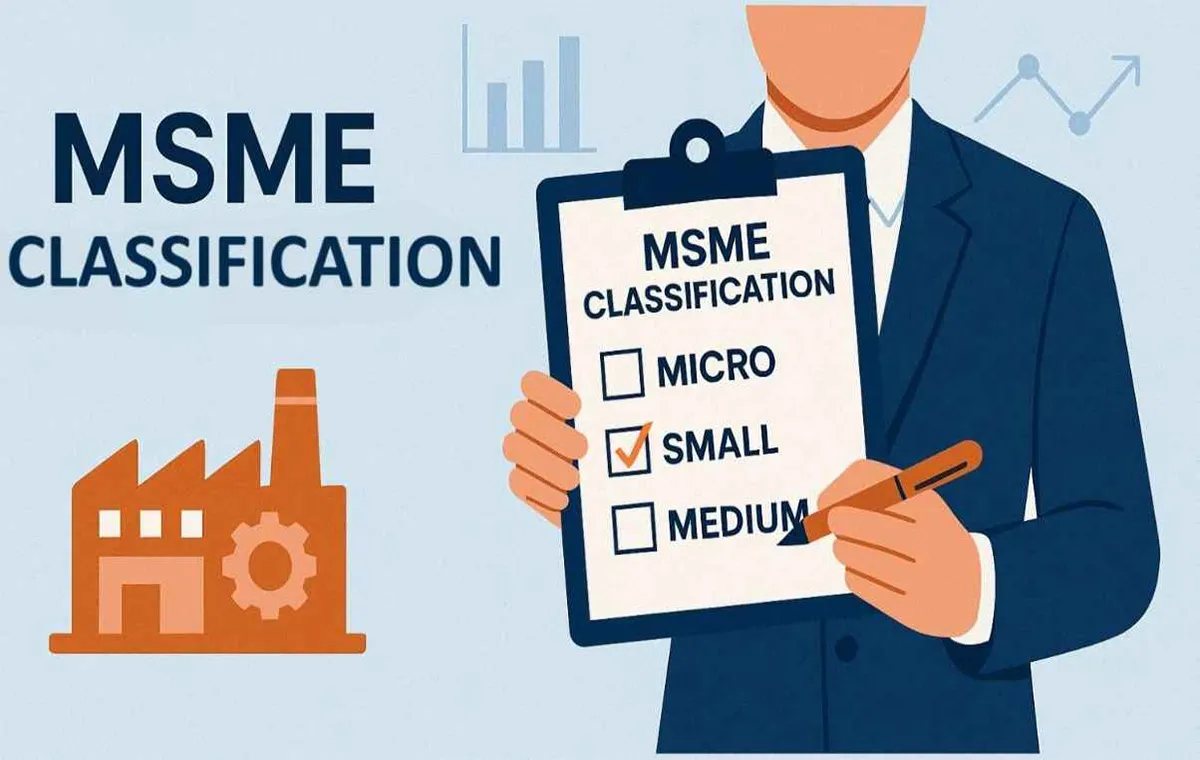

India's small and medium business sector is the backbone of the economy — contributing roughly 29% of GDP, employing around 11 crore people, and covering over 6 crore registered enterprises across manufacturing, services, and trade. Yet a significant portion of businesses that qualify for MSME status have not completed formal registration, and consequently, they are leaving behind a substantial set of financial, legal, and commercial protections that come at no cost to access.
MSME registration in India in 2026 is officially known as Udyam Registration. It is the government's unified digital identity system for Micro, Small, and Medium Enterprises, and it is the gateway to priority sector lending, delayed payment protection, government procurement preferences, collateral-free credit guarantees, and a range of central and state scheme benefits that are unavailable without it.
This guide explains who qualifies, what the current classification thresholds are, how the registration process works step by step, what specific protections and benefits formal registration unlocks, and the relationship between MSME registration and company registration — a distinction that matters for founders who are building formal legal entities.
What Is MSME Registration and How Does It Relate to Company Registration?
MSME registration and company registration are two distinct processes that serve different purposes — but they are often relevant to the same business at the same time, and understanding how they interact is important for any founder or business owner.
Company registration under the Companies Act, 2013 or the LLP Act, 2008 gives your business a separate legal identity — a Private Limited Company, an LLP, or an OPC becomes a distinct legal entity, can enter contracts in its own name, issue shares, and carry on business with limited liability for its owners. Company registration is mandatory for these structures.
MSME registration (Udyam) is a separate, voluntary recognition that any qualifying enterprise — whether it is a sole proprietorship, a partnership firm, an LLP, a Private Limited Company, an OPC, or even a trust or cooperative society — can obtain once it meets the investment and turnover criteria. MSME registration does not incorporate a new entity; it provides an existing business with a government-issued digital identity that unlocks access to MSME-linked schemes and protections.
For a founder who has completed company registration as a Private Limited Company and whose business turnover and investment fall within the applicable MSME limits, completing Udyam registration is the natural next step. The two registrations are complementary: company registration establishes your legal structure, and MSME registration positions that structure within the government's support ecosystem.
MSME Classification Thresholds in 2026
The Union Budget 2025 announced a landmark revision to MSME classification limits — investment thresholds were raised 2.5 times and turnover limits were doubled, effective 1 April 2025 (S.O. 1364(E) dated 21 March 2025). These revised limits continue into FY 2025–26 and represent the most generous classification thresholds since the MSME framework was introduced.
As of 2026, the MSME classification under the MSMED Act, 2006 is determined by a composite criteria of two simultaneous factors: investment in plant, machinery, or equipment, and annual turnover. Both conditions must be satisfied for a given classification to apply.
| Category | Investment Limit | Turnover Limit |
|---|---|---|
| Micro Enterprise | Up to ₹1 crore | Up to ₹5 crore |
| Small Enterprise | Up to ₹10 crore | Up to ₹50 crore |
| Medium Enterprise | Up to ₹50 crore | Up to ₹250 crore |
Once an enterprise's annual turnover exceeds ₹250 crore or its investment surpasses ₹50 crore, it graduates out of the Medium Enterprise category and loses MSME status and related benefits.
Two important points about classification dynamics that founders should understand:
Upward movement is automatic. If a registered MSME crosses a threshold in either investment or turnover, it moves up to the next category — micro to small, or small to medium — automatically. This changes the benefit profile but does not result in losing MSME status entirely unless the Medium Enterprise ceiling is exceeded.
Downward movement requires both thresholds to be crossed. A business falls to a lower category only when it falls below the limits in both investment and turnover simultaneously, not when just one metric changes.
These provisions mean the expanded 2025–26 thresholds give growing businesses significantly more room before they exit the MSME framework entirely.
Who Can Register as an MSME?
MSME registration is intentionally broad in terms of the business structures and sectors it covers. Both manufacturing and service businesses qualify under the same composite criteria. Eligible entities include:
- Sole proprietorships
- Partnership firms
- Private Limited Companies (after company registration under the Companies Act, 2013)
- Limited Liability Partnerships (LLPs)
- One Person Companies (OPCs)
- Hindu Undivided Families (HUFs) carrying on business
- Trusts and cooperative societies
Both manufacturing and service enterprises are eligible. Retail and wholesale traders are eligible to register on the Udyam portal and qualify for priority sector lending benefits, though scheme-specific benefits may vary for trading enterprises under particular government guidelines.
There is no requirement for a minimum operating period. A business can complete MSME registration on or shortly after completing company registration, provided it meets the applicable turnover and investment criteria.
The Udyam Registration Process: Step by Step
MSME registration through the Udyam portal is completely free, fully paperless, and requires no document uploads. The entire process is Aadhaar-authenticated and tax-linked — the government verifies your financial data directly against PAN and GSTIN filings, eliminating the need to submit financial statements or income certificates.
Step 1: Visit the Udyam Registration Portal
Go to the official government portal at udyamregistration.gov.in. This is the only official, free registration platform. All MSME registrations and GSTIN-linked validations are processed through this portal.
For businesses without a GSTIN (those below the GST threshold of ₹40 lakh for goods or ₹20 lakh for services), Udyam registration can still be completed using only PAN. The portal accommodates this category.
Step 2: Aadhaar Verification
Select the appropriate registration type based on your business structure — "For New Entrepreneurs who are not Registered yet as MSME or those with EM-II." Enter the Aadhaar number of the proprietor, managing partner, karta (in case of HUF), or authorised signatory of the company or LLP, and complete the OTP-based verification on the registered mobile number.
For companies and LLPs that have completed formal company registration, the Aadhaar of the authorised representative (typically a director or designated partner) is used.
Step 3: PAN and Business Verification
Enter the enterprise's PAN. The portal automatically fetches and pre-fills financial data linked to the PAN — including ITR-linked income data and, where applicable, GSTIN-linked turnover figures. Verify and confirm the pre-filled information.
Step 4: Enter Enterprise Details
Fill in the remaining enterprise details including:
- Name and type of the enterprise
- Registered office address
- Date of commencement of business
- Bank account number and IFSC code
- NIC (National Industrial Classification) code — this is an important field that classifies your business activity; selecting the correct NIC code matters because it determines which sector-specific MSME schemes you are eligible for
- Number of employees
- Investment in plant, machinery, or equipment
- Annual turnover
The investment and turnover figures are cross-verified against income tax and GST filings — ensuring the classification assigned is based on verified financial data, not self-declared estimates.
Step 5: Submit and Receive the Udyam Registration Certificate
After verification, submit the application. The Udyam Registration Certificate is auto-generated immediately — there is no approval process, no waiting period, and no government fee. The certificate contains a unique 12-digit Udyam Registration Number (URN), a QR code for instant verification, and the enterprise's MSME classification category.
The Udyam Registration Certificate has lifetime validity, meaning it does not need to be renewed annually. However, registered MSMEs are required to update their financial details on the Udyam portal annually to ensure their classification remains current.
The entire process typically takes 15 to 30 minutes for a business with a valid Aadhaar, PAN, and GSTIN.
What MSME Registration Actually Unlocks
The Udyam Registration Number and Certificate are not just a digital identity — they are the eligibility key for a range of protections and benefits with direct financial impact. Eight of the most significant are worth understanding in detail.
1. Delayed Payment Protection Under the MSMED Act
This is arguably the most practically valuable benefit of MSME registration for businesses supplying to larger buyers.
Section 15 of the MSMED Act, 2006 forces every buyer to pay an MSME supplier within 45 days of accepting goods or services. Miss the window, and the buyer owes interest at three times the RBI bank rate, compounded monthly. The MSME supplier can then take the claim to the Micro and Small Enterprises Facilitation Council for adjudication and recovery. These protections kick in automatically the moment Udyam Registration goes through.
The MSME Samadhaan portal (samadhaan.msme.gov.in) is the online platform where delayed payment complaints can be filed and tracked.
2. Section 43B(h) of the Income Tax Act: A Leverage Tool
Effective from FY 2023–24, Section 43B(h) of the Income Tax Act made MSME payment protections functionally mandatory from the buyer's side as well. If a buyer makes payment to a micro or small enterprise beyond the 45-day window prescribed under the MSMED Act, the expenditure is allowed as a deduction only in the year of actual payment — not on the accrual basis that buyers typically use.
The practical consequence is significant: large corporates are increasingly demanding Udyam Registration certificates from their MSME vendors to track payment timelines and avoid tax disallowance under Section 43B(h). This has made MSME registration functionally mandatory even for businesses that may not otherwise be actively seeking government scheme benefits.
3. Priority Sector Lending and Concessional Credit
Public and private sector banks are required by RBI guidelines to allocate a mandated percentage of their total advances to MSMEs — 7.5% to micro enterprises and 10% to MSMEs overall. Udyam registration is the eligibility certificate for these priority sector lending benefits, which typically carry interest rates 0.5% to 1.5% lower than standard commercial lending rates.
4. Collateral-Free Credit Under CGTMSE
The Credit Guarantee Fund Trust for Micro and Small Enterprises (CGTMSE) provides collateral-free credit guarantee coverage of up to ₹5 crore for Udyam-registered micro and small enterprises. No personal guarantee is required. This addresses one of the most significant structural barriers that prevents small businesses from accessing formal bank credit.
5. Government Procurement Preference on GeM
Government tenders reserve 25% of procurement for MSMEs, with 3% specifically for women-led enterprises. MSME registration is the eligibility document for accessing these reserved procurement opportunities and for the EMD (Earnest Money Deposit) waiver on GeM tenders. For a business supplying goods or services to government entities, this is a direct market access benefit.
6. Interest Subvention Schemes
Various central and state government interest subvention schemes provide interest subsidies on loans to Udyam-registered MSMEs. The specific rates and conditions vary by scheme and state, but many provide subsidies of 1% to 3% on working capital and term loans — meaningfully reducing the cost of borrowed capital.
7. Technology and Quality Subsidies
MSME registration is the qualifying condition for several technology and quality support programmes including the ZED (Zero Defect Zero Effect) certification scheme, the ISO Certification Reimbursement Scheme, and cluster development subsidies under the MSME Development Commissioner's office. These schemes support quality upgradation, technology adoption, and export readiness for registered enterprises.
8. Trademark and Patent Fee Concessions
Udyam-registered MSMEs receive a 50% rebate on trademark filing fees and are eligible for subsidised rates on patent filing — the same concessions available to DPIIT-recognised startups. For a manufacturing or product business building intellectual property, these concessions reduce the cost of formal IP protection.
MSME Registration and Company Registration: A Common Path for Founders
For a founder who has recently completed company registration as a Private Limited Company, an LLP, or an OPC, completing Udyam registration is a straightforward, cost-free process that immediately positions the business within India's most widely used business support framework.
The sequence is typically:
- Complete company registration under the appropriate structure (Private Limited Company, LLP, or OPC) through the MCA portal
- Obtain PAN and TAN (automatically issued at incorporation)
- Register for GST if turnover thresholds are met or if the business supplies inter-state or through e-commerce platforms
- Complete MSME registration on the Udyam portal using the company's PAN and the authorised representative's Aadhaar
This sequence takes the business from being an unregistered idea to a formally incorporated, government-recognised, credit-eligible entity positioned within the MSME ecosystem — all within a few working days.
With over 7.5 crore MSMEs registered on the Udyam platform as of 2026, this is India's most widely used business registration after GST. It is free, it is fast, and the protections it unlocks — particularly delayed payment enforcement and priority sector lending eligibility — have direct, material impact on how a business operates and grows.
What MSME Registration Does Not Do
An honest account of MSME registration also clarifies what it does not provide:
MSME registration is not a substitute for company registration. It does not provide a separate legal identity, limited liability protection, or the ability to issue shares. A sole proprietorship with Udyam registration is still a sole proprietorship — the owner's personal assets remain at risk for business liabilities.
MSME registration does not guarantee loan approval. It creates eligibility for priority lending and credit guarantee schemes; the lender still assesses creditworthiness, business viability, and repayment capacity.
MSME registration does not replace GST registration or income tax compliance. It is a recognition layer on top of existing tax compliance, not a replacement for it.
And it is not a one-time permanent exemption from financial discipline. The annual update requirement on the Udyam portal means the classification is linked to actual financial performance — businesses that grow beyond the applicable thresholds are reclassified accordingly.
A Final Note
MSME registration through the Udyam portal is one of the most accessible and highest-return formal registrations available to small and medium businesses in India. It costs nothing, requires no document uploads, takes under 30 minutes, and has lifetime validity. The protections it provides — mandatory payment timelines, credit guarantees, procurement access — address the specific vulnerabilities that constrain small business growth.
For any business that meets the investment and turnover criteria, whether it is a new business completing formal company registration or an established enterprise that has been operating informally, completing Udyam registration is a practical priority, not a discretionary formality.






























Sign in to leave a comment.