Asset visibility has become the cornerstone of operational excellence in modern logistics and fleet asset visibility operations. Traditional tracking methods leave businesses grappling with blind spots, lost shipments, and inefficient resource allocation. Companies lose billions annually due to misplaced assets and delayed deliveries.
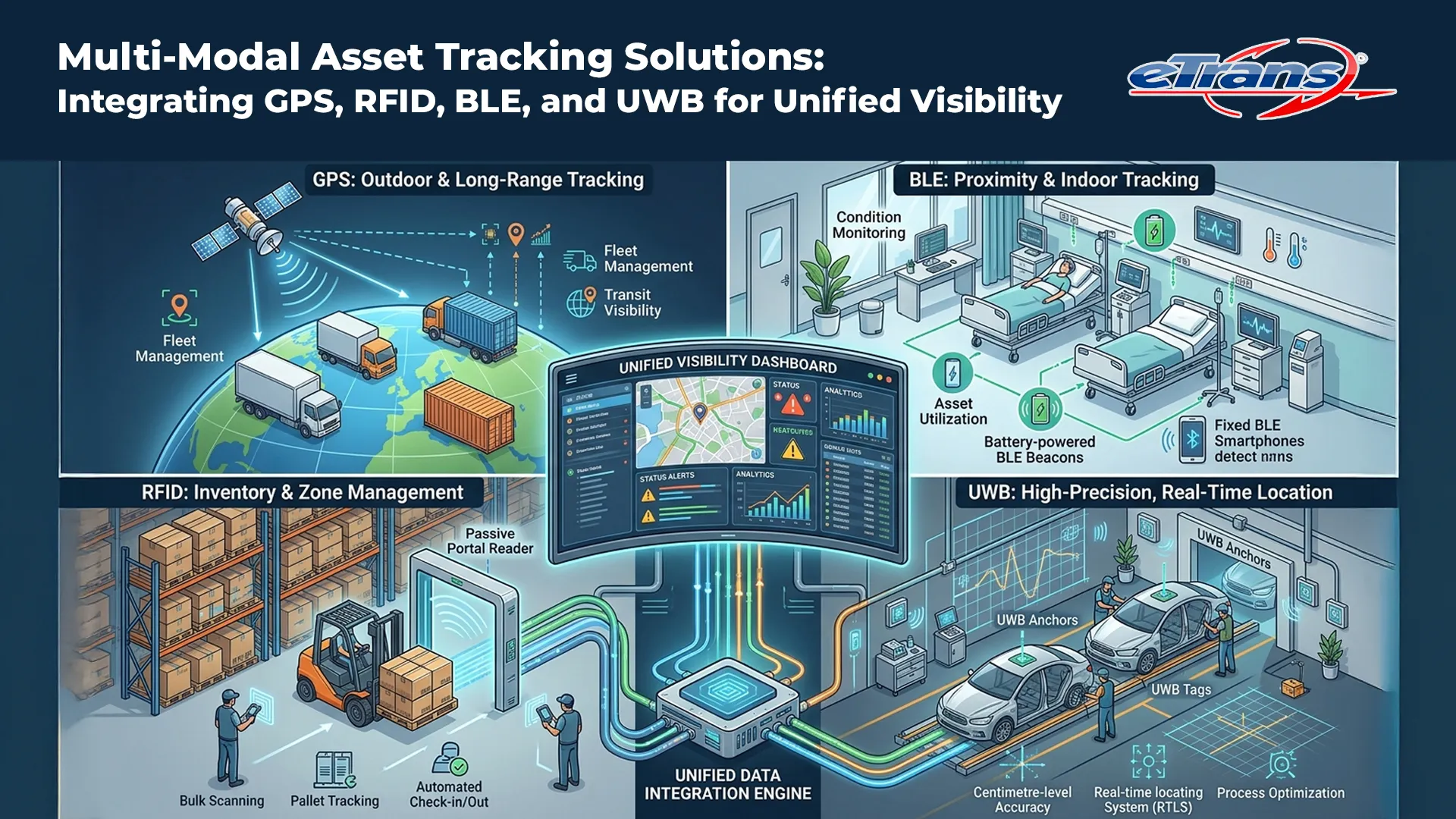
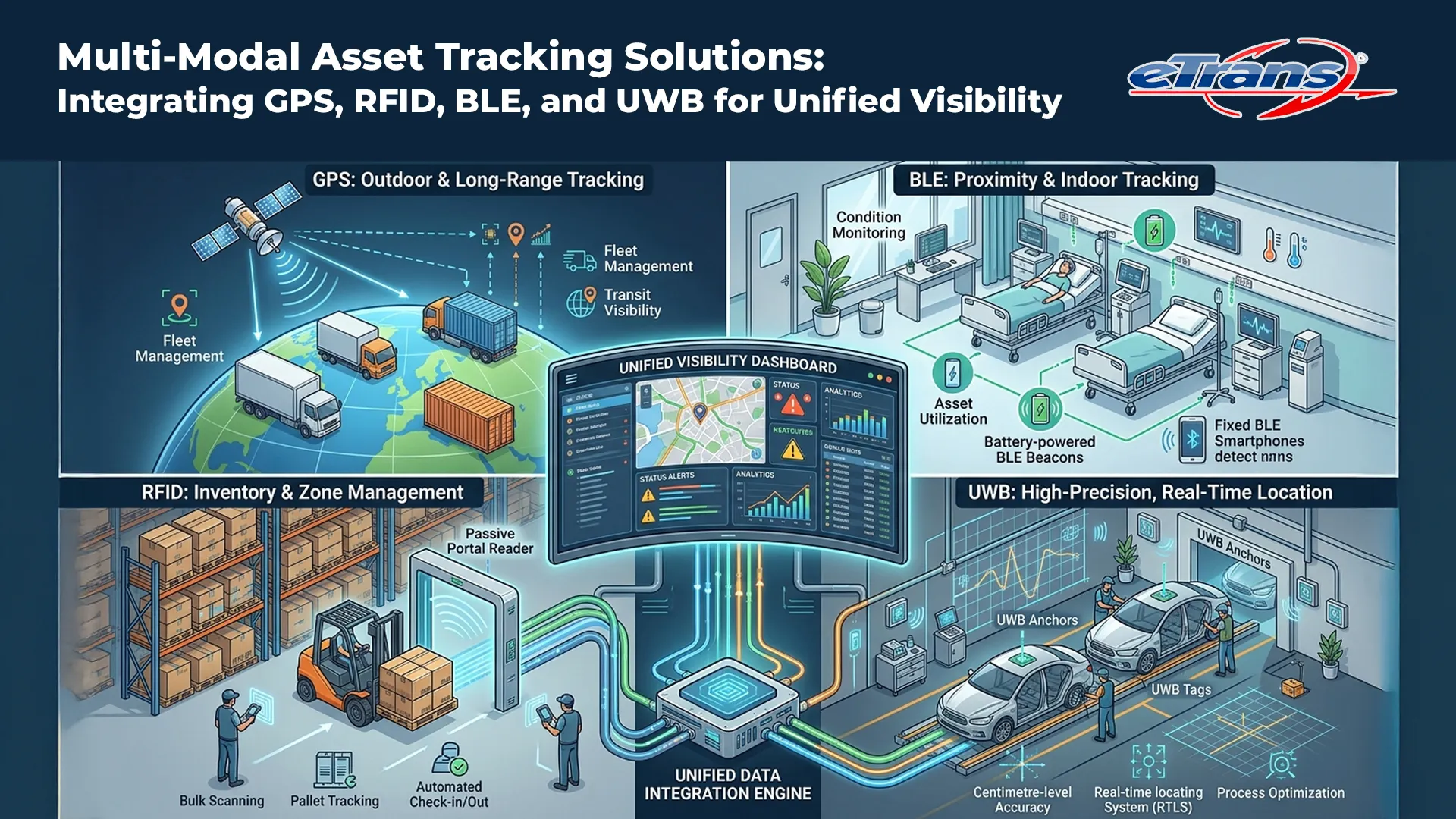
Multi-modal asset tracking solutions are revolutionizing how businesses monitor their assets across diverse environments. By integrating GPS asset tracking devices, RFID asset management, BLE beacon tracking, and UWB real-time location systems together, companies can easily see where their assets are from the warehouse to the customer.
This guide explores how these technologies work together to eliminate tracking gaps, optimize asset tracking analytics, and deliver end-to-end asset visibility. You'll discover practical insights into building a connected asset ecosystem that transforms location data into actionable intelligence, reduces costs, and keeps your business competitive.
The Shift from Single-Mode Tracking to Multi-Modal Asset Intelligence
Single-technology tracking systems have reached their breaking point. GPS works brilliantly outdoors but fails inside warehouses. RFID excels at checkpoint monitoring but can't track assets in transit. Industry research shows companies experience 5-7% annual asset shrinkage, with poor visibility being a primary contributor.
Multi-modal asset tracking solutions solve this by combining multiple technologies into one intelligent system. Real-time asset tracking follows assets through every journey stage, automatically switching between outdoor asset tracking technology and indoor asset tracking systems as needed. A 2023 logistics survey revealed that 78% of enterprise businesses now consider real-time visibility a critical competitive advantage.
Asset tracking software platforms process data from multiple sources simultaneously. This smart asset monitoring approach reduces manual tracking labour by 60% while improving accuracy. Companies deploying hybrid asset tracking systems report 40% fewer lost assets and 35% better utilization rates within the first year.
The shift toward multi-modal intelligence isn't just about technology—it's about operational transformation. Organizations gain flexibility to scale operations, enter new markets, and respond faster to disruptions.
Understanding Multi-Modal Asset Tracking Architecture in Modern Fleet Ecosystems
Multi-modal asset tracking architecture functions as a layered ecosystem where hardware, connectivity, and analytics work in concert. At the foundation sit tracking devices: GPS asset tracking devices, RFID tags, BLE beacons, and UWB anchors. Each continuously collects location and status data.
Data flows through various channels. Cellular networks carry GPS data. Wi-Fi and gateways collect BLE signals. RFID readers capture tag information. Telematics asset tracking systems serve as middleware, processing incoming streams and normalizing them into standardized formats.
Cloud-based asset tracking analytics platforms aggregate data from all sources, apply algorithms, and generate unified dashboards. Modern platforms process millions of data points daily with latency under 500 milliseconds, enabling truly real-time decision-making.
For fleet providers, this architecture enables comprehensive oversight of vehicles, cargo, and equipment simultaneously. Integration APIs connect asset tracking software with WMS, TMS, and ERP platforms, transforming passive tracking into active operational intelligence.
Role of GPS in Outdoor Asset Tracking and Fleet Visibility
GPS asset tracking devices remain the champion of outdoor asset monitoring. Satellite-based positioning delivers global coverage with typical accuracy of 5-10 meters. Modern devices receive signals from 8-12 satellites, calculating position through triangulation.
Advanced systems combine GPS with GLONASS or Galileo networks, improving accuracy to 3-5 meters. Telematics asset tracking uses GPS for more than just location. Geofencing creates virtual boundaries, triggering alerts when assets enter or exit zones. Research indicates GPS-based fleet tracking reduces fuel costs by 15-20% through better route optimization.
Real-time asset tracking enables dynamic dispatch, allowing companies to redirect vehicles mid-route. However, GPS faces significant limitations. Signal penetration inside buildings is essentially zero. Urban canyons degrade accuracy. Industry data shows GPS positioning fails in approximately 40% of typical logistics environments. This necessitates integration with complementary technologies for continuous visibility.
RFID-Based Tracking for Zone-Level Visibility and Inventory Automation
RFID asset management revolutionizes tracking within controlled environments like warehouses. Radio Frequency Identification uses electromagnetic fields to automatically identify and track tags. Unlike barcodes requiring line-of-sight scanning, RFID readers capture multiple tags simultaneously, even through packaging.
Passive RFID tags cost $0.10-$0.50 each, making them viable for large-scale deployments. Active RFID tags contain batteries, broadcasting signals up to 100 meters, typically costing $15-$50 for high-value asset tracking.
Indoor asset tracking systems using RFID achieve read rates exceeding 99.5%. A single RFID portal processes 200+ tags per second. Manufacturing facilities using RFID report 25-30% improvements in inventory accuracy and 50% reductions in manual counting labour.
RFID excels at checkpoint-based visibility. Loading dock readers automatically log shipments. Warehouse zone readers track movement between storage areas. Supply chain visibility tools integrate RFID data to automate workflows and trigger alerts when expected assets don't arrive within specified timeframes.
BLE Technology in Asset Tracking: Enabling Low-Power, Proximity-Based Intelligence
BLE beacon tracking has emerged as a game-changer for smart asset monitoring requiring long battery life and cost-effective deployment. Bluetooth Low Energy enables devices to transmit signals for years on small batteries, drastically reducing maintenance requirements.
BLE beacons cost $5–$20 each and broadcast unique identification signals at regular intervals. Gateway devices calculate approximate distance based on signal strength. This proximity-based approach works exceptionally well for room-level or zone-level accuracy.
Battery life represents a significant BLE advantage. Properly configured beacons operate 3-5 years without replacement. A warehouse managing 10,000 tagged assets would need approximately 200 battery replacements annually with BLE versus 2,700 with traditional tracking.
Real-time asset tracking applications include equipment utilization monitoring and proximity detection for automated workflows. BLE accuracy typically ranges from 1-5 meters, sufficient for most logistics asset tracking systems but insufficient for precision applications. Asset tracking analytics platforms process BLE data to generate heat maps, dwell time analysis, and utilization insights.
Ultra-Wideband (UWB) for High-Precision Indoor Positioning and Real-Time Location Systems
UWB real-time location systems deliver centimeter-level accuracy that other indoor asset tracking systems cannot match. Ultra-Wideband transmits extremely short radio pulses across wide frequency spectrums, enabling precise time-of-flight measurements. The technology achieves positioning accuracy of 10-30 centimeters in three-dimensional space.
High-value asset tracking applications justify UWB's higher costs—typically $50-$150 per tag and $200-$500 per anchor.
Automotive manufacturers use UWB to track vehicles through assembly lines. Pharmaceutical companies track temperature-sensitive inventory with shelf-level precision. Research shows facilities implementing UWB-based safety systems experience 40-50% reductions in workplace incidents.
Industrial asset tracking solutions using UWB enable process automation that is impossible with less precise technologies. Automated guided vehicles navigate using UWB positioning. Robotic systems locate and retrieve specific items with millimeter precision. For applications where precision impacts safety or efficiency, UWB provides unmatched value.
Hybrid Tracking Systems: Combining Technologies for Seamless Indoor-Outdoor Visibility
Hybrid asset tracking systems intelligently coordinate multiple technologies, automatically selecting the optimal method based on location and environment. A tracked container triggers GPS during road transit, switches to RFID at facility entrance, and activates BLE for zone-level warehouse visibility. High-value items engage UWB for precise positioning.
Asset tracking software platforms orchestrate transitions through intelligent logic engines. Geofencing defines switching boundaries. Signal quality monitoring detects degrading GPS accuracy, triggering backup methods.
Companies implementing multi-modal asset tracking solutions report 60-70% reductions in visibility blind spots and 50-80% improvements in asset recovery rates. Supply chain visibility tools leveraging hybrid tracking enable analytics that are impossible with single-mode systems. Complete journey data reveals actual delay locations. Cross-environment dwell time analysis identifies bottlenecks spanning multiple facilities. Cost optimization deploys expensive UWB only where precision matters, using BLE everywhere else.
Data Fusion and Analytics in Multi-Modal Asset Tracking Systems
Asset tracking analytics transforms raw sensor data into operational intelligence through sophisticated fusion techniques. Multiple technologies generate heterogeneous streams with varying formats and accuracy. Analytics platforms harmonize these differences, creating unified asset representations.
Fusion algorithms combine inputs to improve accuracy. GPS places an asset with 5-meter uncertainty. BLE detects it near a specific beacon. The algorithm combines both, narrowing the probable location to 2 meters. Machine learning models learn normal behaviour patterns, triggering predictive alerts before problems escalate.
Real-time asset tracking analytics process millions of events daily, filtering noise and identifying patterns. Historical analytics reveal optimization opportunities. Asset utilization analysis shows idle equipment. Route analysis identifies inefficient paths. Organizations using advanced visualization report 45% faster issue resolution times compared to tabular data approaches.
Real-Time Visibility and Operational Intelligence in Fleet Management
Real-time asset tracking fundamentally changes how organizations respond to disruptions. Visibility latency dropping from hours to seconds enables proactive management. Fleet asset visibility platforms process updates from thousands of vehicles simultaneously, identifying patterns and anomalies instantly.
Smart asset monitoring platforms predict arrival times with 95% accuracy by analyzing positions, traffic, and historical data. Dynamic dispatch algorithms reassign deliveries to nearby vehicles, maintaining service despite disruptions. Delivery tracking portals reduce inquiry calls by 60-70%.
Emergency response scenarios showcase real-time value. Equipment breakdowns trigger automatic replacement dispatch. High-priority orders activate priority routing. Response times improve by 50-70% with real-time systems compared to periodic updates. Performance management transforms through continuous visibility, enabling immediate coaching and rapid redeployment decisions.
Scalability Challenges and Infrastructure Requirements in Multi-Modal Tracking
Scaling multi-modal asset tracking solutions from pilots to enterprise-wide implementations presents significant challenges. Connectivity infrastructure becomes critical. GPS tracking requires cellular connectivity. Facilities need robust Wi-Fi supporting thousands of devices. Network architecture must handle intermittent connectivity gracefully.
Device management complexity grows exponentially. Organizations tracking 100,000 assets must monitor battery status and firmware versions across entire populations. The cloud infrastructure must scale elastically, handling data volumes that fluctuate 5–10 times between peak and average loads.
Edge computing reduces transmission requirements. Gateway devices perform preliminary filtering locally, reducing bandwidth costs by 60-80% while improving latency. The data storage system balances query performance with costs using tiering strategies that reduce total expenses by 50-70%.
Security and Data Integrity in Multi-Modal Asset Tracking Ecosystems
Connected asset ecosystem security extends beyond protecting data to ensuring infrastructure integrity. Encryption protects tracking data throughout its lifecycle using TLS 1.3 and AES-256. Device authentication prevents rogue devices from injecting false data. Digital certificates uniquely identify legitimate hardware.
Network segmentation isolates tracking infrastructure from corporate networks. Asset tracking software platforms operate in dedicated zones with strict firewall policies. Data integrity validation ensures information remains accurate. Cryptographic signatures verify location data hasn't been modified. Blockchain-based logging provides tamper-evident audit trails for high-value asset tracking.
Physical security protects devices from tampering. Tamper-evident seals reveal unauthorized access. Access control limits who can view tracking data through role-based permissions. Organizations report spending 15–25% of their tracking budget on security and compliance capabilities.
Industry Use Cases: Logistics, Transportation, and High- Value Asset Monitoring
Logistics asset tracking systems demonstrate multi-modal asset tracking solutions in demanding environments. Third-party logistics providers manage assets across warehouses and transportation networks. GPS tracks shipments during transit. RFID monitors checkpoints. BLE provides visibility for distribution centers at the zone level.
Container shipping leverages hybrid tracking to manage thousands of containers globally. GPS- enabled trackers provide ocean transit visibility. Port arrival triggers RFID registration. Intermodal facilities use BLE for yard tracking. Industry data shows container tracking reduces cycle times by 15-20% through improved utilization.
High-value asset tracking addresses challenges in managing expensive mobile equipment. Construction companies track equipment across job sites. GPS provides transit visibility. BLE enables within-site zoning. Geofencing alerts if equipment moves off authorized sites. Construction firms report 25-35% utilization improvements and 60-70% theft reductions.
Healthcare asset tracking manages medical equipment across hospital systems. The BLE networks provide room-level equipment locations. UWB tracks operating room instruments. Healthcare organizations report $2-3 million annual savings per hospital from improved visibility. Pharmaceutical supply chain visibility tools ensure cold chain integrity, reducing product spoilage by 40-50%.
Future Trends in AI, Digital Twins, and Intelligent Asset Tracking Systems
Artificial intelligence is transforming asset tracking analytics from descriptive reporting to predictive intelligence. Machine learning analyzes historical patterns, identifying optimal allocation strategies. Predictive maintenance leverages tracking data combined with operational telemetry, predicting failures 7-14 days in advance with 85-90% accuracy. Transportation fleets report 30-40% maintenance cost reductions.
Digital twin technology creates virtual replicas of physical assets. Real-time asset tracking data continuously updates digital twins. Simulation capabilities test operational changes virtually. Organizations using digital twins report 25-30% improvements in planning accuracy.
Autonomous systems increasingly rely on precise tracking. Self-driving vehicles require centimeter-level positioning from UWB real-time location systems. Warehouse automation coordinates robots using integrated tracking. Augmented reality overlays tracking data on physical environments, improving productivity by 20–30%.
5G networks enable massive IoT asset tracking solution deployments with reduced latency. Edge computing and 5G work together to process data locally, which allows for responses with latencies of milliseconds for applications that are critical to safety.
Conclusion: Building Unified Visibility Through Multi- Modal Asset Tracking Solutions
Multi-modal asset tracking solutions integrating GPS asset tracking devices, RFID asset management, BLE beacon tracking, and UWB real-time location systems have evolved from novelties to operational necessities. Single-technology approaches no longer meet modern logistics demands, where assets traverse environments requiring continuous visibility.
The business case extends beyond simple location.
Asset tracking analytics transforms data into operational intelligence that reduces costs and improves service. Real-time asset tracking supports dynamic operations, which are impossible with periodic visibility. End-to-end asset visibility eliminates blind spots, creating loss and inefficiency.
Implementation success requires strategic technology selection that matches capabilities with requirements. Hybrid asset tracking systems combining these technologies deliver comprehensive visibility optimizing performance and cost. Businesses are delaying investment risk due to competitive disadvantages as industry standards evolve toward continuous visibility expectations.
Organizations looking to gain an edge with asset tracking software should focus on platforms that support multiple technologies, allow easy integration, and provide advanced analytics. The investment transforms tracking from a tactical tool into a strategic asset driving measurable business outcomes.
Frequently Asked Questions
What are the main differences between GPS, RFID, BLE, and UWB tracking technologies?
GPS provides global outdoor positioning via satellites with 5-10 meter accuracy. RFID offers checkpoint-based identification. BLE delivers low-power proximity tracking for indoor zones. UWB achieves centimeter-level precision indoors using time-of-flight measurements for high- accuracy applications.
2. How do multi-modal asset tracking systems automatically switch between different technologies?
Integrated platforms use geofencing to detect environment changes, signal quality monitoring to identify transitions, and intelligent logic engines that seamlessly hand off tracking responsibility based on asset location, ensuring continuous visibility without manual intervention or data gaps.
3. What ROI can businesses expect from implementing multi-modal asset tracking solutions?
Organizations typically achieve 30-40% operational efficiency gains, 40-60% reductions in lost assets, 15-25% inventory carrying cost decreases, and 50-70% improvements in asset utilization within the first year, with payback periods averaging 8-18 months depending on scale.
4. Which industries benefit most from integrated GPS, RFID, BLE, and UWB tracking systems?
Logistics, transportation, healthcare, manufacturing, construction, pharmaceuticals, and retail industries gain substantial value from multi-modal tracking due to assets moving across diverse indoor-outdoor environments requiring continuous visibility for operational efficiency, security, and regulatory compliance.
5. What infrastructure is required to deploy a scalable multi-modal asset tracking system?
Essential infrastructure includes tracking devices (tags, beacons, GPS units), connectivity networks (cellular, Wi-Fi), gateway devices, cloud platforms for data processing and analytics, integration APIs for enterprise systems, and security protocols, with architecture designed for elastic scaling.


























Sign in to leave a comment.