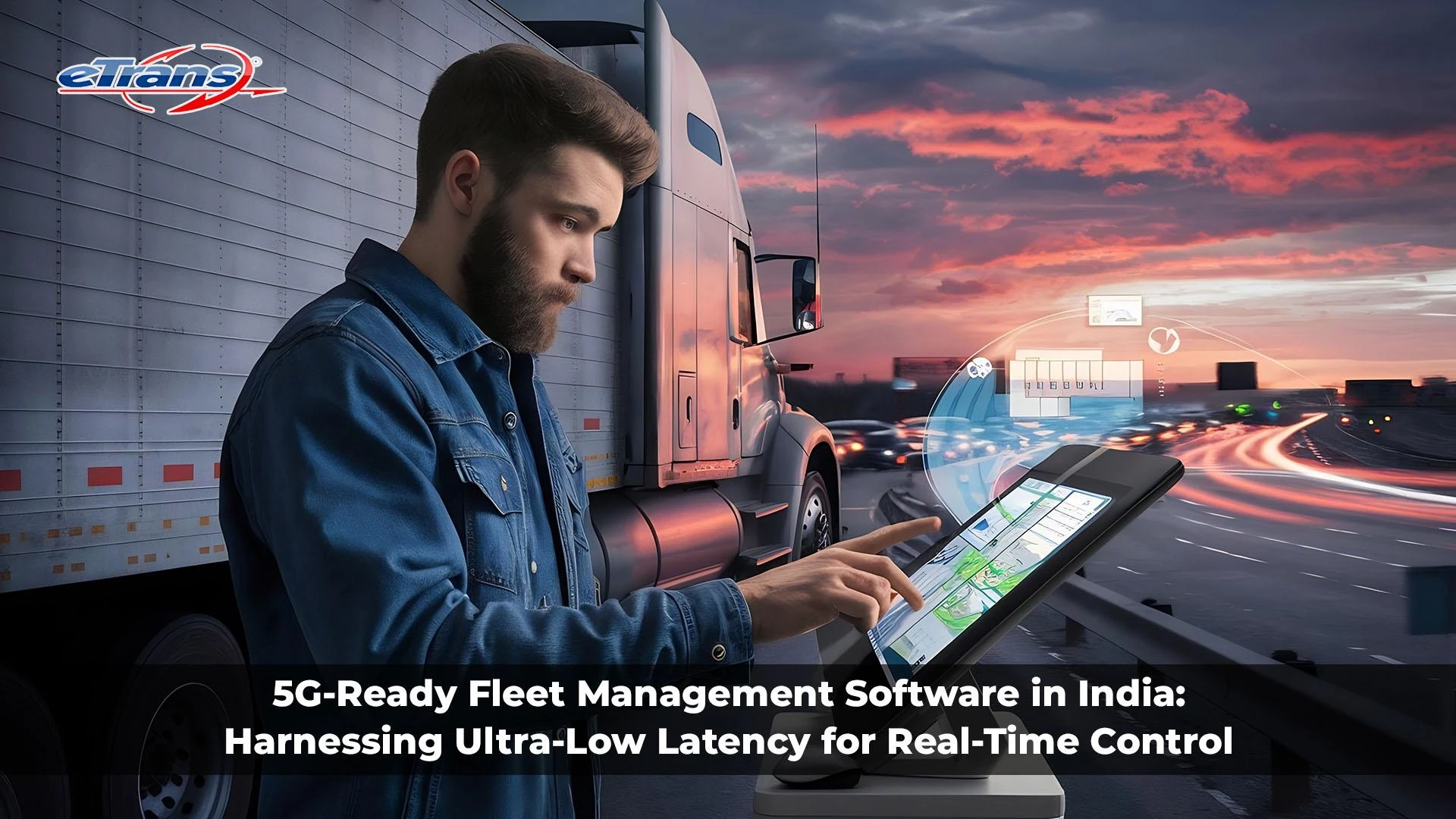
Let’s be real — fleet managers in India are tired of dropped signals, delayed GPS updates, and choppy video feeds that make real-time control feel like playing a video game on dial-up internet. The logistics sector is screaming for speed, reliability, and precision, and 5G is finally here to answer that call.
This isn’t just another network upgrade; it’s a complete shift in how fleets will operate. Think ultra-low latency, deterministic networking, and edge computing working together to make your fleet respond in milliseconds.
The gap between seeing an incident on a dashcam and actually responding to it could be the difference between avoiding a crash and filing an insurance claim. In India, where fleets range from last-mile two-wheelers navigating congested city streets to massive mining trucks in remote zones, speed of response is everything. 5G fleet telematics in India changes the game.
We’re talking about ultra-reliable low latency communications (URLLC) that enable teleoperation and remote driving control, real-time HD dashcam streaming, and even cooperative platooning over 5G.
And here’s the kicker, 5G private network rollout in India is happening fast, and network slicing for fleets means you can have guaranteed bandwidth even during peak hours. The result? Your best fleet management software in India becomes a real-time control hub, rather than just a dashboard that shows what happened five minutes ago.
If you’re wondering how all this works, stick around. This guide will break down how the best fleet management software in India integrates with 5G, why MEC (Mobile Edge Computing) is your new best friend, and how to implement features like secure OTA for telematics devices, Fleet SIM lifecycle management, 5G fallback and dual-SIM failover.
By the end, you’ll know exactly how to pilot and scale a 5G-enabled fleet that’s faster, smarter, and safer.
Core 5G Capabilities That Change the Telematics Stack
The jump from 4G to 5G is not just about faster internet for watching cat videos in HD. For fleets, it’s about three main capabilities:
Ultra-Reliable Low-Latency Communications (URLLC): This is the operation of nearly instantaneous data transmission. We’re talking milliseconds of delay. This is perfect for mission-critical tasks like deterministic telemetry SLAs, driver assistance alerts, teleoperation and remote driving control.
Enhanced Mobile Broadband (eMBB): Finally, multi-camera HD streams become practical. That means real-time HD dashcam streaming without buffering nightmares, enabling live monitoring from your control center.
Massive Machine-Type Communications (mMTC): Thousands of sensors in your fleet can now report data without collapsing the network. This is crucial for edge inference for driver monitoring, MEC orchestration for fleet analytics, and predictive maintenance.
The takeaway? Event thresholds can drop because latency is no longer a bottleneck, video can run continuously for priority assets, and massive IoT becomes cost-effective.
Network Slicing and Service Differentiation for Fleet SLAs
You can establish dedicated, virtual lanes on the network with 5G network slicing for fleets. One slice might handle safety-critical URLLC data, and another for driver infotainment or training content. This matters when public networks get congested — your emergency braking signal won’t be stuck in traffic.
The carrier slice provisioning API lets your fleet software automatically request the right slice for the right job. Imagine an ambulance in rush-hour traffic. The fleet system pings the carrier, provisions a low-latency slice, and ensures uplink priority for telemetry and HD video. The result? SLAs with guaranteed latency, jitter, and packet loss metrics — even at network saturation.
Slice-aware endpoints and automated orchestration keep mission-critical data flowing with network-assured QoS for telematics.
MEC (Mobile Edge Computing) and Distributed Analytics Architecture
With MEC / Mobile Edge Computing for telematics, your fleet data gets processed closer to where it’s generated. A depot with an edge node can run real-time driver behaviour models or 5G-enabled EV charging orchestration without round trips to a distant cloud.
Fleet software can split workloads: edge for real-time inference (like hazard detection) and cloud for model training. This speeds up processes, increases safety, and decreases reaction times.
Key design patterns include:
- Secure OTA for telematics devices to push model updates.
- Latency budgets for telematics to ensure consistent response times.
- MEC orchestration for fleet analytics for deterministic processing.
Private 5G / Captive Networks for Mission-Critical Fleet Sites in India
In India’s rapidly advancing logistics sector, deploying private 5G (CNPN) or captive networks for logistics at mission-critical fleet hubs ensures ultra-reliable, low-latency communication essential for seamless fleet tracking, real-time route optimisation, and autonomous vehicle coordination.
These dedicated networks offer enhanced security, high bandwidth, and minimal downtime, making them ideal for fleet depots, ports, and distribution centres where uninterrupted connectivity directly impacts operational efficiency and safety.
Why it matters:
- Local breakouts mean faster processing.
- Tighter security through IMSI whitelisting.
- Predictable coverage even in RF-hostile environments.
Fleet software needs to integrate with these networks using fleet SIM lifecycle management and network slice APIs.
5G-Ready In-Vehicle Hardware and Secure Routing
Leveraging ultra-low latency connectivity, advanced telematics control units, and IoT-enabled vehicle sensors to enable real-time fleet monitoring, predictive maintenance, and over-the-air updates.
Secure routing protocols, data encryption, and cyber threat prevention ensure safe, uninterrupted communication between fleet vehicles and control centres, enhancing operational efficiency and resilience against network vulnerabilities.
A 5G vehicle router with dual-SIM failover and an integrated HSM is now a must-have. NPUs/TPUs can pre-process camera feeds before sending them over 5G, saving bandwidth.
Best practices:
- Isolate the CAN bus from the passenger Wi-Fi.
- Use secure boot and signed firmware.
- Implement QoS mapping to carrier slices.
High-Value 5G Use-Cases for Indian Fleets
Exploring how ultra-low latency, massive IoT connectivity, and real-time analytics can revolutionise fleet operations in India, from predictive maintenance and route optimisation to EV fleet management, smart charging, load balancing, and driver safety systems, enabling a new era of sustainable, efficient, and connected transportation.
- Live HD Multi-Camera Streaming with edge object detection.
- Teleoperation and Remote Assistance using URLLC.
- Cooperative Platooning with synchronised telemetry for efficiency.
Each relies on defined latency budgets for telematics, slice provisioning, and MEC processing.
Integration with EV Fleets and Charging Orchestration
This involves aligning 5G-ready fleet management software with electric vehicle (EV) operations, ensuring seamless connectivity between vehicles, smart charging stations, and energy management systems.
It supports dynamic load balancing, real-time charge scheduling, and integration with renewable energy sources, enabling sustainability goals while optimising cost and efficiency.
5G makes EV management dynamic:
- SOC telemetry drives real-time charging schedules.
- Grid-aware coordination reduces costs.
- 5G-enabled EV charging orchestration allows price-based decision-making.
Security, Privacy, and Regulatory Concerns
For 5G-enabled fleet systems, security is not just a feature; it’s a design principle. Every telematics device should have a hardware root of trust, secure OTA for telematics devices, and on-device encryption to protect data in transit.
Using Fleet SIM lifecycle management with strict provisioning and IMSI whitelisting for private networks ensures only authorised units connect. 5G fallback and dual-SIM failover must be implemented without compromising data integrity.
End-to-end encryption combined with network-assured QoS for telematics helps maintain reliability while complying with India’s data localisation rules and lawful interception requirements.
Properly managing latency budgets for telematics also safeguards against service degradation in critical workflows, making security a performance enabler rather than a bottleneck.
Implementation Roadmap
Rolling out 5G-ready fleet telematics in India isn’t about flipping a switch; it’s about phased, strategic adoption that aligns with your operational priorities. Start with pilot deployments in select corridors where carrier coverage supports ultra-reliable low-latency communications (URLLC), and include MEC integration at logistics hubs.
Ensure vehicles are fitted with 5G vehicle routers and HSM supporting dual-SIM failover and secure OTA for telematics devices. Work closely with providers on network slicing for fleets, defining latency budgets for telematics that match safety-critical workflows. Use MEC orchestration for fleet analytics to validate edge processing benefits, and keep a migration path for 5G private network rollout at mission-critical depots. This roadmap keeps risk low while building measurable wins for real-time control.
Start small:
- Pilot in a metro with strong 5G.
- Use hardware with 5G fallback.
- Measure KPIs for latency, packet loss, and uptime.
Final Notes
In conclusion, the advent of 5G-ready fleet management software in India signals a transformative shift for the logistics and transportation sector.
By leveraging ultra-low latency, enhanced connectivity, and real-time control capabilities, fleet operators can optimise routes, reduce downtime, and improve overall operational efficiency.
The integration of advanced telematics, IoT-enabled sensors, and cloud-based data analytics ensures more reliable decision-making and faster response times.
With these innovations, businesses can not only meet the demands of a fast-paced market but also set new benchmarks in safety, cost-effectiveness, and sustainability, solidifying their competitive edge in the evolving mobility landscape.
5G isn’t just the next step for fleets in India — it’s the leap that turns them into real-time, AI-assisted, ultra-reliable operations. With network slicing, MEC, and private 5G, your fleet software can act instantly, safely, and smartly.
Frequently Asked Questions
1. What is 5G-ready fleet management software?
Software built to leverage ultra-low latency, edge computing, and real-time telematics for faster, safer, and smarter fleet operations.
2. Why is ultra-low latency important?
It enables instant data transfer for hazard detection, driver monitoring, and predictive maintenance, critical for time-sensitive logistics.
3. How does Private 5G help fleets?
Offers dedicated, secure coverage with network slicing, IMSI whitelisting, and QoS assurance at ports, depots, and hubs.
4. Can 5G work in low-coverage areas?
Yes — with dual-SIM failover, 5G fallback, and local MEC analytics until high-speed coverage is restored.
5. How to start implementing 5G telematics?
Begin with pilot projects, use 5G vehicle routers, and expand to private 5G in mission-critical fleet sites.
























Sign in to leave a comment.