

The landscape for retail participation in the Indian derivatives market has undergone a structural shift. The combination of the SEBI 50:50 Margin Rule push to increase the cash component in F&O margins (commonly referred to as a 50:50 cash-to-collateral framework) and recent government notifications increasing STT on certain derivative transactions has materially increased trading friction for many retail strategies. (Confirm exact circular dates and STT notification dates before publication.)
For years, retail participants relied on pledged equity portfolios to fund aggressive intraday and derivative positions with minimal cash reserves. Today, rising friction costs and tighter capital constraints mean that trading purely on leverage is no longer viable. To stay profitable, active traders must move away from high-churn strategies and focus on capital allocation efficiency.
1. The Friction Breakdown: Real-Math Impact of STT Hikes
The increase in STT across derivative instruments directly impacts strategy design and expected return profiles:
- Futures (Sell Side): Increased from 0.02% to 0.05% of turnover (a 150% jump).
- Options Premium (Sell Side): Increased from 0.10% to 0.15% of option premium (a 50% jump).
- Exercised Options: Increased from 0.125% to 0.15% of settlement value.
- Double-Friction Thresholds: The combination of wider bid-ask spreads in stock options and higher STT creates a cumulative friction tax. On low-volatility days, scalpers and high-churn traders face an increased breakeven requirement—often requiring 1.5x to 2x more price movement per trade just to cover execution and tax costs.
- Intraday vs. Overnight Optimization: High-frequency traders must close high-friction or non-essential hedged positions prior to market close to prevent unexpected overnight margin spikes and avoid unnecessary exposure to peak margin penalties.
The Real Math on High-Frequency vs. Positional Trades
To understand how this friction alters trading expectancy, consider the impact on a single lot trade across different strategy holding times: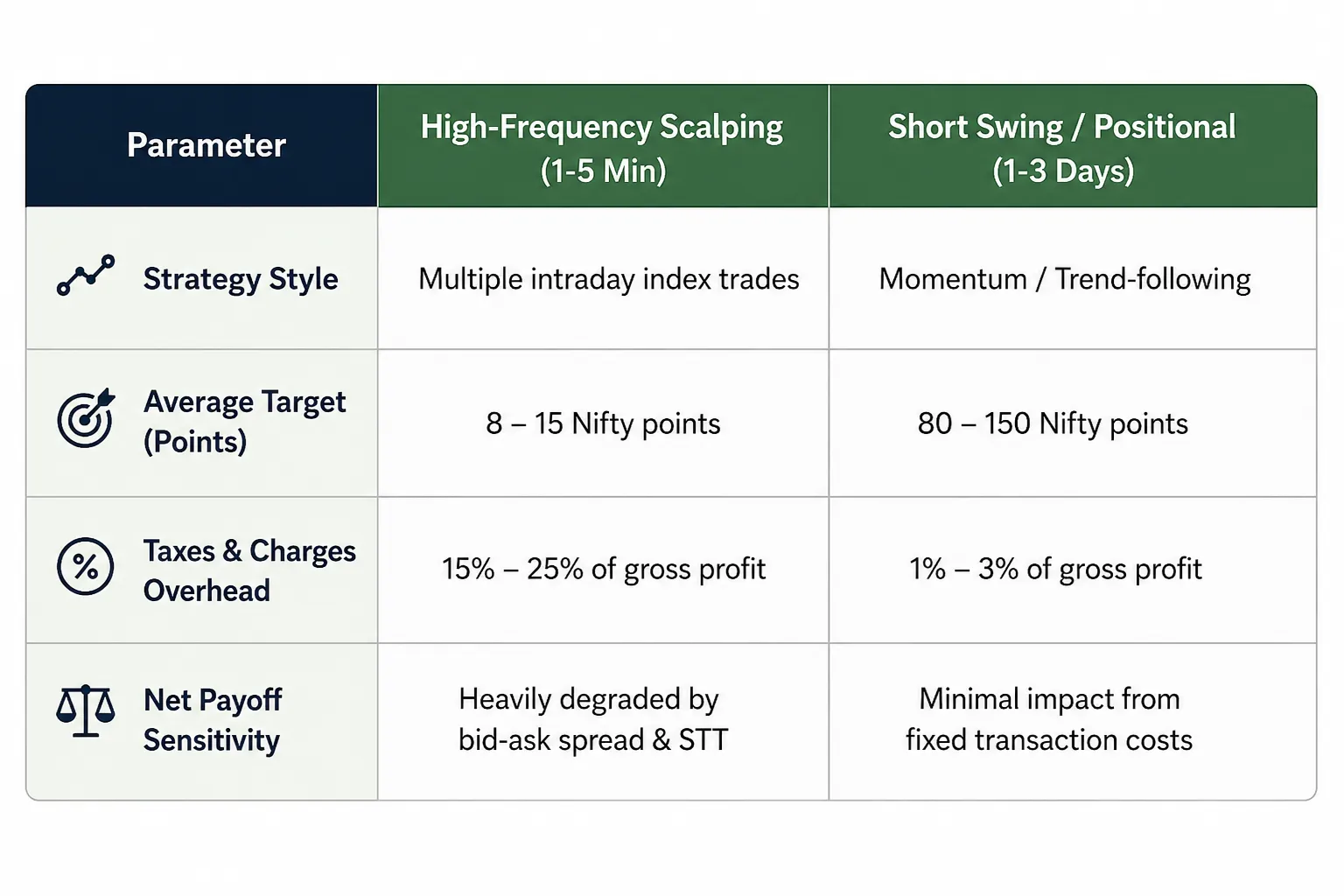
For scalpers and automated high-frequency option traders capturing micro-movements, transaction fees eat up a large portion of net profits. Every tick missed or lost to slippage compounds the drag imposed by STT.
The Strategic Shift
When fixed costs rise, expectancy per trade must increase to remain profitable. As a result, capital is naturally moving away from low-conviction, high-frequency scalping toward higher-timeframe setups where the risk-to-reward ratio comfortably absorbs trading friction.
2. The Cash-Collateral Dilemma: Managing the SEBI 50:50 Margin rule Requirement
Under SEBI’s 50:50 margin framework, at least 50% of the total margin required for an F&O position must be backed by cash or cash equivalents. The remaining 50% can be funded using non-cash collateral, such as pledged equity shares.
Total F&O Margin Required
├── Minimum 50%: Cash / Cash Equivalents (Liquid Funds, Overnight Funds, T-Bills)
└── Maximum 50%: Non-Cash Collateral (Pledged Stocks/ETFs after haircut)
If a trader maintains 100% of their margin in pledged equity and 0% in cash, brokers automatically charge margin shortfall interest (often 15% to 18% per annum) on the uncollateralized cash component, severely eroding returns.
Evaluating Cash-Equivalent Debt Instruments
- Treasury Bills (T-Bills) & Sovereign Gold Bonds (SGBs): Beyond liquid ETFs and overnight funds, T-Bills offer high-safety cash-equivalent collateral with low haircut percentages. SGBs can also serve as effective long-term non-cash collateral while earning a fixed interest yield, optimizing total capital efficiency without diluting equity exposure.
- Defined-Risk Spread Margin Benefits: Utilizing defined-risk strategies (e.g., bull call spreads, iron condors) over naked options or futures positions significantly reduces gross margin requirements, helping traders remain strictly compliant with the 50:50 cash-to-collateral split.
Leaving raw cash idle in a trading account carries an opportunity cost. To maintain liquidity without sacrificing returns, traders are actively using cash-equivalent debt instruments approved by clearing corporations:
- Liquid ETFs & Liquid Mutual Funds:
- Haircut: Very low (typically 10%).
- Yield: Accrues market-linked returns (around 6%–7% annualized) directly into NAV or as growth.
- Collateral Treatment: Counts 100% toward the cash component of the 50:50 rule.
- Overnight Funds & Treasury Bills (T-Bills):
- Haircut: Minimal (typically 3%–5%).
- Risk Profile: Virtually zero credit risk.
- Collateral Treatment: Qualifies as cash-equivalent margin while earning sovereign or low-risk yields.
- Pledged Equity Shares:
- Haircut: Moderate to high (15% to 45% based on volatility and liquidity).
- Collateral Treatment: Counts only toward the non-cash 50% component.
Capital Allocation Matrix Example
For a portfolio requiring ₹10,000,000 in active margin:
- Sub-Optimal Allocation: ₹10,000,000 in pledged stocks + ₹0 cash.
- Result: High broker debit interest penalty on ₹5,000,000 cash shortfall.
- Optimal Allocation: ₹5,000,000 in pledged equity + ₹5,000,000 in liquid ETFs/funds.
- Result: Zero shortfall interest, full compliance with the 50:50 rule, and an additional yield generated on the liquid fund component.
3. Swing Trading vs. F&O: The Migration to Cash Market Momentum
Because the margin requirements for derivatives now match or exceed cash delivery margin requirements without the drag of time decay (theta) or elevated STT, traders are increasingly moving capital back to cash market swing trading.
Why Cash Momentum is Gaining Traction
- Zero Time Decay Risk: Options buyers constantly fight time decay. Cash market positions allow traders to hold high-conviction breakout stocks through multi-week consolidation phases without theta loss.
- Superior Capital Efficiency: Cash swing trades do not trigger the 50:50 cash-to-collateral rule or intraday peak margin snapshot penalties.
- Favourable Risk-to-Reward Ratio: Cash market momentum setups allow traders to set clear stop-losses based on price structure (e.g., prior swing lows or moving averages) without worrying about implied volatility (IV) crush or contract expiration.
Core Screening Framework for Cash Swing Trades
To build a robust cash-market swing trading workflow, filter for stocks meeting three primary technical and fundamental conditions:
- Relative Strength (RS): Outperformance compared to the broader market index (e.g., Nifty 50 or Nifty 500) over a 20-to-50-day window.
- Delivery Volume Expansion: A clear spike in delivery volume accompanying price breakouts, signalling institutional accumulation rather than purely speculative turnover.
- Tight Consolidation (VCP): Narrowing price ranges near multi-month resistance levels, offering low-risk entry points with clear structural stop-losses.
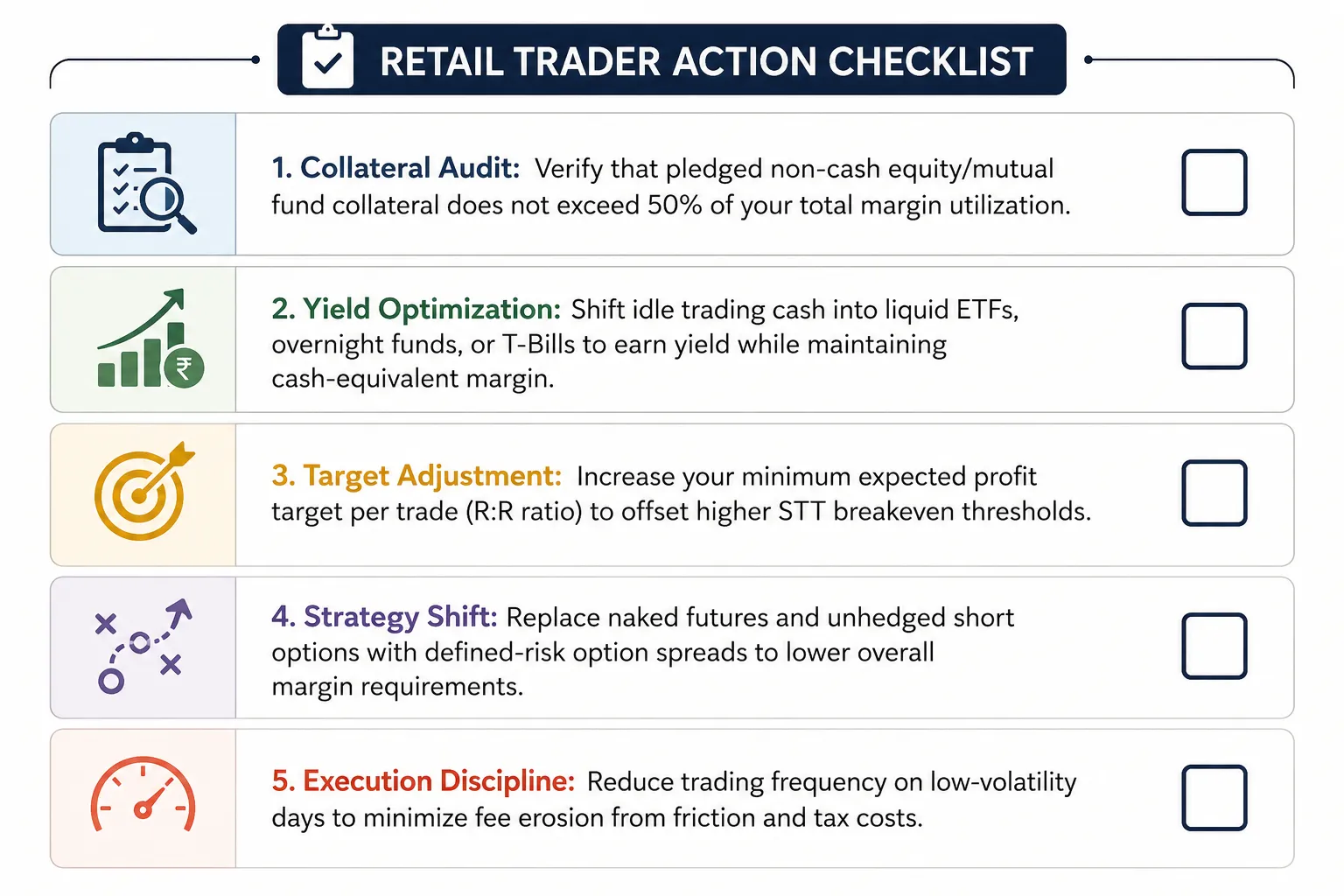
4. Retail Trader Action Checklist
Use this quick reference checklist to audit and adjust your trading operations under the current regulatory framework:
Strategic Summary for Traders
- Audit Friction Costs: Review your trading ledger over the last quarter to calculate the percentage of gross profits lost to STT and charges. Shift toward higher-timeframe trades if transaction costs exceed 10% of total profits.
- Optimize Idle Cash: Park cash margins in low-haircut liquid mutual funds or overnight instruments to meet the 50% cash requirement while earning base returns.
- Diversify into Cash Momentum: Allocate a portion of your capital to cash market swing strategies to trade clean breakouts without expiration pressures or derivative margin penalties.
Conclusion: Adapting to the New Reality
The convergence of higher STT rates and strict 50:50 cash-to-collateral margin requirements marks a fundamental shift in the Indian retail trading landscape. While these regulatory updates increase execution friction for short-term scalpers and high-frequency traders, they also enforce healthier risk management practices.
Success in this environment no longer depends solely on directional accuracy; it requires capital discipline and cost efficiency. By migrating toward defined-risk options strategies, optimizing cash collateral using high-yield instruments like T-Bills, and incorporating cash market swing trading, retail traders can effectively insulate their portfolios from friction erosion and build a sustainable trading edge.
Disclaimer: This article is for educational and informational purposes only and should not be construed as financial or investment advice. Trading in securities and derivatives involves substantial risk of loss. Readers are advised to consult a qualified financial advisor before making any investment decisions.
Frequently Asked Questions
What is the 50:50 cash-to-collateral framework in Indian derivatives trading?
The 50:50 cash-to-collateral framework requires traders to back at least 50% of their total margin for futures and options positions with cash or cash equivalents. The remaining 50% can be funded through non-cash collateral, like pledged equity shares. This shift aims to enhance capital efficiency and reduce leverage risks for retail traders.
How have recent STT hikes affected retail trading strategies?
Recent hikes in Securities Transaction Tax (STT) have significantly increased trading costs for retail participants, especially for high-frequency and scalping strategies. With higher STT rates, traders must adjust their strategies to ensure that potential profits can cover these increased costs, often leading to a shift towards longer-term trading approaches.
What are some effective cash-equivalent instruments for meeting margin requirements?
Traders can utilize several cash-equivalent instruments to meet the 50% cash requirement, including Treasury Bills (T-Bills), Liquid Mutual Funds, and Sovereign Gold Bonds (SGBs). These instruments offer low haircuts and can generate returns, allowing traders to maintain liquidity while adhering to margin regulations.
Why is swing trading gaining popularity over derivatives trading?
Swing trading is becoming more popular due to its lower margin requirements and lack of time decay risk associated with cash market positions. Traders can hold onto high-conviction stocks without the pressure of expiration or elevated margin penalties, making swing trading an attractive option in the current regulatory landscape.
How can I optimize my trading operations under the new regulatory framework?
To optimize trading operations, consider auditing your trading costs to understand the impact of STT and transaction fees, park idle cash in low-haircut instruments to meet margin requirements, and diversify into cash market swing trades. This approach can enhance capital efficiency and reduce friction in trading.
What are defined-risk strategies, and how do they help with margin requirements?
Defined-risk strategies, such as bull call spreads or iron condors, limit the potential loss and reduce overall margin requirements compared to naked options or futures positions. By utilizing these strategies, traders can more easily comply with the 50:50 cash-to-collateral rule while managing their risk effectively.
What should I consider when evaluating my trading strategies post-STT hikes?
Post-STT hikes, it's crucial to evaluate the profitability of your trading strategies by factoring in increased friction costs. Assess whether transaction costs exceed 10% of total profits and consider shifting towards higher-timeframe trades or strategies that can better absorb these new costs.






























Sign in to leave a comment.