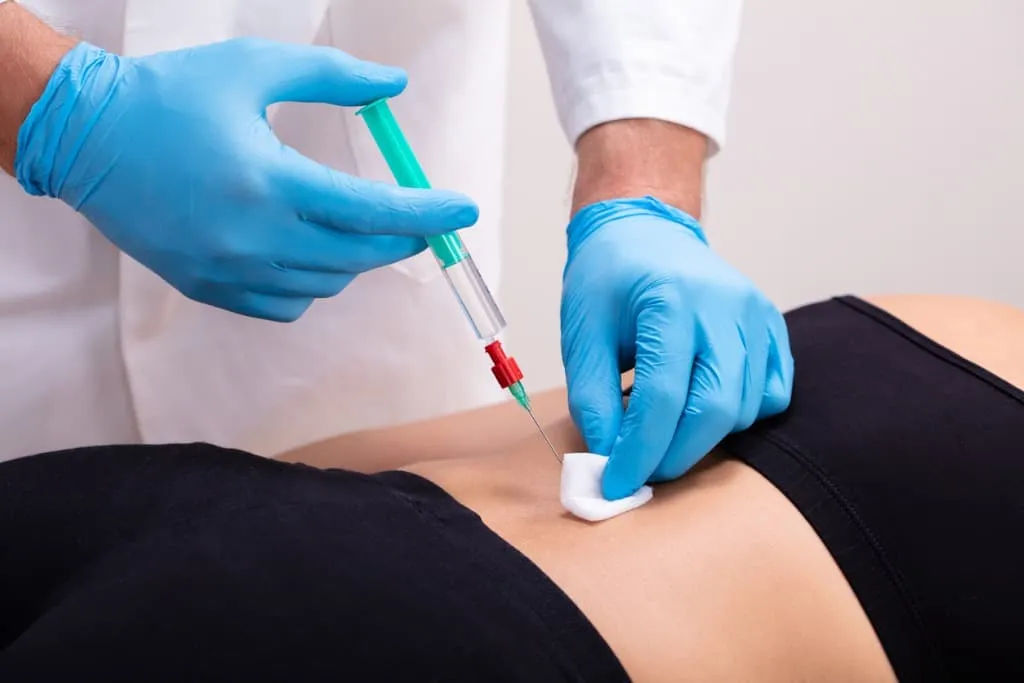

Living with lumbar spinal stenosis — a narrowing of the spinal canal in the lower back — can make even a short walk feel like an ordeal. The leg pain, heaviness, and numbness that come with this condition often leave patients wondering whether surgery is the only answer. It is not. At RAD Clinics, we specialise in evidence-based, non-surgical Spinal Stenosis Treatment, combining expert clinical assessment with ultrasound-guided injection therapy — all in a single appointment, without the NHS waiting list. If you are struggling with back pain or leg symptoms, book your assessment today.
What Is Lumbar Spinal Stenosis and Why Does It Cause Leg Pain?
Lumbar spinal stenosis describes a narrowing of the spinal canal in the lower back, most commonly at the L3–L5 vertebral levels. As the canal narrows, it places pressure on the spinal nerve roots that travel down into the legs.
This narrowing typically develops gradually through degenerative changes associated with ageing: bone spurs (osteophytes), thickening of the ligamentum flavum, facet joint arthritis, and herniated intervertebral discs can all reduce the space available for the nerve roots. There are two main subtypes: central canal stenosis, where the main spinal canal is narrowed, and foraminal (lateral recess) stenosis, where the openings through which individual nerve roots exit are compressed. Both can produce significant symptoms. Lumbar spinal stenosis predominantly affects adults over 50, and while it is related to natural spinal ageing, its impact on quality of life can be profound.
What Is Neuroclaudication and How Is It Different from Other Back Pain?
One of the hallmark features of lumbar spinal stenosis is a symptom pattern known as neuroclaudication — also called pseudoclaudication. Unlike straightforward lower back pain, neuroclaudication presents as aching, cramping, heaviness, or numbness in the legs that comes on with walking or prolonged standing, and is characteristically relieved by sitting down or leaning forward.
Common signs of neuroclaudication include:
- Bilateral leg pain or weakness that worsens with walking
- Relief when bending forward, such as leaning on a shopping trolley
- No pain at rest or when seated
- A progressive reduction in the distance you can walk before symptoms appear
It is important to distinguish neuroclaudication from vascular claudication, which is caused by poor arterial circulation (peripheral artery disease) rather than nerve compression, and requires a different treatment pathway. Where symptoms include bladder or bowel dysfunction, this may indicate cauda equina syndrome — a medical emergency requiring immediate attention.
Can Spinal Stenosis Be Cured, or Can Symptoms Be Managed Long-Term?
This is one of the most common questions our clinicians hear. The honest answer is that lumbar spinal stenosis cannot be structurally reversed without surgery — the degenerative changes to bones and ligaments do not simply resolve on their own. However, the symptoms, including neuroclaudication and associated spinal stenosis relief of pain, can be very effectively managed non-surgically, often for many years.
Many patients with confirmed stenosis remain stable for extended periods with appropriate treatment. NICE and wider clinical guidance support a stepwise approach: conservative, non-surgical management should be the first-line pathway before surgery is considered. Surgical options such as laminectomy or spinal decompression carry real risks, require significant recovery time, and are simply not necessary for a large proportion of patients.
With the right combination of injection therapy, physiotherapy, and lifestyle adjustment, many people regain meaningful function and a greatly improved quality of life — without ever needing an operation.
What Are the Non-Surgical Treatment Options for Spinal Stenosis?
1. Steroid Injections for Lumbar Spinal Stenosis
Steroid injections are among the most effective non-surgical treatments available for lumbar spinal stenosis. A corticosteroid is delivered directly into the area surrounding the compressed nerve roots, where it reduces inflammation and provides significant spinal stenosis relief from pain.
At RAD Clinics, we use real-time ultrasound guidance to ensure precise needle placement. Our clinicians are trained in both interlaminar and transforaminal (nerve root) approaches, selecting the technique most appropriate for each patient's anatomy and symptom pattern. The result is meaningful pain reduction, improved mobility, and — critically — the ability to engage effectively with physiotherapy. Relief typically lasts several weeks to months, and repeat injections can be considered within clinical guidelines.
2. Facet Joint Injections
Arthritic facet joints are a common contributor to lumbar spinal stenosis, as their enlargement can narrow both the spinal canal and the foramina through which nerve roots exit. Facet joint steroid injections reduce local inflammation in these degenerated joints, alleviating axial back pain and, where relevant, radicular leg symptoms. Ultrasound guidance at RAD Clinics ensures accurate, safe delivery to the target joint.
3. Nerve Root (Foraminal) Injections
For patients with foraminal or lateral recess stenosis causing unilateral leg pain, a targeted nerve root injection can provide highly specific relief. Corticosteroid is delivered precisely around the affected nerve root under real-time ultrasound visualisation, making this an especially effective option where symptoms are localised to one side.
4. Physiotherapy and Guided Exercise
Physiotherapy plays a central role in the long-term non-surgical management of lumbar spinal stenosis. Core strengthening, lumbar flexion exercises — which help open the spinal canal — and postural retraining can all reduce symptom burden and slow progression. Injection therapy at RAD Clinics frequently creates a window of pain relief that enables patients to engage meaningfully with physiotherapy for the first time. RAD Clinics' physiotherapy services are covered by many private insurers.
5. Activity Modification and Pain Management
Alongside injection therapy and physiotherapy, practical lifestyle adjustments play a supportive role. Pacing activities, using walking aids, and participating in aquatic exercise — which reduces mechanical load on the lumbar spine — can all help manage symptoms day to day. Short-term use of anti-inflammatory medication (NSAIDs) may provide additional relief, and weight management to reduce spinal loading is often beneficial. These measures work best as part of a wider treatment plan rather than as standalone solutions.
Why Does Ultrasound Guidance Make Injections for Spinal Stenosis Safer and More Effective?
Non-guided ("blind") injections rely on external anatomical landmarks to estimate needle placement, which carries a higher risk of misplacement and reduced clinical efficacy. Ultrasound guidance transforms this: the clinician can visualise the needle, the surrounding soft tissues, and the target structure in real time, adjusting placement dynamically for maximum precision.
Unlike fluoroscopy (X-ray guidance), ultrasound involves no ionising radiation — an important consideration for patients who may require repeat procedures. RAD Clinics performs over 3,000 ultrasound-guided procedures annually. Our specialists bring both NHS and private hospital experience to every consultation, and our one-stop model means assessment, imaging, and treatment can all take place on the same day. We serve patients across Northampton, Milton Keynes, and the surrounding areas — including Wellingborough, Kettering, Rushden, Daventry, Corby, Leicester, Coventry, and Rugby.
Am I Suitable for Non-Surgical Spinal Stenosis Treatment at RAD Clinics?
Good candidates for injection therapy include adults with confirmed or suspected lumbar spinal stenosis who are experiencing neuroclaudication, leg pain, or back pain that is not adequately controlled by rest or over-the-counter medication. Treatment is particularly appropriate where pain is limiting daily activities, where physiotherapy or medication has not provided sufficient relief, or where the patient wishes to avoid or delay surgery.
Red flags — including cauda equina syndrome, rapidly progressive neurological deficit, or signs of cord compression — require urgent onward referral, and our clinicians are trained to identify and act on these promptly. Every patient at RAD Clinics undergoes a thorough same-day assessment before any treatment decision is made.
What Happens During a Spinal Stenosis Injection Appointment at RAD Clinics?
Our one-stop model is designed to eliminate uncertainty and unnecessary delays:
- Consultation — A detailed clinical history and symptom assessment, including review of any existing MRI or X-ray imaging
- Ultrasound assessment — Real-time imaging of the spine and relevant surrounding structures
- Diagnosis confirmation — Your clinician explains their findings immediately; no waiting for a separate appointment
- Injection procedure — Following skin preparation and local anaesthetic, the corticosteroid is delivered under ultrasound guidance; the procedure typically takes around 30 minutes
- Post-procedure monitoring — A brief period of observation; most patients return to light activities within 24–48 hours
Spinal injection procedures at RAD Clinics are available from £550, with the consultation, injection, and written report included. We operate on a self-pay basis for injections — clear, transparent pricing with no hidden costs.
Frequently Asked Questions About Spinal Stenosis Treatment
| FAQs | Answers |
|---|---|
| Can spinal stenosis be cured without surgery? | Lumbar spinal stenosis cannot be structurally reversed without surgery, but non-surgical treatments — particularly ultrasound-guided injection therapy — can provide significant and lasting spinal stenosis relief of pain, allowing many patients to avoid or delay an operation. |
| What is neuroclaudication? | Neuroclaudication is the hallmark symptom of lumbar spinal stenosis: aching, cramping, or heaviness in the legs that comes on with walking or standing and is relieved by sitting or leaning forward. It results from pressure on spinal nerve roots within the narrowed canal. |
| What is the best non-surgical treatment for lumbar spinal stenosis? | Evidence supports epidural steroid injections — especially when ultrasound-guided — as an effective first-line non-surgical treatment for lumbar spinal stenosis. They reduce nerve root inflammation, relieve neuroclaudication, and enable patients to engage with physiotherapy. |
| How long do spinal injections last for spinal stenosis? | The duration of relief varies between individuals. Many patients experience meaningful improvement for several weeks to months. Repeat injections are possible within clinical guidelines and can be discussed with your clinician at RAD Clinics. |
| Is there a long wait for spinal stenosis injections at RAD Clinics? | RAD Clinics operates on a one-stop model: assessment, ultrasound imaging, and injection therapy can take place in a single consultation, avoiding lengthy NHS waiting lists. Clinics are located in Northampton and Milton Keynes. |
| Do I need a referral to see RAD Clinics for spinal stenosis treatment? | No GP referral is required. Patients can self-refer directly to RAD Clinics for a consultation and, where appropriate, same-day spinal injection therapy. |
Start Your Spinal Stenosis Treatment Journey with RAD Clinics
Living with lumbar spinal stenosis and neuroclaudication does not have to mean accepting a life limited by pain. At RAD Clinics, our one-stop approach brings together ultrasound-guided precision, NHS-trained specialists, and over 3,000 procedures annually — across our clinics in Northampton and Milton Keynes.
Whether you are searching for spinal stenosis treatment in Northampton, a spinal injection clinic in Milton Keynes, or lumbar spinal stenosis expertise, our team is ready to help you take the next step.



























Sign in to leave a comment.