

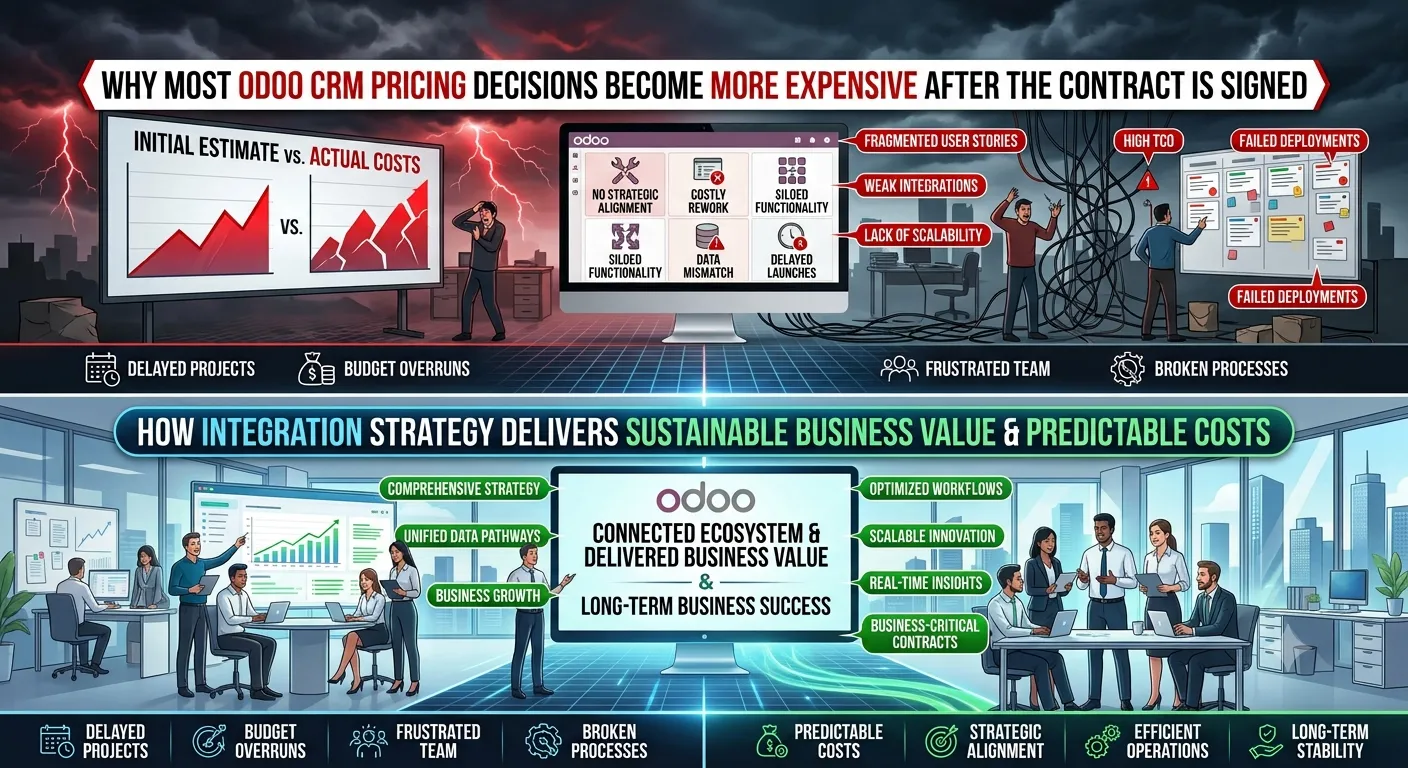
For many growing businesses, Odoo CRM Pricing appears simple at first glance. You compare subscription plans, request a few implementation estimates, and assume the lowest proposal offers the best value. Unfortunately, many CTOs, founders, and operations leaders discover later that the initial quote covered only a fraction of the actual project. Costs associated with integrations, data migration, custom workflows, user training, and post-deployment support often emerge once implementation is underway.
Understanding how Odoo CRM Pricing impacts long-term ERP investment is essential before selecting an implementation partner. The real investment extends far beyond software licensing. It includes the effort required to align the CRM with your business processes, connect existing systems, and prepare the platform for future growth. Businesses that evaluate Odoo CRM Pricing through this broader lens are better positioned to avoid budget surprises, accelerate user adoption, and achieve stronger returns from their ERP initiatives.
The reality is simple. The cheapest proposal rarely represents the lowest total cost of ownership. The organizations that make informed pricing decisions are the ones that treat CRM implementation as a business transformation initiative rather than a software purchase.
Why Odoo CRM Pricing Becomes Difficult to Predict
Odoo CRM Pricing depends on much more than the number of users or the edition you choose. While licensing is transparent, implementation costs vary based on business complexity, customization requirements, and the maturity of existing business processes.
Many organizations make the mistake of requesting implementation quotations before documenting their operational requirements. As a result, vendors estimate based on assumptions instead of clearly defined workflows, leading to revisions once the project begins.
Industry research highlights why this continues to happen. According to McKinsey & Company, around 70% of digital transformation initiatives fail to achieve their intended objectives, with unclear business requirements and organizational challenges being among the leading contributors. ERP and CRM initiatives are no exception, as unclear scope frequently translates into higher implementation costs and extended project timelines.
Similarly, Gartner projects that by 2027, more than 70% of recently implemented ERP initiatives will fail to fully meet their original business goals because organizations underestimate implementation complexity and focus primarily on technology rather than business outcomes.
The pricing conversation therefore extends beyond software subscriptions. A realistic estimate should account for several interconnected components:
- Business process discovery and requirement analysis
- Odoo Enterprise licensing
- CRM configuration and workflow design
- Custom feature development
- Third-party integrations
- Legacy data migration
- User training and change management
- Ongoing optimization and support
Ignoring any of these factors can significantly alter Odoo CRM Pricing during implementation.
Another overlooked factor is operational maturity. Two companies with similar team sizes can receive vastly different estimates because their internal processes differ. One organization may require only lead management and sales pipeline tracking, while another may need marketing automation, customer portals, accounting synchronization, inventory visibility, approval workflows, and reporting dashboards.
The software platform remains the same.
The implementation effort does not.
That distinction explains why experienced implementation partners spend considerable time understanding business operations before discussing Odoo CRM Pricing.
A Practical Framework for Evaluating Odoo CRM Pricing Beyond License Costs
Businesses that achieve successful ERP outcomes rarely begin with vendor comparisons. They begin by identifying operational inefficiencies, mapping future workflows, and evaluating how technology should support long-term growth. This approach produces more accurate implementation estimates and reduces costly project revisions.
Define Business Objectives Before Comparing Odoo CRM Pricing
The first question should not be:
"How much does Odoo cost?"
Instead, decision-makers should ask:
"Which operational problems are we trying to solve?"
This distinction changes the entire pricing conversation.
For example, an organization looking to centralize customer information and manage sales opportunities has very different implementation requirements from one planning to automate approvals, integrate accounting software, synchronize inventory, and create executive dashboards.
Each additional workflow directly influences Odoo CRM Pricing, not because the software changes, but because implementation effort increases.
Before requesting proposals, organizations should document:
- Existing business processes
- Current software ecosystem
- Manual activities that need automation
- Required third-party integrations
- Reporting expectations
- Future scalability requirements
This information enables implementation partners to provide estimates based on measurable business needs rather than assumptions.
Businesses that skip this discovery phase often receive attractive initial quotations but experience continuous scope revisions as implementation progresses. Those revisions eventually increase both project timelines and overall investment.
The next step is understanding how implementation methodology, customization strategy, and long-term maintenance influence the overall cost of ownership, which is where many ERP projects either remain within budget or exceed expectations.
Evaluate Customization Against Long-Term Maintainability
Every customization should solve a measurable business problem. While Odoo's modular architecture allows extensive flexibility, excessive customization can increase implementation costs, extend deployment timelines, and make future upgrades more complex.
According to IDC, organizations that standardize business processes before implementing enterprise applications are significantly more likely to achieve faster deployment timelines and lower operational costs than those that rely heavily on custom development. The common pattern is simple: configuration should always be the first choice, with customization reserved for capabilities that directly support competitive advantage.
When evaluating Odoo CRM Pricing, decision-makers should classify every requested feature into three categories:
- Standard Odoo functionality
- Configurable workflows
- Custom development
This exercise helps identify where investment delivers measurable value and where standard capabilities are sufficient. It also creates greater transparency during project estimation, reducing the likelihood of unexpected costs later in the implementation.
Balance Immediate Budget Against Future Scalability
A lower implementation quote is attractive only if the solution can support future business growth without requiring another major investment.
This is where Odoo CRM Pricing should be evaluated as a long-term operational investment rather than a one-time software expense.
Questions worth asking include:
- Will additional users require significant reconfiguration?
- Can new business units be added easily?
- How difficult will future integrations become?
- Will upgrades require rebuilding custom modules?
- Does the proposed architecture support expansion into new markets?
The answers to these questions often determine whether today's savings become tomorrow's technical debt.
Organizations that prioritize scalability during implementation typically spend less on future enhancements because their CRM foundation is designed to accommodate growth instead of reacting to it.
What We Learned from a Real Implementation
In one of our Odoo CRM Pricing consulting engagements, a fast-growing B2B distribution company approached Oodles after receiving multiple implementation quotations that varied by more than 45%. Every proposal appeared technically correct, yet none explained why the estimates differed so dramatically.
Our discovery team spent two weeks mapping existing sales operations, approval workflows, customer lifecycle stages, and reporting requirements before proposing a phased implementation roadmap.
Instead of recommending extensive customization from the beginning, we identified several business requirements that could be achieved through native Odoo configuration. Custom development was reserved only for specialized approval workflows and integrations with the client's legacy inventory system.
As a result, the implementation scope became substantially clearer before development started.
The project delivered:
- Approximately 30% lower implementation effort compared to the client's initial estimated scope
- 40% faster lead processing through automated sales workflows
- More than 80% reduction in manual CRM data duplication
- Executive dashboards that reduced reporting preparation from several hours to a few minutes
This experience reinforced an important lesson. Predictable Odoo CRM Pricing begins with accurate business discovery rather than aggressive price negotiation.
Businesses evaluating enterprise software should focus on implementation quality, governance, and long-term maintainability instead of selecting a partner based solely on the lowest quotation.
To learn more about Odoo implementation strategies and enterprise ERP solutions, explore Oodles.
Key Takeaways
- Odoo CRM Pricing should be evaluated based on total cost of ownership rather than subscription fees alone.
- Business process discovery is one of the strongest predictors of implementation accuracy and budget stability.
- Standard configuration often delivers greater long-term value than unnecessary custom development.
- Scalability should be considered during implementation planning instead of after deployment.
- Transparent project scoping reduces change requests, implementation delays, and overall project risk.
- Organizations that align pricing with operational objectives achieve stronger adoption and faster returns.
Conclusion
Choosing the right implementation partner is ultimately more important than choosing the lowest quotation. Odoo CRM Pricing becomes predictable when organizations define business objectives, document operational requirements, and evaluate proposals based on long-term value instead of short-term savings. A structured implementation approach not only controls costs but also creates a CRM platform that continues delivering value as the business grows.
If you're planning an implementation or comparing vendors, connect with our specialists to discuss Odoo CRM Pricing and determine the approach that best aligns with your business objectives.
Frequently Asked Questions
Q1. What factors influence Odoo CRM Pricing the most?
A. Odoo CRM Pricing is influenced by licensing, implementation scope, business process complexity, integrations, custom development, data migration, user training, and ongoing support. Implementation requirements typically have a greater impact on total investment than software subscription costs.
Q2. Is Odoo CRM cheaper than Salesforce or Microsoft Dynamics?
A. In many scenarios, Odoo offers a lower entry cost because of its modular licensing model. However, the total cost depends on implementation complexity, customization requirements, and long-term maintenance rather than licensing alone.
Q3. How can businesses reduce CRM implementation costs?
A. Organizations can reduce costs by documenting business requirements early, minimizing unnecessary customization, adopting phased implementation, and selecting experienced implementation partners who prioritize business process alignment.
Q4. Why do implementation quotations vary between vendors?
A. Different vendors estimate projects based on varying assumptions regarding customization, integrations, implementation methodology, project governance, and support services. A detailed discovery phase usually produces more consistent and accurate estimates.
Q5. How should businesses compare Odoo CRM implementation proposals?
A. Decision-makers should compare project scope, implementation methodology, customization strategy, support model, scalability, and total ownership cost instead of evaluating proposals solely on the quoted implementation price.























Sign in to leave a comment.