
Introduction
An oil change is a routine maintenance service, but remembering when the next service is due is not always routine for vehicle owners. That is where oil change stickers provide a simple and visible solution.
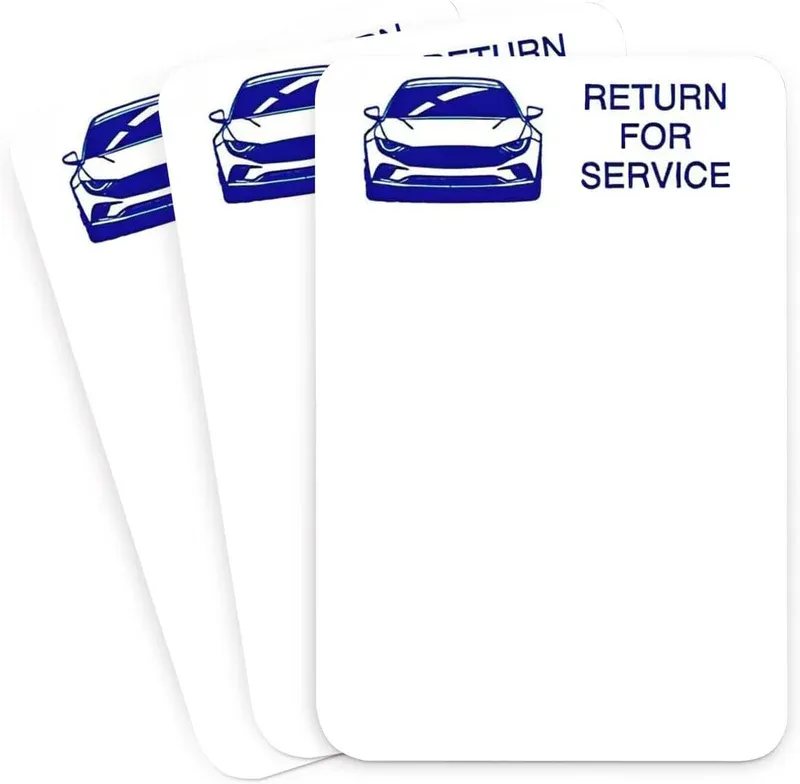
An oil change sticker is a small service reminder label placed inside or around a vehicle, usually on the windshield. It records information such as the date of the last oil change, current mileage, recommended next service mileage, or a suggested service date. For dealerships, automotive repair shops, quick-lube centers, and service departments, these labels connect a completed maintenance visit with the customer's next maintenance decision.
The value goes beyond reminding someone to change engine oil. A well-designed service reminder can support preventive maintenance, improve communication between technicians and customers, and create another opportunity for a dealership or repair shop to bring customers back.
For businesses that regularly handle vehicle maintenance, the right automotive dealership supplies can make routine service processes more consistent and professional.
What Are Oil Change Stickers?
Oil change stickers are service reminder labels used to record and communicate when a vehicle's next oil service or maintenance appointment should occur.
They are commonly attached to the inside of the windshield where the driver can see them without interfering with normal driving visibility.
Depending on the design, an oil change sticker may include:
- Date of the completed oil service
- Vehicle mileage at the time of service
- Recommended next service mileage
- Recommended next service date
- Oil grade or viscosity
- Service center name
- Dealership or repair shop phone number
- Customer service information
- Technician or service department notes
The sticker acts as a physical reminder that stays with the vehicle after the repair order has been closed.
Unlike a digital maintenance notification that can be ignored or buried in an inbox, a windshield reminder remains visible during everyday vehicle use.
Why Service Reminder Stickers Matter
They turn maintenance information into a visible reminder
Vehicle maintenance depends partly on timing. Engine oil, filters, fluids, tires, brakes, and other components need attention according to the vehicle manufacturer's maintenance schedule and the vehicle's actual operating conditions.
A customer may leave a service department satisfied with the completed repair but forget when the next visit should happen.
A windshield reminder provides a simple reference point.
For example:
Next Oil Service: 45,000 Miles
Recommended By: October 2026
The customer does not need to search through an invoice or remember what a technician said several months earlier.
They support preventive maintenance
Preventive maintenance is based on servicing a vehicle before a minor maintenance need becomes a larger problem.
Oil service is one part of that process. Regular maintenance can also involve:
- Oil and filter replacement
- Tire inspection
- Brake inspection
- Fluid checks
- Battery inspection
- Air filter replacement
- Wiper inspection
- Manufacturer-recommended services
Oil change windshield stickers can therefore become part of a broader maintenance communication system rather than functioning only as advertising.
They keep service information connected to the vehicle
Paperwork can be misplaced. Digital records can be difficult for customers to access quickly. A windshield label stays physically associated with the vehicle.
This makes oil service labels particularly useful when a customer has multiple vehicles or does not regularly use a dealership's mobile app or online service portal.
How Oil Change Stickers Work in a Service Department
A service reminder system usually begins when a vehicle arrives for maintenance.
The technician or service advisor records the vehicle's current mileage and the maintenance performed. After the oil and filter service is completed, the next recommended service point is determined according to the applicable maintenance schedule and service recommendations.
The reminder information can then be written or printed on an oil change sticker.
A simple workflow looks like this:
- Vehicle arrives for scheduled maintenance.
- Service advisor verifies vehicle information and mileage.
- Technician performs the approved oil service.
- Repair order documents the work completed.
- Next maintenance point is determined.
- Oil change sticker is completed.
- Sticker is positioned appropriately inside the vehicle.
- Customer receives the vehicle and understands the next service recommendation.
This creates a connection between the repair order, vehicle maintenance history, and next service reminder.
Oil Change Stickers vs. Oil Change Decals
The terms oil change stickers, oil change decals, and oil change windshield stickers are often used interchangeably, but businesses may use different formats depending on the application.
| Type | Typical Use | Main Advantage |
|---|---|---|
| Paper oil change sticker | Short-term service reminders | Low cost and easy to write |
| Static cling sticker | Windshield reminders | Easy application and removal |
| Adhesive oil change decal | Long-lasting labeling | Stronger attachment |
| Custom oil change sticker | Branded dealership or shop reminders | Combines service information with branding |
| Printed maintenance label | High-volume service departments | Consistent professional appearance |
| Digital/printed service reminder | Organized service operations | Faster and more standardized documentation |
The best format depends on how long the reminder needs to remain in place, the windshield surface, the shop's workflow, and whether branding is important.
Where Should Oil Change Stickers Be Placed?
Oil change stickers for windshield use are normally positioned inside the vehicle where the driver can easily see the information.
The exact placement should avoid obstructing the driver's field of vision or interfering with legally required vehicle markings, inspection information, sensors, or other windshield equipment.
A practical location should satisfy three requirements:
Visibility
The customer should be able to find the reminder quickly.
Safety
The label should not obstruct the driver's view or interfere with vehicle operation.
Removability
When the vehicle returns for another service, staff should be able to update or replace the reminder without creating unnecessary cleanup.
Static cling oil change stickers can be useful where easy removal and replacement are priorities.
What Information Should an Oil Change Sticker Include?
A useful reminder label should answer one basic question:
When should this vehicle return for its next service?
A more complete label can provide additional context.
Essential information
At minimum, consider including:
- Current mileage
- Next recommended mileage
- Service date
- Next recommended service date
Helpful additional information
Depending on the sticker design and service process, businesses may also include:
- Dealership or repair shop name
- Phone number
- Website
- Oil type
- Oil viscosity
- Technician initials
- Service department identification
- Customer-facing maintenance notes
Avoid filling the label with unnecessary information. The most important data should remain easy to read.
How Custom Oil Change Stickers Can Support Customer Retention
A service department has an important advantage over a one-time retail transaction: vehicle maintenance creates recurring needs.
A customer who receives an oil change today may need another oil service later, followed by tire service, brake inspection, fluid maintenance, or other recommended work.
Custom oil change stickers can reinforce that relationship.
The sticker can display the dealership's name, service phone number, or other useful contact information. Every time the customer notices the reminder, the business name is also reinforced.
This creates a subtle connection:
Vehicle service → reminder → dealership recognition → future service opportunity
That does not guarantee a return visit, but it removes one barrier: the customer already has a physical reminder telling them where to start when maintenance is due.
For dealerships investing in broader operational organization, resources such as Car Dealer Key Tags can complement service reminder processes by helping staff identify and manage vehicles throughout the dealership.
Oil Change Stickers for Dealerships vs. Independent Repair Shops
Both dealerships and independent automotive repair shops can use service reminder labels, but their goals may differ.
Dealership service departments
Dealerships often have access to manufacturer-specific maintenance schedules and detailed customer vehicle histories.
Their stickers may focus on:
- Next recommended maintenance
- Dealership branding
- Service department contact information
- Customer retention
- Consistent service documentation
Independent repair shops
Independent shops may place greater emphasis on:
- Simple mileage tracking
- Service date
- Oil type
- Shop contact details
- Repeat customer visits
Fleet operations
Fleet managers may use vehicle maintenance stickers as one layer of a larger tracking system.
A fleet vehicle could have maintenance records stored digitally while the windshield label provides an immediate visual reminder to the driver or fleet coordinator.
This is particularly useful when several vehicles are operated by different employees.
Choosing Between Static Cling and Adhesive Oil Change Stickers
One of the most important buying decisions is how the label attaches to the vehicle.
Static cling
Static cling labels attach to glass without traditional permanent adhesive.
Advantages:
- Easy to remove
- Convenient for recurring service
- Less adhesive residue
- Good fit for windshield applications
They can be especially practical when a dealership expects the sticker to be replaced frequently.
Adhesive labels
Adhesive oil change window stickers use a bonding surface to stay attached.
Advantages:
- Stronger attachment
- Suitable when longer retention is needed
- Useful for certain non-glass surfaces
However, adhesive products may require more care during removal.
The choice should depend on the intended service cycle rather than simply selecting the strongest attachment available.
How to Choose the Right Oil Change Stickers
Before ordering, evaluate the actual workflow in your service department.
1. Determine the application
Are the labels going on windshields, service paperwork, vehicle files, or another surface?
For windshield applications, choose a product specifically designed for glass.
2. Consider replacement frequency
If the sticker is replaced every service visit, easy removal can be more important than maximum adhesion.
3. Check writing space
The label needs enough room for mileage, dates, and other required information without forcing technicians to use extremely small handwriting.
4. Consider customization
Custom oil change stickers may be worthwhile if branding and customer retention are important parts of your service strategy.
5. Think about service volume
A shop processing dozens or hundreds of vehicles each week needs a different purchasing strategy than a small independent garage.
High-volume operations should consider pack sizes, unit cost, storage requirements, and how quickly employees can complete each reminder.
6. Match the label to your workflow
The best oil change sticker is not necessarily the one with the most features. It is the one that technicians can complete accurately and consistently without slowing down the service lane.
Practical Tips for Using Oil Change Windshield Stickers
A good reminder system depends on consistent execution.
Use standardized information
Decide which fields employees must complete and use the same process for every vehicle.
Make mileage easy to read
Mileage is often one of the most useful pieces of information on a service reminder. Write it clearly and avoid cramped fields.
Verify the reminder before releasing the vehicle
A quick review can catch an incorrect mileage figure or date before the customer leaves.
Keep stickers and supplies near the service workflow
If labels are stored far from the service counter, employees may skip them when the department becomes busy.
Train employees on placement
Every technician or service advisor should understand where reminders should be placed and what areas of the windshield must remain unobstructed.
Replace damaged labels
A faded, torn, curled, or unreadable sticker no longer performs its primary function.
For dealerships that also need a reliable vehicle identification system, Plastic Key Tags for Car Dealerships provide another way to keep vehicle information organized during movement between sales, service, and other departments.
Common Mistakes to Avoid
Giving only a vague recommendation
"Come back for service soon" is less useful than a clear mileage or date-based reminder.
Using the wrong surface
A label designed for paper may not perform well on glass. Select products based on the intended application.
Overloading the sticker
The reminder should be quickly understandable. Too much information reduces readability.
Forgetting to update the reminder
A service sticker should represent the most recent maintenance event. Old information can create confusion.
Ignoring customer-specific conditions
Service intervals can depend on vehicle manufacturer recommendations, oil specifications, driving conditions, vehicle age, mileage, and other factors. A generic interval should not override the applicable maintenance schedule.
Treating the sticker as the complete maintenance record
An oil change sticker is a reminder, not a replacement for a proper repair order, invoice, digital service record, or maintenance history.
Expert Insight: The Sticker Is a Small Part of a Larger Service System
The most effective dealerships do not treat service reminder labels as isolated pieces of paper.
They connect them to a broader process involving:
Vehicle identification → inspection → repair order → completed maintenance → service documentation → customer communication → next service reminder
That relationship matters because every step supports the next one.
For example, vehicle identification systems help staff match a vehicle to its paperwork. Service documentation records what was completed. The windshield reminder communicates what comes next. The customer then has a simple physical cue for future action.
This is why seemingly inexpensive supplies can have operational value when they are integrated into a consistent workflow.
A broader overview of dealership operations and supply categories can be found in Auto Dealer Supplies: The Complete Guide for Car Dealerships.
A Simple Oil Change Reminder Workflow
A service department can establish a repeatable process using five checkpoints:
1. Identify the vehicle
Confirm stock number, VIN, customer information, and mileage.
2. Complete the service
Perform the approved oil and filter service according to the vehicle's applicable requirements.
3. Document the work
Record the completed maintenance in the repair order and applicable service history.
4. Prepare the reminder
Enter the current mileage and next recommended service information on the oil change sticker.
5. Confirm before delivery
Check the label for accuracy and place it appropriately inside the vehicle.
This process is simple enough for high-volume environments while still providing a clear audit trail through the dealership's formal records.
Comparing Common Oil Change Sticker Options
| Feature | Static Cling | Adhesive | Custom Printed |
| Easy removal | Excellent | Moderate | Depends on construction |
| Windshield use | Excellent | Good | Excellent when designed for glass |
| Branding | Limited to printed design | Available | Strong |
| Frequent replacement | Very suitable | Less convenient | Depends on format |
| Customer-facing appearance | Good | Good | Excellent |
| Best for | Recurring reminders | Longer-term labels | Dealership and shop branding |
There is no universally best format. The right choice depends on your service frequency, application surface, branding goals, and staff workflow.
For businesses that want to compare different automotive labeling and identification approaches, Plastic Key Tags for Auto Dealerships: The Complete Comparison Guide offers a useful example of how material and application should influence purchasing decisions.
Frequently Asked Questions About Oil Change Stickers
1. How long do oil change stickers last?
The lifespan depends on the material, printing method, windshield conditions, exposure, and how frequently the vehicle is serviced. In practice, many service reminder labels are replaced when the vehicle returns for its next maintenance visit.
2. Where should oil change stickers be placed?
They should generally be placed inside the vehicle on the windshield in a location that is visible to the driver but does not obstruct the driver's field of vision or interfere with required windshield equipment.
3. Are windshield oil change stickers removable?
Many windshield-specific stickers are designed to be removable. Static cling versions are particularly useful when a service department expects to replace the reminder regularly.
4. What information should an oil change sticker include?
The most useful information includes the service date, vehicle mileage at service, and recommended next service mileage or date. Businesses may also include oil information and contact details.
5. Are oil change decals only for dealerships?
No. Automotive repair shops, quick-lube businesses, fleet operators, service centers, and other organizations that maintain vehicles can use service reminder labels.
6. Do oil change stickers replace maintenance records?
No. A sticker is a visual reminder. It should not replace the repair order, invoice, digital service history, or other formal maintenance documentation.
7. Are custom oil change stickers worth buying?
They can be valuable for dealerships and repair shops that want consistent branding and a direct service contact point on every serviced vehicle. The benefit is strongest when the business relies on repeat maintenance visits.
8. Should the mileage on an oil change sticker match the vehicle's maintenance schedule?
The reminder should be based on the applicable vehicle manufacturer's recommendations and the service performed. Businesses should avoid using a generic mileage interval when the vehicle's specific requirements call for something different.
9. Can oil change stickers be used for services other than oil changes?
Yes. Similar service reminder labels can communicate tire rotations, inspections, brake checks, fluid services, or other maintenance recommendations, provided the information is clear and appropriate for the intended use.
Conclusion
Oil change stickers are simple vehicle service reminders, but they can play an important role in preventive maintenance and customer communication. By placing the next service information where the driver can easily see it, dealerships and repair shops give customers a practical reminder that remains with the vehicle.
The best approach is to choose a label based on its application, durability, attachment method, readability, customization options, and service workflow. Static cling formats can be useful for frequent windshield replacement, while other adhesive or custom formats may better suit specific operational requirements.
Most importantly, an oil change sticker should work as part of a larger maintenance process. Accurate vehicle identification, inspection, repair-order documentation, service completion, and customer communication all contribute to a reliable service experience.
When those pieces work together, a small windshield reminder becomes more than a sticker. It becomes a simple bridge between today's completed service and the customer's next maintenance decision.



























Sign in to leave a comment.