

Introduction
As industries accelerate toward digitalization, the convergence of IT and operational environments has fundamentally altered the cybersecurity landscape. The Operational Technology (OT) Security Market is emerging as a critical pillar in protecting industrial control systems, SCADA networks, and connected infrastructure from increasingly sophisticated cyber threats. Unlike traditional IT environments, OT systems prioritize availability and safety—making security breaches not just a data risk, but a potential physical hazard.
With cyberattacks targeting energy grids, manufacturing plants, and transportation networks becoming more frequent, organizations are rapidly shifting from reactive defenses to proactive OT cybersecurity strategies. This transition is redefining how enterprises invest in industrial cybersecurity solutions, driving sustained growth in the OT security ecosystem.
Market Overview
The global Operational Technology (OT) Security Market is currently estimated to be valued at approximately USD 20.8 billion in 2025, with projections indicating a compound annual growth rate (CAGR) of 14.8%. By the end of the forecast period, the market is expected to surpass USD 47.6 billion in 2031, fueled by regulatory pressures and increasing cyber-physical risks.
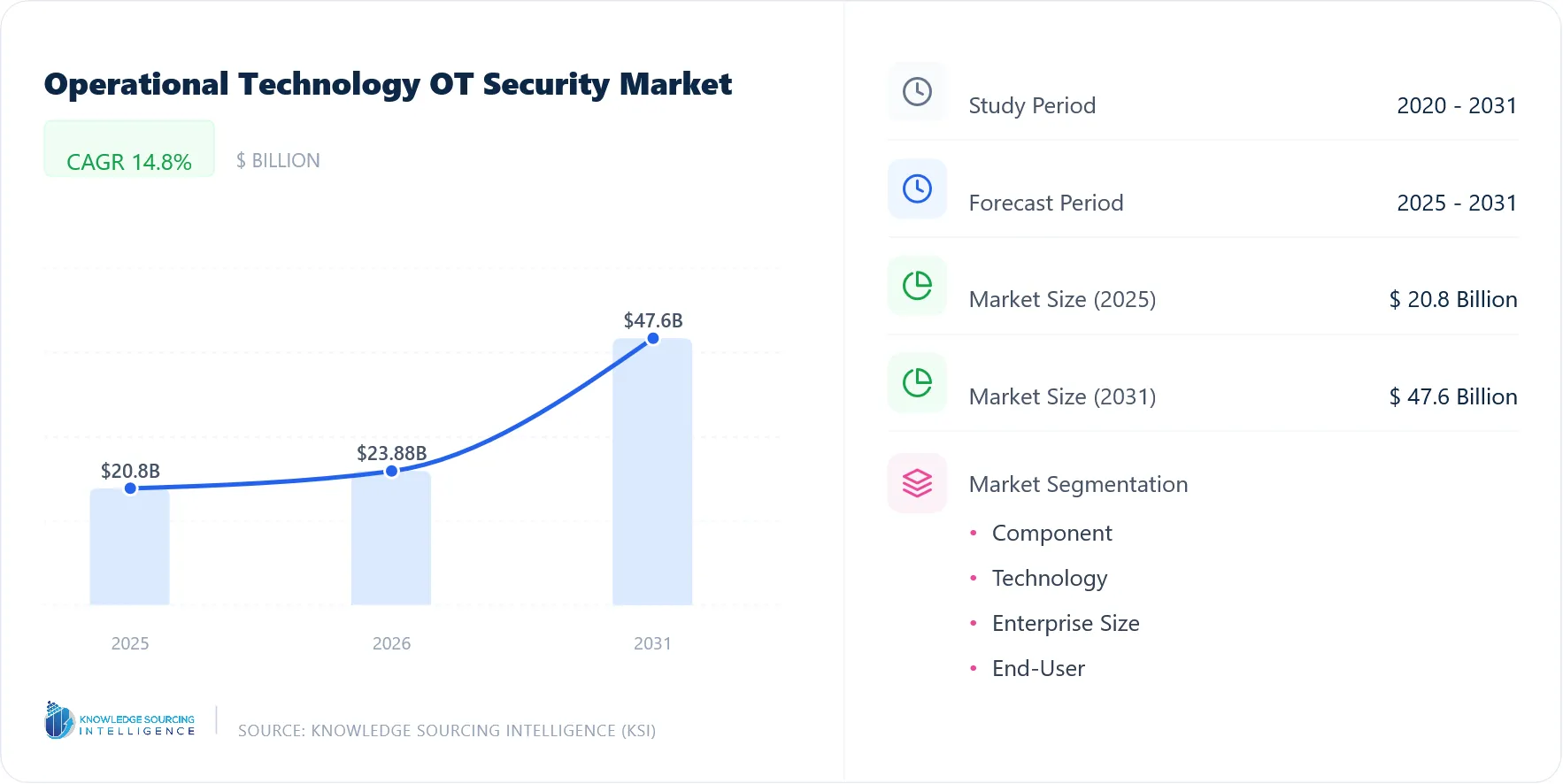
This growth trajectory is supported by several structural shifts:
- The expansion of Industrial Internet of Things (IIoT)
- Increasing integration of legacy OT systems with cloud platforms
- Rising ransomware attacks targeting critical infrastructure
Unlike IT security markets that matured over decades, OT security is still in a relatively early adoption phase, leaving significant room for expansion as industries modernize their cybersecurity frameworks.
Key Drivers
Rising Cyber Threats Targeting Critical Infrastructure
Industrial sectors such as energy, utilities, and manufacturing are experiencing a surge in targeted cyberattacks. Attackers are no longer focusing solely on data theft; instead, they aim to disrupt operations, causing financial and reputational damage. The growing sophistication of ransomware and nation-state attacks has made OT environments a prime target.
IT-OT Convergence
The integration of IT systems with OT environments has introduced new vulnerabilities. While this convergence improves operational efficiency and data visibility, it also expands the attack surface. Organizations are increasingly investing in industrial cybersecurity solutions that bridge this gap without compromising operational continuity.
Regulatory Compliance and Standards
Governments worldwide are enforcing stricter regulations for critical infrastructure protection. Frameworks such as NIS2 in Europe and sector-specific mandates in North America and Asia are compelling organizations to adopt robust OT security solutions. Compliance is no longer optional—it is a strategic necessity.
Growth of IIoT and Smart Manufacturing
The adoption of IIoT devices in smart factories has significantly increased connectivity within industrial environments. While this enables real-time monitoring and predictive maintenance, it also introduces multiple entry points for cyber threats, driving demand for SCADA security and ICS security solutions.
Challenges and Restraints
Legacy Infrastructure Limitations
A major barrier in the OT security market is the presence of outdated systems that were not designed with cybersecurity in mind. Retrofitting these systems with modern security tools is complex, costly, and sometimes technically unfeasible.
Lack of Skilled Workforce
The shortage of professionals with expertise in both IT and OT environments remains a critical challenge. OT security requires specialized knowledge of industrial protocols and systems, which limits the pace of adoption.
Operational Downtime Concerns
Unlike IT systems, OT environments cannot afford frequent downtime. Implementing security solutions without disrupting operations is a delicate balance, often slowing deployment.
Opportunities and Future Trends
Zero Trust Architecture for OT
The adoption of Zero Trust principles is gaining traction in industrial environments. This approach ensures that every device, user, and system interaction is continuously verified, reducing the risk of lateral movement within networks.
AI and Machine Learning Integration
Advanced analytics powered by AI and machine learning are transforming threat detection in OT environments. These technologies enable real-time anomaly detection, helping organizations respond to threats before they escalate.
Cloud-Based OT Security Solutions
As industries embrace digital transformation, cloud-based security platforms are becoming increasingly popular. These solutions offer scalability, centralized monitoring, and cost efficiency, particularly for large, distributed operations.
Digital Twin Security
With the rise of digital twins in manufacturing and energy sectors, securing virtual replicas of physical systems is becoming a new frontier in critical infrastructure protection.
Segment Analysis
By Component
- Solutions: Includes firewalls, intrusion detection systems, and endpoint security tailored for OT environments. This segment dominates due to increasing demand for comprehensive protection.
- Services: Consulting, integration, and managed security services are growing rapidly as organizations seek expert guidance.
Regional Insights
North America
North America leads the OT security market, driven by strong regulatory frameworks and high awareness of cybersecurity risks. The United States, in particular, is investing heavily in securing critical infrastructure.
Europe
Europe is witnessing significant growth due to stringent regulations such as NIS2 and increasing cyber threats. Countries like Germany, the UK, and France are focusing on industrial cybersecurity to protect manufacturing and energy sectors.
Asia-Pacific
Asia-Pacific is the fastest-growing region, fueled by rapid industrialization and digital transformation. China, Japan, and India are investing in industrial control systems security to support smart manufacturing initiatives.
Middle East & Africa
The region is seeing increased adoption due to investments in energy infrastructure and smart city projects. Cybersecurity is becoming a priority as digitalization accelerates.
Competitive Landscape
The OT security market is highly competitive, with players adopting a mix of organic and inorganic growth strategies. Companies are focusing on:
- Strategic Partnerships: Collaborating with industrial automation providers to integrate security solutions directly into OT systems.
- Product Innovation: Developing AI-driven threat detection and response platforms tailored for OT environments.
- Mergers and Acquisitions: Expanding capabilities and market presence through acquisitions of niche cybersecurity firms.
- Managed Security Services: Offering end-to-end solutions to address the shortage of skilled professionals.
Vendors are also emphasizing interoperability, ensuring their solutions can seamlessly integrate with legacy systems—a key differentiator in this market.
Conclusion
The Operational Technology (OT) Security Market is at a pivotal stage, driven by the convergence of digital transformation and escalating cyber threats. As industries become more interconnected, the need for robust, scalable, and intelligent security solutions will only intensify.
Looking ahead, the market’s growth will be shaped by advancements in AI, the adoption of Zero Trust frameworks, and increasing regulatory scrutiny. Organizations that proactively invest in OT security today will not only safeguard their operations but also gain a competitive edge in an increasingly digital industrial landscape.
In essence, OT security is no longer a technical requirement—it is a strategic imperative for ensuring resilience, continuity, and trust in the modern industrial economy.





















Sign in to leave a comment.