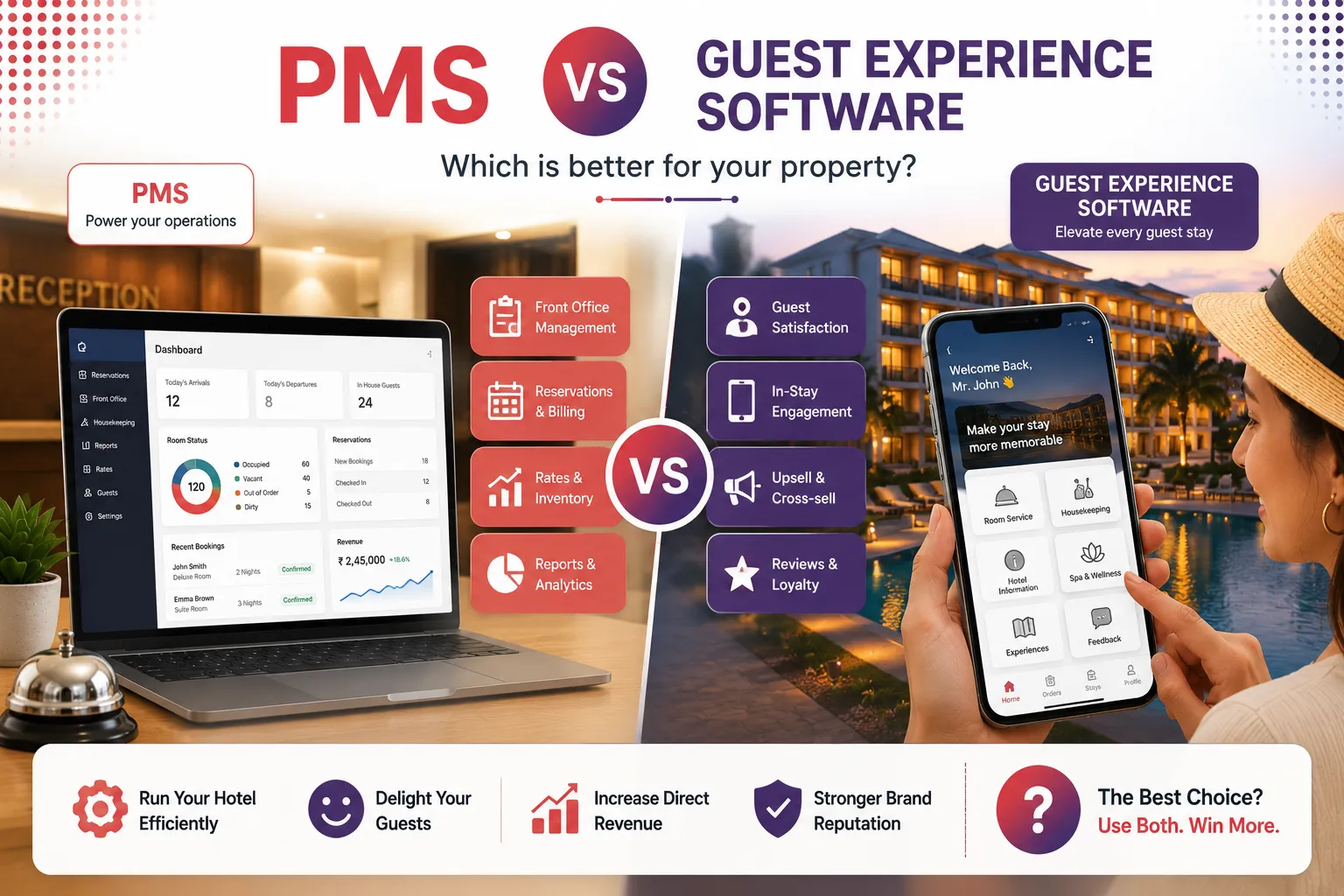

Shopping for hotel tech gets confusing fast. Every vendor promises to run your hotel, delight your guests, and grow your revenue. So when a PMS and a guest experience platform both claim to improve the guest stay, it is fair to ask what actually separates them.
The short version is simple. A PMS runs your operations. Guest experience tools shape how your guests feel. They overlap a little, but they solve different problems, and most hotels end up needing both.
Here is what each one does and how to tell them apart.
What Is a PMS?

A property management system is the operational backbone of a hotel. It handles the daily mechanics that keep the building running, from the reservation a guest makes to the bill they settle at checkout.
86 percent of hoteliers call the PMS their most important system for daily operations, and for good reason. It is the single source of truth for what is happening across the property. Core PMS jobs include reservations and availability, check-in and checkout, room assignments, billing and folios, housekeeping status, rates, and reporting.
In short, a PMS keeps the hotel organized. It is built for staff, not really for guests.
What Is Guest Experience Software?
Guest experience tools work on a different layer. Instead of running operations, it focuses on the guest journey, from the moment someone books to the review they leave after they go home.
This is the software that sends pre-arrival messages, lets guests order food or request housekeeping from their phone, pushes upsells at the right moment, and collects feedback during the stay. It integrates with the PMS rather than replacing it, adding a personal, digital layer on top. That matters more than ever, since 86 percent of travelers say the quality of their experience shapes whether they return.
Where a PMS is built for staff efficiency, this software is built for guest satisfaction and extra revenue.
PMS vs Guest Experience Software: The Key Differences
The easiest way to see the split is side by side.
| Factor | PMS | Guest Experience Software |
|---|---|---|
| Main job | Runs hotel operations | Improves the guest journey |
| Focus | Staff efficiency and accuracy | Guest satisfaction and engagement |
| Core features | Reservations, billing, room status, reporting | Messaging, requests, upsells, feedback |
| Built for | Front desk and back office | Guests and the staff who serve them |
| Main goal | Keep the property organized | Personalize the stay and lift revenue |
| Replaces the other? | No | No |
The pattern is clear. One is about running the hotel. The other is about the guest who is staying in it.
Do You Need Both?
For most hotels, yes. They are not competitors, they are partners. A PMS without a guest experience layer runs smoothly but feels impersonal. A guest experience layer without a PMS has no operational data to stand on.
Together they cover the full picture. The PMS knows who is arriving and when. The guest experience layer uses that to greet the guest by name, offer a relevant upgrade, and route a towel request to housekeeping in seconds. Each makes the other more useful, which is why modern hotel tech stack design assumes the two will connect and share data.
How to Choose What You Need
Start with what is broken. If your operations are messy, reservations clash, or reporting is a nightmare, a strong PMS comes first. It is the foundation, and everything else sits on top of it.
If your operations already run fine but guests feel like just a room number, the gap is experience. That is where a guest experience platform earns its keep, by handling requests, upsells, and feedback without adding work for your team. Pick a guest experience tool that connects cleanly to your existing PMS, so guest data flows between them instead of living in two separate places.
Bringing It Together
So, PMS vs guest experience software, what is the difference? A PMS runs the operation. The guest experience layer shapes the stay. One keeps your hotel organized behind the scenes, the other makes guests want to come back. They are not rivals, and the strongest hotels run both, connected, so operations and guest experience finally speak the same language.
FAQs
What is the difference between a PMS and guest experience software? A PMS runs hotel operations like reservations, billing, and housekeeping. Guest experience tools focus on the guest journey, handling messaging, requests, upsells, and feedback. One is built for staff efficiency, the other for guest satisfaction, and they work best connected together.
Can a guest experience platform replace a PMS? No. It is designed to work on top of a PMS, not instead of it. The PMS handles core operations and data, while the guest experience layer uses that data to personalize the stay and add revenue.
Do small hotels need both a PMS and a guest experience platform? Most benefit from both, but the PMS usually comes first since it runs daily operations. Once that foundation is in place, a guest experience tool adds personalization and upsell revenue, often without extra staff.
How do a PMS and guest experience tools work together? They share data. The PMS knows the booking, room, and stay details. The guest experience layer uses that to send timely messages, route requests, and offer relevant upsells, creating one smooth experience across the whole hotel tech stack.





















Sign in to leave a comment.