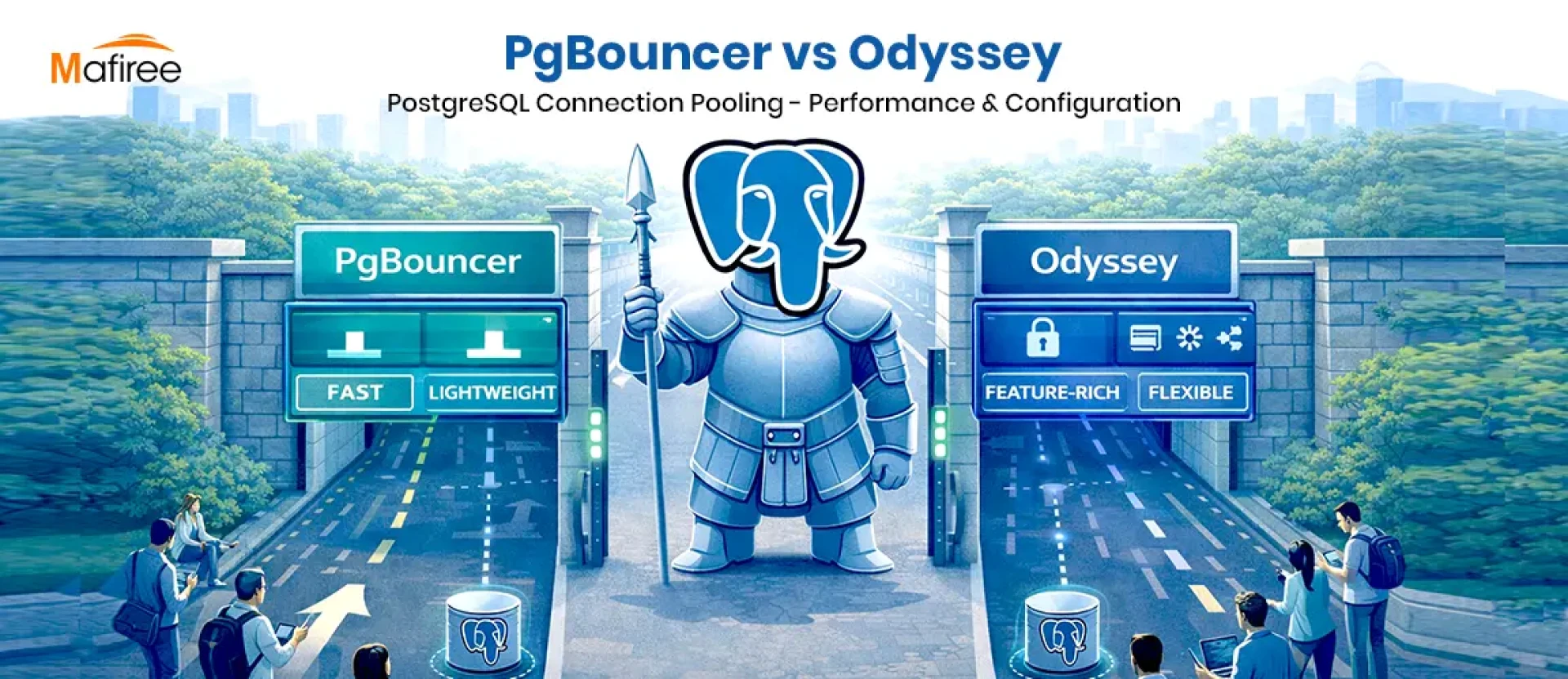

Have you ever been curious about how you can improve the performance of PostgreSQL when it is under a heavy load? The process-per-connection mechanism of PostgreSQL can become a bottleneck when concurrency is high–- especially when dozens or even hundreds of client connections are hitting your database simultaneously. This is where PostgreSQL connection pooling becomes essential for managing resources efficiently.
In the PostgreSQL world, PgBouncer and Odyssey are two of the most popular connection poolers being discussed, although they are slightly different in what they offer
PgBouncer — Lightweight & Reliable
PgBouncer is the most commonly used solution for PostgreSQL. It is recognized for being:
- Lightweight and easy to set up
- Very stable in production
- Excellent for standard OLTP workloads
- Great when combined with tools like Patroni for high availability
PgBouncer is particularly good at minimizing overhead by keeping a pool of persistent connections that your database doesn’t have to create for every new client. This is a massive advantage for most applications, whether they are monoliths, microservices, or web applications.
Odyssey — Built for High Concurrency
While Odyssey is designed for more complex scaling patterns, it excels at:
- High concurrency environments
- Cloud-native and multi-tenant designs
- Scenarios where more sophisticated connection routing and processing are beneficial
Odyssey offers a more efficient routing paradigm and is capable of handling extremely high numbers of concurrent connections, making it well-suited for challenging use cases that stretch PostgreSQL to its limits.
Key Differences to Remember
- Architecture: PgBouncer is designed to be simple, while Odyssey has complex routing logic.
- Use Cases: PgBouncer is great for general OLTP use cases, while Odyssey is better for very concurrent workloads.
- Integration: PgBouncer is designed to work well with traditional HA configurations, while Odyssey is designed for complex cloud and multi-tenant deployments.
Conclusion
PgBouncer and Odyssey are two different solutions for the same problem: how to make PostgreSQL scale better under load. PgBouncer is the reliable, simple solution for most users, while Odyssey is designed for scalability and complex routing. The choice between the two poolers depends on your use case.























Sign in to leave a comment.