
The Problem: Access Debt
Many organizations unknowingly build up "access debt" — tables originally created for one team gradually get shared across departments. Over time, support staff end up viewing salary fields, junior developers can query national IDs, and reporting users gain visibility into financial records they should never see.
This isn't just a security gap — it's a compliance liability. Regulations like GDPR, CCPA, and HIPAA require that users only access data their role genuinely needs. Exposing sensitive columns to unauthorized users risks audit failures and regulatory penalties.
Why CDC Replication Is the Wrong Fix
A common engineering workaround is to use Change Data Capture (CDC) to replicate tables while stripping out sensitive columns for specific user groups. But CDC was designed for data pipelines and analytics — not access control. Using it this way introduces hidden costs: extra infrastructure, replication lag, duplicated storage, and two systems to maintain instead of one. Synchronization failures can cause data gaps, and the approach becomes harder to manage as restrictions grow. Fundamentally, it's an architectural mismatch — creating copies of data to solve an access problem, rather than addressing it at the access layer.
What Column-Level Security Actually Does
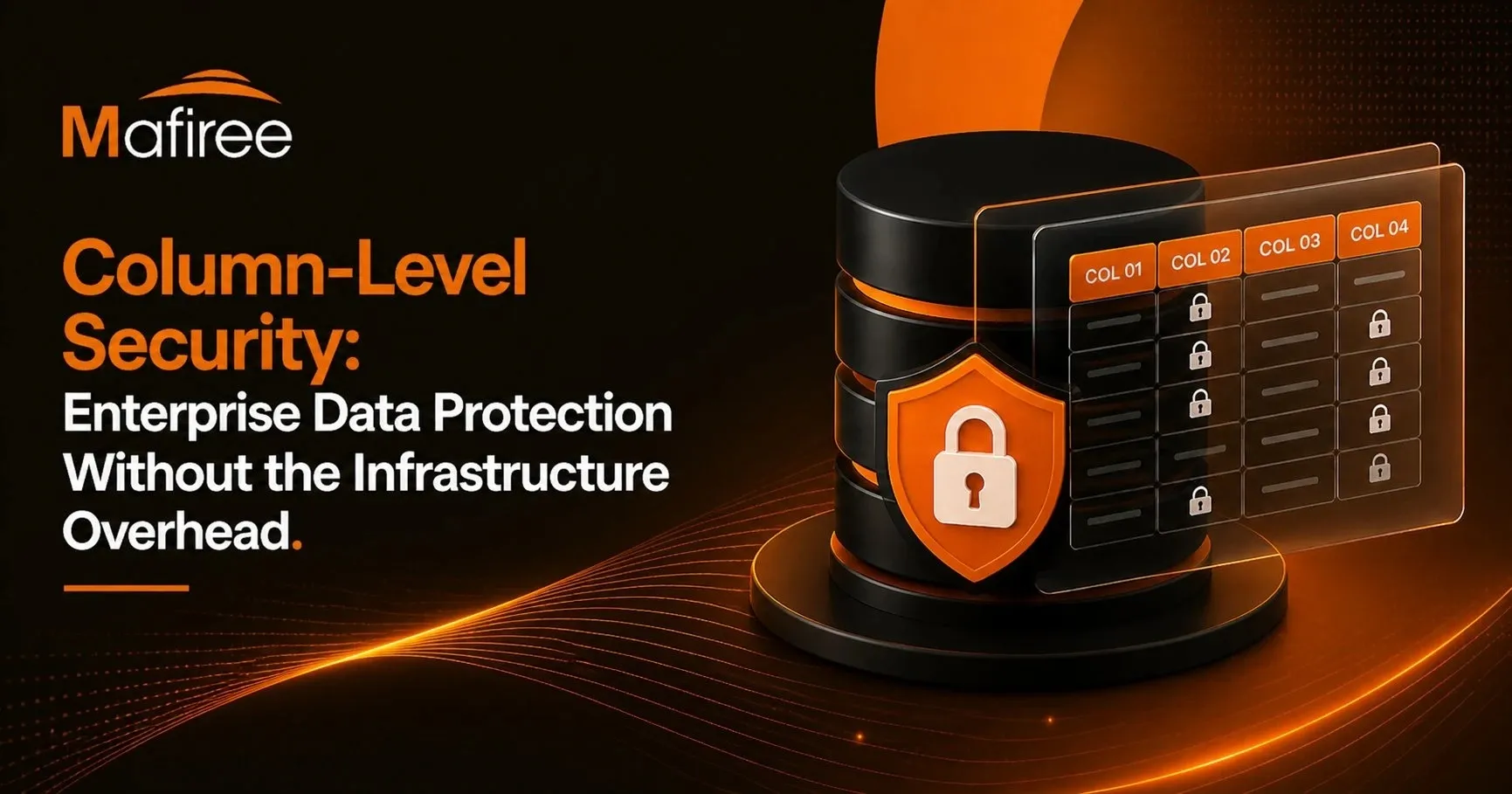
Column-level security is a native feature in all major relational databases — MySQL 8.0+, MariaDB 10.5+, PostgreSQL, and SQL Server. Instead of controlling access at the whole-table level, it lets administrators restrict access field by field. When an unauthorized user runs a query that touches a restricted column — even through a SELECT * — the database engine denies access to that specific field. Authorized users see everything; others see only what they're permitted to.
Fields best suited for this protection include PII (national IDs, birth dates, addresses), financial data (salaries, account numbers, credit scores), health information under HIPAA, authentication data (password hashes, API keys), and commercially sensitive fields like pricing or contract values.
A Four-Step Implementation
Step 1 — Define roles. Identify which business functions genuinely need each sensitive column, and create purpose-specific database roles (e.g., role_hr_full, role_reporting_restricted).
Step 2 — Grant column-level privileges. Use the database's native GRANT syntax to assign SELECT (and UPDATE where needed) privileges on specific columns to the right roles, explicitly withholding sensitive fields from roles that don't require them.
Step 3 — Assign users to roles. Map each database user to the appropriate role based on job function. Users can hold multiple roles. When someone changes teams, only their role assignment needs updating — not individual column permissions.
Step 4 — Validate thoroughly. Test access for every role. Confirm that unauthorized users cannot reach protected columns through any query method, and that authorized users retain full expected access. Document everything for the audit trail.
Key Benefits
- Zero additional infrastructure — no new servers, pipelines, or replication tools needed
- No synchronization issues — all users query the same table, eliminating consistency problems
- Negligible performance overhead — access checks happen at the database engine level
- Direct compliance support — satisfies data minimization requirements under GDPR, CCPA, and HIPAA
- Easy governance scaling — adding restrictions to new columns only requires role updates
Real-World Validation
This approach was implemented for a client running a multi-team database environment with sensitive employee and financial data, replacing a planned CDC architecture. The outcome confirmed full restriction of sensitive columns from unauthorized roles, uninterrupted access for authorized users, no bypass possible via SELECT *, all compliance requirements met, and zero performance degradation under production load.
Important Limitations
Column-level security solves one specific problem well: controlling which users can read or modify particular fields. It is not a replacement for row-level security, encryption at rest, or network-level controls. It also provides stronger protection than database views, which can be bypassed if users hold direct table-level privileges — column-level grants are enforced at the privilege layer regardless of how a query reaches the table.
Bottom Line
If your reason for replicating data is simply to control column visibility, the solution is already built into your database. Define roles, grant column-level privileges, assign users, validate — and gain a stronger compliance posture with less infrastructure and far less operational complexity.


























Sign in to leave a comment.