
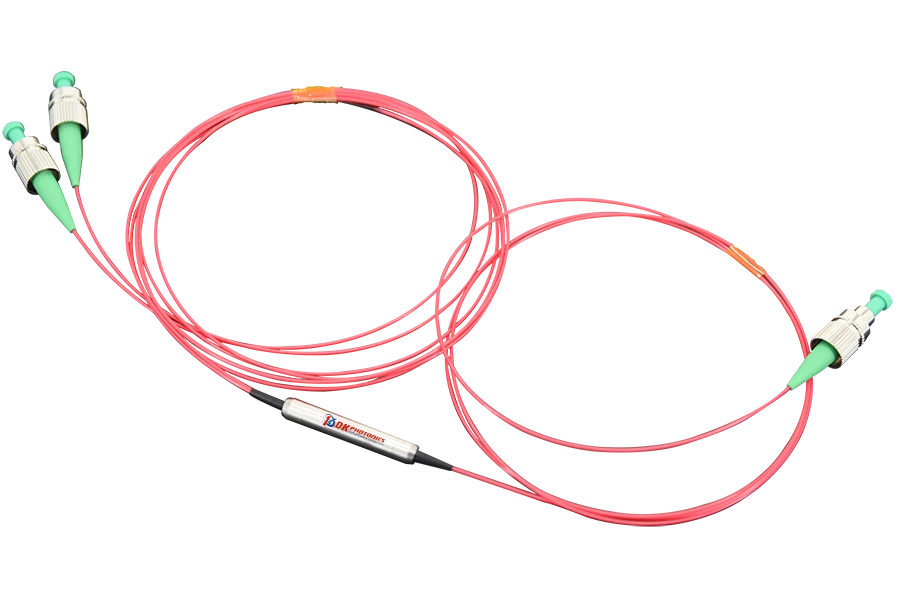
In today’s precision-driven optical world, the smallest interference can disrupt entire systems. Whether in biomedical imaging, fiber sensors, or high-resolution spectroscopy, maintaining laser stability is key. That’s where the 780nm Optical Isolator from DK Laser becomes an essential part of the setup — quietly ensuring every laser beam performs just as intended.
Why the 780nm Range Matters
The 780nm wavelength isn’t chosen by accident. It’s widely used in optical communication, spectroscopy, and laser cooling applications — especially in systems that demand precision and low noise. But here’s the challenge: reflections.
When light reflects back into a laser cavity, it can cause feedback that destabilizes the source. Even a 1% reflection can trigger noise or reduce efficiency. The 780nm Optical Isolator eliminates this issue by allowing light to pass in one direction while blocking it in the reverse. Think of it as a “one-way street” for photons — simple in concept, but vital for maintaining performance.
How It Works (Without the Jargon)
At its heart, an optical isolator uses the Faraday Effect, which rotates the plane of light polarization when it passes through a magneto-optic crystal. When combined with polarizers, the setup ensures forward transmission but blocks any backward reflection.
In plain terms, it’s like noise-cancelling headphones for your laser — it filters out unwanted “feedback noise” so the system runs clean and stable.
This is particularly useful in fiber laser setups, where even minor disturbances can shift output wavelength or intensity. DK Laser’s design keeps insertion loss low (typically below 0.3dB) and isolation high (above 30dB), achieving the perfect balance of efficiency and protection.
Built with Real-World Demands in Mind
The team at DK Laser doesn’t just design components — they engineer reliability. Their isolators are built using high-quality TGG (Terbium Gallium Garnet) crystals, known for superior magneto-optic performance. Each unit is tested under realistic conditions — including temperature variations, humidity, and mechanical stress — because optical labs aren’t perfect environments.
It’s easy to underestimate how much that matters until you’ve seen a laser drift mid-measurement due to feedback. I remember a colleague who once spent hours recalibrating his spectroscopy setup, only to realize that a missing isolator was the culprit. Lesson learned: a $100 component can save a $10,000 experiment.
Applications of 780nm Optical Isolators
DK Laser’s isolators are used across several industries, including:
· Biomedical imaging: maintaining clean, stable beams for fluorescence microscopy and OCT systems.
· Atomic physics experiments: minimizing optical feedback in laser cooling setups for rubidium atoms, which resonate near 780nm.
· Fiber laser systems: protecting diodes and amplifiers from back-reflected light that could cause instability or damage.
· Optical communication: ensuring clean signal transmission over long distances.
A 2024 study in Optics Express reported that isolators in this range can improve laser stability by up to 40% in continuous-wave applications — a figure that matches what DK Laser customers experience in practice.
What Sets DK Laser Apart
Unlike mass-produced components, each isolator from DK Laser undergoes careful alignment and calibration. Their team focuses on maintaining polarization purity, minimizing insertion loss, and ensuring long-term thermal stability.
They also offer custom designs, so whether your system requires free-space, fiber-coupled, or high-power variants, the isolator can be adapted to your exact setup. It’s a level of flexibility that’s hard to find in off-the-shelf components.
And while these products are technical by nature, the company’s service approach feels personal — clear communication, fast delivery, and reliable post-sales support.
A Small Component with Big Impact
It’s funny how something as compact as a few centimeters of glass and magnets can have such a significant impact on system performance. The 780nm Optical Isolator might not draw attention, but it’s often the difference between a laser setup that hums along perfectly — and one that constantly needs recalibration.
Whether you’re working in research, industrial production, or optical sensing, it’s a smart move to invest in quality components that protect your system and your results.

























Sign in to leave a comment.