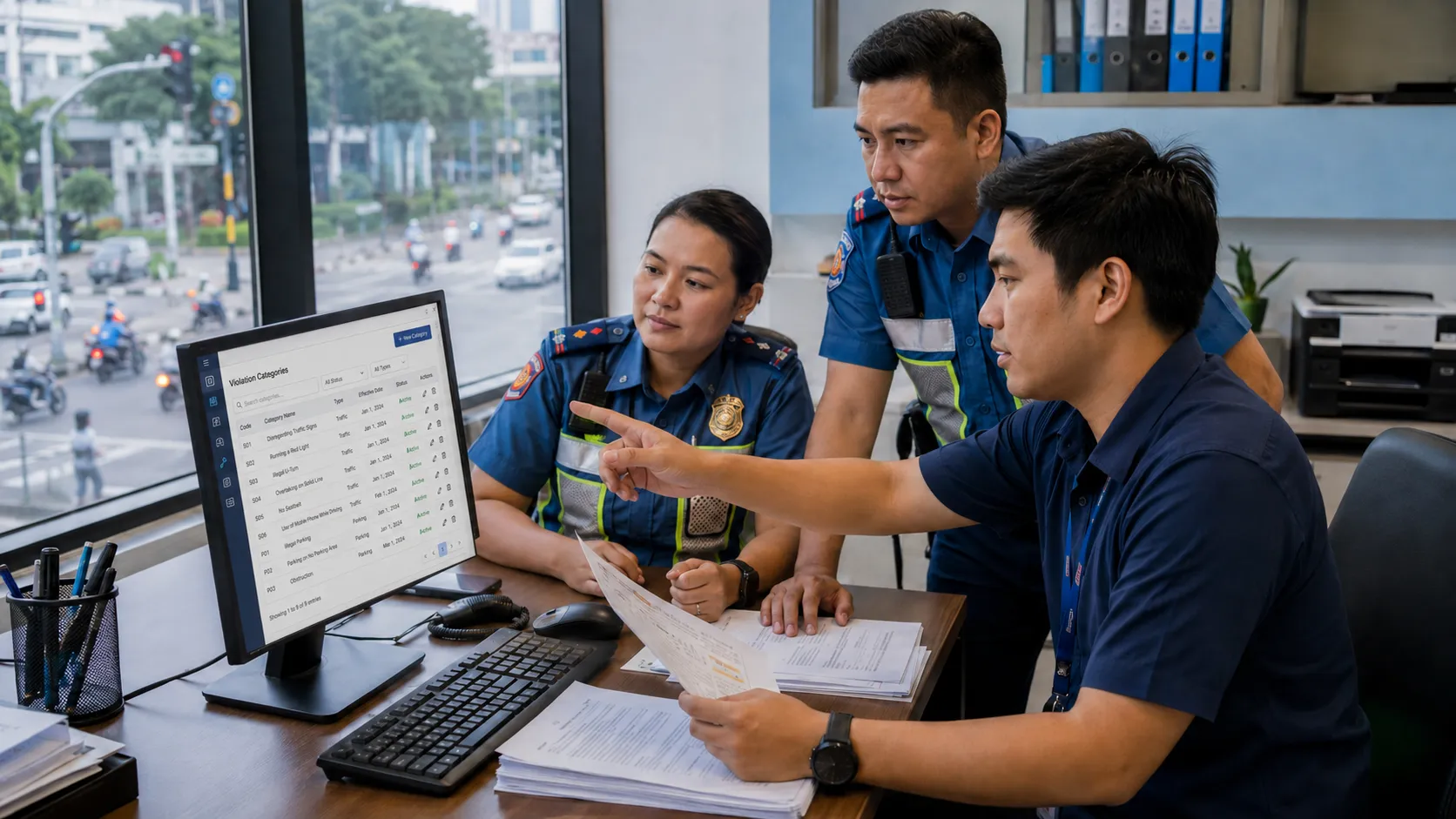

How to Prepare Violation Categories Before Traffic Setup starts with one rule: verify the authority for every category before staff enters the category into the system. An LGU should confirm the legal basis, jurisdiction, effective date, responsible office, category status, and review evidence. This preparation keeps unsupported, duplicated, or expired entries out of the live citation list. The Smart Traffic Management system for Philippine LGUs provides the operational context for this review.
The review is a governance task, not a software shortcut. A dropdown label does not create an offense, set a fine, or give an office enforcement authority. The local government unit (LGU) must rely on current laws, ordinances, regulations, and valid issuances that apply to its area and operations.
Why should an LGU review categories before configuration?
A traffic system turns category data into daily choices for enforcement staff. Once a category appears on a device, users might treat the label as ready for use. A weak violation category setup therefore spreads errors quickly across tickets, reports, and later office reviews.
Early review gives the LGU a clear point for deciding which entries belong in the active list. It also separates legal questions from technical work. The legal or policy reviewer confirms the authority. The traffic office checks operational meaning. The system administrator enters only the approved values.
The goal is not to copy every label from an old spreadsheet. The goal is to build a controlled traffic offense master list whose entries have a stated source, scope, owner, and status.
Which authority sources should the LGU examine?
Begin with the exact authority behind each proposed offense. Republic Act No. 4136 contains national land transportation and traffic rules. Later national laws, amendments, regulations, and official issuances also affect specific offenses. Local ordinances address matters within local authority. Metro Manila offices must also examine the applicable Metropolitan Manila Development Authority framework and current single-ticketing rules.
Record the full title of the source, section or provision, issuing body, adoption date, effectivity date, and geographic scope. A search result, old ticket sample, training slide, or copied list is not enough.
For a local ordinance, the office needs the signed or officially published text and its amendments. If a later ordinance replaced an earlier rule, the category record needs the correct transition date. LGU traffic violation codes must point to the current authority rather than an office nickname for the offense.
What information belongs in a category record?
The exact fields depend on the LGU’s authority, policy, and system design. A practical record groups information by decision purpose instead of placing every detail in one long description.
Identity and authority
- Unique category code
- Official category name
- Short display label for staff
- Law, ordinance, regulation, or issuance
- Exact section or provision
- Issuing authority
The official name and display label need consistent meanings. If staff use a shorter term, keep the formal name and link the short label as an alias. This approach supports consistent searches without rewriting the legal source.
Scope and timing
- National, metropolitan, city, municipal, or other valid scope
- Moving or non-moving classification, where the authority uses this distinction
- Start date for operational use
- Retirement date, when applicable
- Location or road coverage, when the source defines one
- Conditions or exceptions that affect selection
Dates matter because an offense name might stay familiar after its authority changes. Keep a retired entry available for historical records while removing it from new citations after the approved retirement point.
Ownership and control
- Office responsible for the category
- Named reviewer or official role
- Approval reference and date
- Current status, such as proposed, active, suspended, or retired
- Reason for the latest change
- Person who entered the approved change
These fields are governance recommendations. They are not a universal form prescribed for every Philippine LGU. Each office needs to align the record with its own lawful authority, records rules, and assignment of duties.
How should national, local, and Metro Manila rules be separated?
Do not merge different sources merely because they use similar words. A national offense, a local ordinance violation, and a Metro Manila rule might have different authority, coverage, penalties, or enforcement arrangements.
For LGUs outside Metro Manila, the traffic office identifies which national and local provisions govern its work. For Metro Manila, the review covers the Metropolitan Manila Development Authority’s statutory role and current single-ticketing arrangements. A Metro Manila rule does not belong as a nationwide rule in another LGU’s traffic offense master list.
When two sources use the same label, retain separate authority details if their scope differs. Citation category approval should resolve whether the entries stay separate, use one controlled alias, or require another local decision. The system administrator should not settle this legal question through field naming.
Who should review and approve the proposed list?
The LGU assigns roles according to its valid organizational structure and delegated authority. No single national approval chain applies to every local office. A practical review usually involves the traffic or public safety office, a legal or ordinance reviewer, the records function, and the Information and Communications Technology team.
The traffic office explains how officers distinguish each category during enforcement. The legal reviewer confirms the cited authority and scope. The records function identifies how prior and retired versions stay traceable. The technical team confirms the uniqueness of LGU traffic violation codes, field limits, status behavior, and controlled access.
The final approver must hold authority under the LGU’s own rules. Citation category approval needs a date and reference. An email without clear authority or an unsigned working list should not serve as the final basis for live configuration.
How should duplicates, aliases, and retired entries be handled?
First, compare normalized names and codes. Differences in punctuation, abbreviations, spacing, or word order often hide duplicate entries. Next, compare legal sources and scope. Two similar labels might represent one offense, or they might reflect separate authorities.
Use aliases for common search terms only after the official category stays clear. Do not assign one code to unrelated offenses. Do not reuse the code of a retired entry for a new offense because old records still depend on the original meaning.
Retirement is safer than deletion. A retired category stays visible in historical records but disappears from new selection lists after its approved end date. The change log states why the entry was retired and which category replaced it, if any.
How do you test the list before traffic setup?
How to Prepare Violation Categories Before Traffic Setup becomes practical when reviewers test each proposed entry against a fixed readiness decision. Use the following sequence.
- Match the official name to the cited provision.
- Confirm the issuing authority and geographic coverage.
- Check whether a newer law, ordinance, rule, or issuance changed the entry.
- Review the effective date and any retirement date.
- Search for duplicate codes, names, and aliases.
- Confirm the responsible office and final approver.
- Test whether inactive entries stay unavailable for new citations.
- Record the readiness result as accepted, returned for correction, or excluded.
This Smart Traffic Management implementation checklist ends before live transactions start. It does not test payment posting, dispute handling, photo evidence, ticket printing, or citation reconciliation.
What does a practical review look like?
Suppose a working file lists “Restricted Turn” with a local code but no ordinance section. A second row lists “No Left Turn” with the same code and an older ordinance reference. The technical team pauses both entries rather than choosing one label.
The traffic office identifies how the rule is enforced. The legal reviewer examines the current ordinance and any later amendment. The group then decides whether the two rows describe one offense, separate offenses, or an unsupported offense label. Only the approved result enters the violation category setup.
If the earlier code belongs to a retired rule, keep it for historical lookup and assign no new citation to it. If a current rule requires a new code, record the source, start date, owner, and approval reference before activation.
What errors should LGUs avoid?
- Copying categories from another LGU without checking jurisdiction
- Using old ticket samples as the only authority source
- Entering a fine from memory
- Combining national and local rules under one unsupported label
- Deleting retired categories tied to historical records
- Letting a system administrator decide legal meaning
- Activating categories before the approval record is complete
- Claiming the software grants enforcement authority
Personal information usually enters the process when an officer creates an actual citation, not when the office defines an offense category. If testing uses real citation records, the LGU applies the Data Privacy Act of 2012, limits access, and uses reasonable organizational, physical, and technical safeguards. Category preparation uses non-personal test values wherever real identities are unnecessary.
When is the category list ready?
The list is ready when every active entry has a verified source, clear scope, unique identity, valid dates, assigned owner, and approved decision. Any unresolved legal basis, duplicate, or scope conflict should keep the affected entry outside the live selection list.
How to Prepare Violation Categories Before Traffic Setup is therefore a control over what users see before enforcement begins. The final decision belongs to the authorized LGU officials, not the software. Teams reviewing a GoLGU Smart Traffic Management workflow need their current ordinances, category list, and one disputed category example for the configuration discussion.
For a review of your proposed setup and related office requirements, request a GoLGU system demonstration.
Frequently Asked Questions
Should an LGU copy violation categories from another city or municipality?
No. Another LGU’s list might reflect different ordinances, jurisdiction, office authority, and dates. Use the list only as a comparison point. Verify every proposed entry against sources applicable to your LGU.
Who decides the final traffic violation category name?
The authorized local officials decide through the LGU’s own review and approval structure. The displayed name needs to stay consistent with the governing source and preserve its legal meaning.
Should an expired category be deleted?
Usually, no. Retire the category from new selection while preserving its connection to historical records. Record the end date and reason for retirement.
What if two violations use similar names?
Compare their legal basis, elements, scope, and dates. If they describe the same offense, use one official category with controlled aliases. If their authority or meaning differs, keep separate codes and descriptions.
Does a traffic system approve legal penalties?
No. Software records the values entered under authorized LGU decisions. A system does not enact an ordinance, set a penalty, grant enforcement power, or replace legal review.
How often should the category list be reviewed?
The LGU sets a review schedule based on its policy and risk. A new law, ordinance, regulation, court ruling, or official issuance affecting an existing category also triggers a review.
References
Use How to Prepare Violation Categories Before Traffic Setup as a review question before every initial configuration or major category revision.
- Lawphil, Republic Act No. 4136, Land Transportation and Traffic Code
- Supreme Court of the Philippines, G.R. No. 209479, July 11, 2023
- Lawphil, Republic Act No. 10173, Data Privacy Act of 2012
- Lawphil, Republic Act No. 12254, E-Governance Act
Disclaimer
This guide provides operational planning information for Philippine LGUs. It does not provide legal advice or replace review by authorized officials. Confirm current laws, ordinances, regulations, issuances, and office authority before configuring or activating any traffic violation category.

























Sign in to leave a comment.