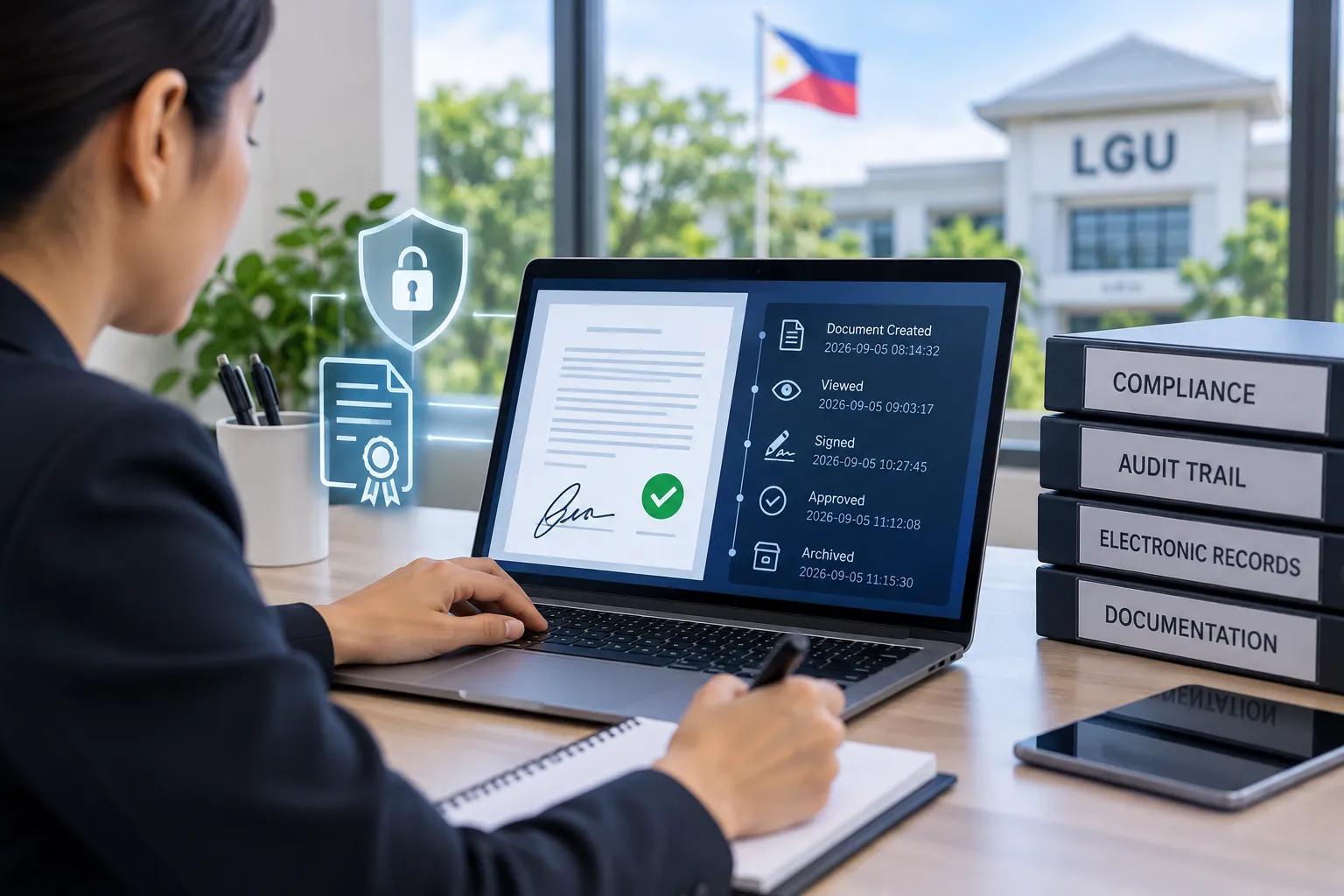

Digital signatures audit trail Philippines practices support compliance by linking a signer to a specific electronic document and helping reviewers check whether the signed content remained intact. A complete audit review still requires more than just the signature. LGUs should also preserve the signer’s authority, workflow events, final records, access controls, and the policy or legal basis for the action. These layers help an auditor reconstruct what happened without treating digital signing as an automatic guarantee of compliance.
For LGUs planning digital government transformation for LGUs, the goal is to preserve evidence that explains a decision from preparation through final retention. Digital signing adds strong evidence to that chain, but each office still needs clear authority, records management, privacy controls, and approved procedures.
How Do Digital Signatures Support Compliance Evidence?
Republic Act No. 8792, the Electronic Commerce Act of 2000, gives legal recognition to electronic documents and electronic signatures when applicable requirements are satisfied. Its provisions focus on signer identification, intent or approval, authentication, and document integrity. Those elements help an LGU explain who approved a document and whether the electronic record remained complete and unaltered after signing.
The law does not say that every digitally signed file is automatically compliant with every government rule. Compliance still depends on the transaction, the signer’s authority, the governing procedure, and the records retained around the action.
A useful digital signatures audit trail Philippines approach therefore combines signature evidence with the surrounding administrative evidence instead of treating the signature as a complete compliance package.
What Does a Digital Signature Help Prove?
A digital signature uses cryptographic methods to associate a signer with electronic content and to support detection of changes after signing. In an audit review, that evidence helps answer two important questions: who signed the document and whether the signed version is still intact.
Those questions are different from asking whether the signer had authority to approve the transaction. A technically valid signature from the wrong person does not create approval authority. The office still needs the appointment, delegation, role assignment, office order, workflow rule, or other authorized basis that explains why the signer was allowed to act.
What Does an Audit Trail Prove That a Signature Does Not?
An audit trail records the sequence of system or workflow events surrounding a document. Depending on the system design, it may show when a request was created, who reviewed it, when it was returned, who approved it, when it was signed, and when the final record was released or stored.
A signature and workflow history answer different questions. The signature supports signer and integrity evidence. The event history supports process evidence. An LGU needs both when the review must explain not only who signed, but also what happened before and after signing.
Why Should LGUs Separate Signature Evidence From Approval Authority?
Approval authority comes from the government office’s valid legal and administrative basis, not from software access alone. The audit reviewer should therefore be able to connect the signer’s identity to the role or authority that applied on the signing date.
This is where a focused digital signing access review becomes useful. Personnel transfers, temporary designations, expired delegations, or role changes may affect whether a person should continue to have signing access. The compliance review does not repeat the access review procedure. It uses current authority as one of the evidence layers during a later audit.
Which Signer Details Should Be Retained for Review?
The exact record design depends on the LGU and the document type, but a reviewer should be able to identify the signer without relying solely on a visual signature image. Useful evidence may include the signer’s name, office, role, signing date and time, certificate or credential information when applicable, and the document reference connected to the action.
How Should Document Integrity Be Checked?
Republic Act No. 8792 treats integrity as an important component of electronic document reliability. For audit purposes, the LGU should be able to show that the version reviewed is the signed version and that any later alteration is detectable or separately documented.
Useful controls include preserving the final signed file, keeping version references, preventing silent overwriting, and retaining verification information associated with the signature. If a signed document needs correction, the safer records practice is to preserve the earlier version and create a new controlled version rather than replacing history.
Which Approval Logs Matter During an Audit?
Approval logs help reconstruct the administrative path around the signature. A reviewer may need to know who prepared the record, who reviewed it, who returned it for correction, who approved it, and when the final signing action occurred.
The logs should also preserve meaningful status changes and exception events. A generic “completed” label gives weak evidence when the office later needs to distinguish review, approval, signing, release, and records storage.
Current Philippine government procurement documents for electronic-signature services indicate that some agencies require transaction logging, complete activity histories, timestamps, and certificates of completion. Those specifications are useful examples for implementation, but they are not a nationwide LGU rule.
How Should Electronic Records Support Later Review?
Republic Act No. 12254 calls for government records and knowledge systems that support the creation, processing, tracking, storage, verification, authentication, archiving, and disposal, while complying with existing laws and standards. This reinforces the need to keep the signed document connected to its record history.
Electronic records should answer practical questions such as which file is final, where it is stored, which transaction it belongs to, who may access it, and whether the supporting evidence is still retrievable. These records also support continuity: reviewers should not need to reconstruct the transaction from scattered emails or personal folders.
How Should Privacy Affect Audit Logs?
Audit evidence can contain personal information, user identifiers, timestamps, IP details, document references, or other sensitive context. The Data Privacy Act and its rules say that we need to have good organizational, physical, and technical measures in place to protect personal data.
LGUs should protect the evidence they keep. Access should follow legitimate duties, logging should collect only what the purpose needs, and retention should follow applicable schedules and rules.
What Compliance Documentation Should an LGU Keep?
Compliance documentation should connect the digital signature to the administrative basis for the action. Depending on the transaction, the evidence package may include the final signed document, signer verification details, current authority or delegation, relevant workflow events, exception history, records-location reference, and the policy, law, circular, or office procedure used for the decision.
This evidence should explain why the document was approved, who was authorized to act, which version became final, and what controls protected the record.
How Should LGUs Keep Workflow Logs Without Overcollecting Data?
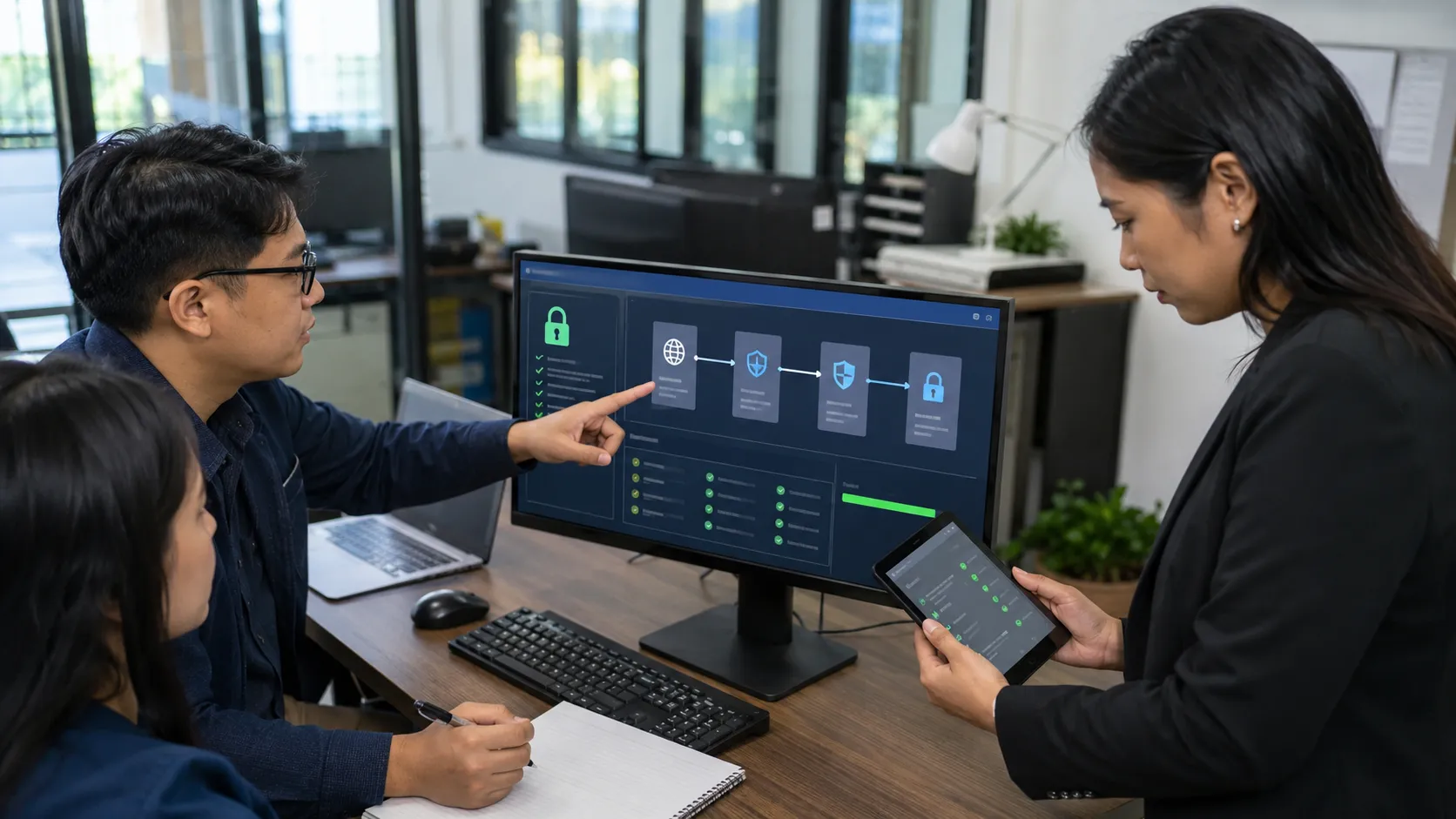
Workflow logs should contain enough information to reconstruct the approval path without copying all personal data from the transaction. The National Privacy Commission’s rules support access management, system monitoring, records of processing activities, and security measures that limit unnecessary exposure.
A practical design records the event, the responsible user or role, the time, the status, the reason when relevant, and the related document or transaction reference. Sensitive attachments should remain in their controlled repository unless the audit purpose requires access.
What Should an Auditor Be Able to Reconstruct?
A useful audit review should allow the LGU to answer a sequence of questions:
- What government document or transaction was being approved?
- Which version became the signed final record?
- Who signed it?
- Was the signer authorized for that action on that date?
- Was the signed document still intact when reviewed?
- What review or approval events occurred before signing?
- Were there returns, corrections, or exceptions?
- Where was the final record retained?
- Who had access to the record and audit evidence?
- Which law, policy, delegation, or office procedure governed the action?
That reconstruction is the practical value of digital signatures audit trail Philippines controls. The result is not a claim that the system made the decision legally correct. It is a stronger evidence base for checking whether the office followed the applicable rule.
What Does GoLGU Publicly Verify About Digital Signing?
GoLGU’s public digital signature workflows page describes remote signing within its ERP environment and the use of digital certificates embedded in the system. Those published functions support the discussion of controlled digital signing.
The public page does not prove that every LGU transaction automatically meets audit, privacy, procurement, or other agency requirements. The applicable rule still determines what evidence is required.
What Should LGUs Avoid Claiming From a Digital Signature?
- Do not say a digital signature alone proves the signer had legal approval authority.
- Do not say a signed file automatically proves the full workflow was followed.
- Do not say system event history alone proves the signed document is cryptographically valid.
- Do not assume every log field should be retained forever.
- Do not treat a visual signature image as equivalent to cryptographic signing evidence.
- Do not state that one vendor’s audit report guarantees government compliance.
- Do not hide corrected or superseded signed versions when record history requires preservation.
What Example Shows the Difference Between Signing and Audit Evidence?
Example: An LGU auditor reviews a digitally signed approval several months after release. The signed file verifies successfully and shows the signer's name. That answers part of the review.
The auditor then checks whether the signer held authority on the signing date, whether the final file matches the approved transaction, which review events preceded signing, whether the document was returned or corrected, where the final record was stored, and whether access was limited to authorized personnel.
The signature supports evidence of identity and integrity. The surrounding records explain authority, process, retention, and access. Together they provide a clearer basis for the audit review.
Frequently Asked Questions
Do digital signatures automatically make an LGU document compliant?
No. Digital signing supports evidence of identity and integrity, but compliance depends on the applicable law, authority, procedures, recordkeeping, and controls for the specific government action.
Is an audit trail the same as a digital signature?
No. The digital signature supports verification of the signer and signed content. Workflow history records the surrounding document events.
Should LGUs keep every audit log forever?
No universal retention period applies to every digital-signing record. Retention should follow applicable records-management, audit, privacy, legal, and LGU requirements.
What evidence helps show that the signer was authorized?
The LGU should connect the signer to the applicable appointment, role, delegation, office order, approval rule, or other valid authority that existed on the signing date.
Can audit records include personal data?
Yes. When they do, access, security, retention, and processing should follow the Data Privacy Act, its rules, and the LGU’s lawful purpose.
What is the main audit value of digital signing?
Digital signing helps connect a signer to a specific document and supports integrity checking. Its audit value increases when the LGU also preserves authority, workflow, records, and evidence of access.
What Is the Practical Takeaway?
A strong digital signatures audit trail Philippines approach does not rely on one signature image or one system log. LGUs should preserve evidence of signer identity, document integrity, approval authority, workflow events, final record storage, privacy controls, and the governing rule. These layers make later review clearer while avoiding the false claim that technology alone creates compliance.
LGUs reviewing how digital signing, records, and approval controls should fit into a connected government system can schedule a GoLGU consultation to discuss system requirements.
Reference
- Republic Act No. 8792, Electronic Commerce Act of 2000
- Republic Act No. 12254, E-Governance Act
- National Privacy Commission, Implementing Rules and Regulations of the Data Privacy Act of 2012
- Insurance Commission, 2026 Electronic Signature Procurement Specification
Disclaimer
This guide provides operational guidance for Philippine local government digital-signing and records workflows. It does not replace Republic Act No. 8792, Republic Act No. 12254, data privacy requirements, Commission on Audit issuances, records-management rules, agency-specific policies, legal advice, or the LGU’s approved authority structure. Compliance and audit requirements should be verified for the specific document, transaction, office, and governing rule.






















Sign in to leave a comment.