
Introduction
India's private security industry has grown significantly over the years, supporting the security needs of businesses, residential communities, commercial establishments, educational institutions, hospitals, industrial facilities, and other organizations. As the sector expanded, the need for a structured regulatory framework became increasingly important.
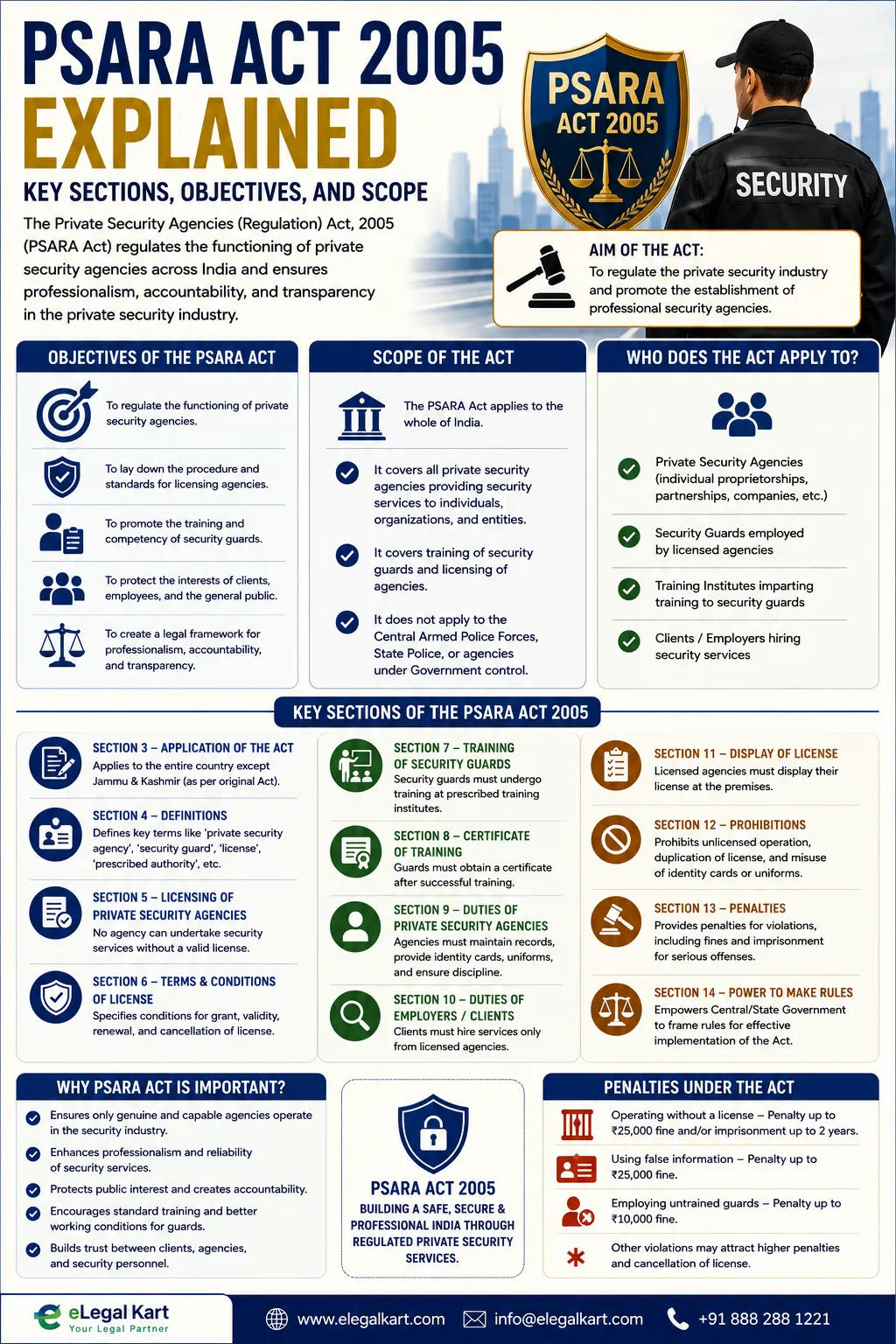
The Private Security Agencies (Regulation) Act, 2005, commonly known as the PSARA Act, was enacted to regulate private security agencies in India. The legislation establishes a licensing framework and sets out requirements concerning the operation of private security agencies and the training and conduct of private security guards.
For entrepreneurs and businesses planning to operate a private security agency, understanding the PSARA Act is essential. A PSARA Licence is not simply a business registration document; it is a regulatory authorization connected specifically with the provision of private security services under the Act.
This article explains the key objectives, important provisions, scope, licensing framework, and compliance responsibilities associated with the PSARA Act. It is intended as an educational overview and should not be treated as a substitute for professional legal advice or a review of the latest applicable legislation and rules.
What Is the PSARA Act, 2005?
The Private Security Agencies (Regulation) Act, 2005 was enacted to regulate private security agencies operating in India.
The Act provides a legal framework for:
- Licensing private security agencies
- Establishing eligibility conditions
- Regulating private security guards
- Providing for training requirements
- Creating accountability for private security agencies
- Empowering designated authorities to oversee licensing
The legislation applies to private security agencies that provide security services within the scope of the Act.
The term PSARA Licence is commonly used to refer to the licence issued to an eligible private security agency under this regulatory framework.
Why Was the PSARA Act Introduced?
Before the introduction of a dedicated regulatory framework, private security services were not subject to the same level of standardized regulation that exists today.
The PSARA Act was introduced with several broad objectives.
1. Regulation of Private Security Agencies
The primary purpose is to establish a formal regulatory system for agencies providing private security services.
This ensures that agencies meet prescribed conditions before they begin operating.
2. Improving Professional Standards
Private security personnel often work in environments where they may be responsible for protecting people and property.
The regulatory framework recognizes the importance of:
- Proper training
- Background verification
- Professional conduct
- Defined responsibilities
3. Promoting Accountability
A licensing system allows regulatory authorities to monitor private security agencies and take action where applicable if legal requirements are not followed.
4. Establishing Training Requirements
The Act and associated rules provide a framework for training private security guards.
Training can help personnel develop skills related to:
- Access control
- Security procedures
- Emergency response
- Fire safety
- First aid
- Crowd management
The specific requirements should be checked against the current applicable rules.
Scope of the PSARA Act
The PSARA Act primarily addresses private security agencies and their activities.
A private security agency generally refers to an entity engaged in providing private security services to another person or organization.
These services may involve providing security guards or other personnel for the protection of:
- Individuals
- Buildings
- Property
- Commercial premises
- Industrial facilities
- Residential communities
- Institutions
The scope of the law should be assessed based on the actual nature of services provided.
What Is a PSARA Licence?
A PSARA Licence is the regulatory licence required by private security agencies that fall within the scope of the PSARA Act.
The licence demonstrates that the agency has been authorized under the applicable regulatory framework to provide private security services.
The licensing process generally involves examination of matters such as:
- Applicant eligibility
- Background information
- Police verification
- Business details
- Training arrangements
- Prescribed documentation
The exact procedure and documentation may vary depending on the jurisdiction and applicable rules.
Key Provisions of the PSARA Act
The Act contains several important provisions that private security agency owners should understand.
Licensing of Private Security Agencies
One of the central requirements under the PSARA framework is that an eligible private security agency must obtain the required licence before commencing operations.
The licence is issued by the designated licensing authority in accordance with the Act and applicable procedures.
Operating a private security agency without the required licence can result in legal consequences.
Eligibility of Applicants
The PSARA framework establishes conditions relating to who may operate a private security agency.
The licensing authority may examine the background and eligibility of:
- Individuals
- Directors
- Partners
- Key persons associated with the agency
Certain individuals may be disqualified based on factors prescribed under the law.
Applicants should carefully review the eligibility requirements before submitting an application.
Police Verification
Police verification is an important component of the licensing framework.
The authorities may conduct verification relating to the applicant and other relevant persons associated with the agency.
The objective is to ensure that individuals responsible for operating security agencies meet the prescribed suitability requirements.
Accurate information is therefore important during the application process.
Training of Private Security Guards
The PSARA framework emphasizes appropriate training for private security guards.
Training helps personnel understand their responsibilities and respond effectively to different security situations.
Training may cover areas such as:
- Physical fitness
- Security procedures
- Access control
- Fire prevention
- First aid
- Emergency response
- Crowd management
- Communication skills
- Basic legal awareness
The prescribed training requirements should be reviewed under the latest applicable rules.
Memorandum of Understanding With a Training Institute
An applicant may need to enter into an arrangement or Memorandum of Understanding (MoU) with an eligible private security training institute, depending on applicable requirements.
The purpose is to ensure that security guards receive the required training.
Applicants should verify:
- Whether an MoU is required
- Eligibility of the training institute
- Required training standards
- Documentation requirements
The rules and procedures applicable to the relevant jurisdiction should always be checked.
Role of the Controlling Authority
The PSARA framework provides for a designated Controlling Authority responsible for administering licensing functions.
The Controlling Authority may be responsible for:
- Receiving licence applications
- Processing applications
- Granting licences
- Renewing licences
- Monitoring compliance
- Taking regulatory action where permitted
The specific administrative process may differ across states and Union Territories.
Geographical Scope of a PSARA Licence
A significant aspect of the PSARA framework is the geographical scope of licensing.
Depending on the applicable provisions and licensing arrangements, an agency may operate within:
- A specific district
- Multiple districts
- The entire state
The geographical area for which the licence is granted should be clearly understood by the agency.
If a business intends to expand operations, it should determine whether additional licensing or amendments are required.
Validity and Renewal
A PSARA Licence is issued for a specified period and may require renewal according to applicable provisions.
Agency owners should monitor:
- Licence expiry date
- Renewal deadlines
- Changes in agency information
- Changes in ownership or management
Allowing a licence to expire can create operational and legal complications.
Maintaining a compliance calendar can help agencies track important regulatory dates.
Duties of Private Security Agencies
Once licensed, agencies may have ongoing responsibilities under the PSARA framework and other applicable laws.
These may include:
- Employing eligible personnel
- Ensuring prescribed training
- Maintaining personnel records
- Completing required verification
- Complying with licence conditions
- Renewing licences on time
In addition, agencies may need to comply with other laws concerning employment, taxation, labour welfare, and business operations.
Role and Responsibilities of Security Guards
Security guards are an important part of the private security ecosystem.
Depending on their assignment, guards may be responsible for:
- Monitoring access points
- Preventing unauthorized entry
- Protecting property
- Reporting suspicious activity
- Managing visitor access
- Responding to emergencies
- Following established security procedures
Security guards generally do not have the same legal powers as police officers. Their responsibilities should be understood within the limits of applicable law.
Difference Between PSARA Licence and Other Registrations
A common misconception is that a PSARA Licence replaces all other business registrations.
This is incorrect.
Depending on the structure and activities of the agency, other registrations or approvals may include:
- Company or LLP registration
- PAN and TAN
- GST registration, where applicable
- Shops and Establishments registration
- Labour law registrations
- EPF and ESI compliance, where applicable
- Professional tax, where applicable
The PSARA Licence specifically relates to the regulation of private security agencies.
What Happens If an Agency Violates PSARA Requirements?
The PSARA framework provides regulatory mechanisms for dealing with violations.
Depending on the nature of the violation, consequences may include:
- Suspension
- Cancellation of licence
- Penalties
- Legal proceedings
The exact consequences depend on the applicable provisions and circumstances.
Agencies should therefore treat licensing as an ongoing compliance responsibility rather than a one-time formality.
Why the PSARA Act Matters in 2026
The relevance of the PSARA Act continues as India's private security industry supports a wide range of sectors.
Private security services are increasingly used by:
- Corporate offices
- Manufacturing facilities
- Logistics companies
- Warehouses
- Hospitals
- Schools
- Residential societies
- Retail establishments
- Construction projects
- Infrastructure facilities
As the industry grows, regulation remains important for maintaining professional standards and ensuring accountability.
Technology is also changing the nature of private security. Agencies may increasingly use:
- CCTV monitoring
- Access control systems
- Digital visitor management
- GPS-enabled patrol systems
- Centralized security operations
However, technology does not eliminate the need for regulatory compliance. Agencies using modern security systems must still understand the legal obligations applicable to their operations.
Common Misunderstandings About PSARA
"PSARA Licence Is the Same as Company Registration"
No. A business may need to complete company or LLP registration separately before applying for the relevant security agency licence.
"The Licence Is Permanent"
A PSARA Licence has a specified validity period and may require renewal.
"One Licence Automatically Covers Every State"
Licensing requirements are linked to the applicable geographical jurisdiction. Expansion into other states should be evaluated separately.
"A Licence Eliminates All Other Compliance"
A PSARA Licence does not replace tax, labour, employment, or other applicable business compliance obligations.
Practical Compliance Checklist
Private security agency operators should consider maintaining a checklist covering:
- Valid PSARA Licence
- Licence expiry date
- Police verification records
- Security guard training records
- Employee documentation
- Training institute arrangements
- Employment records
- Applicable tax registrations
- Labour law compliance
- Contract documentation
- Changes in ownership or management
Regular compliance reviews can help identify potential issues before they become serious.
Frequently Asked Questions
What does PSARA stand for?
PSARA stands for the Private Security Agencies (Regulation) Act, 2005.
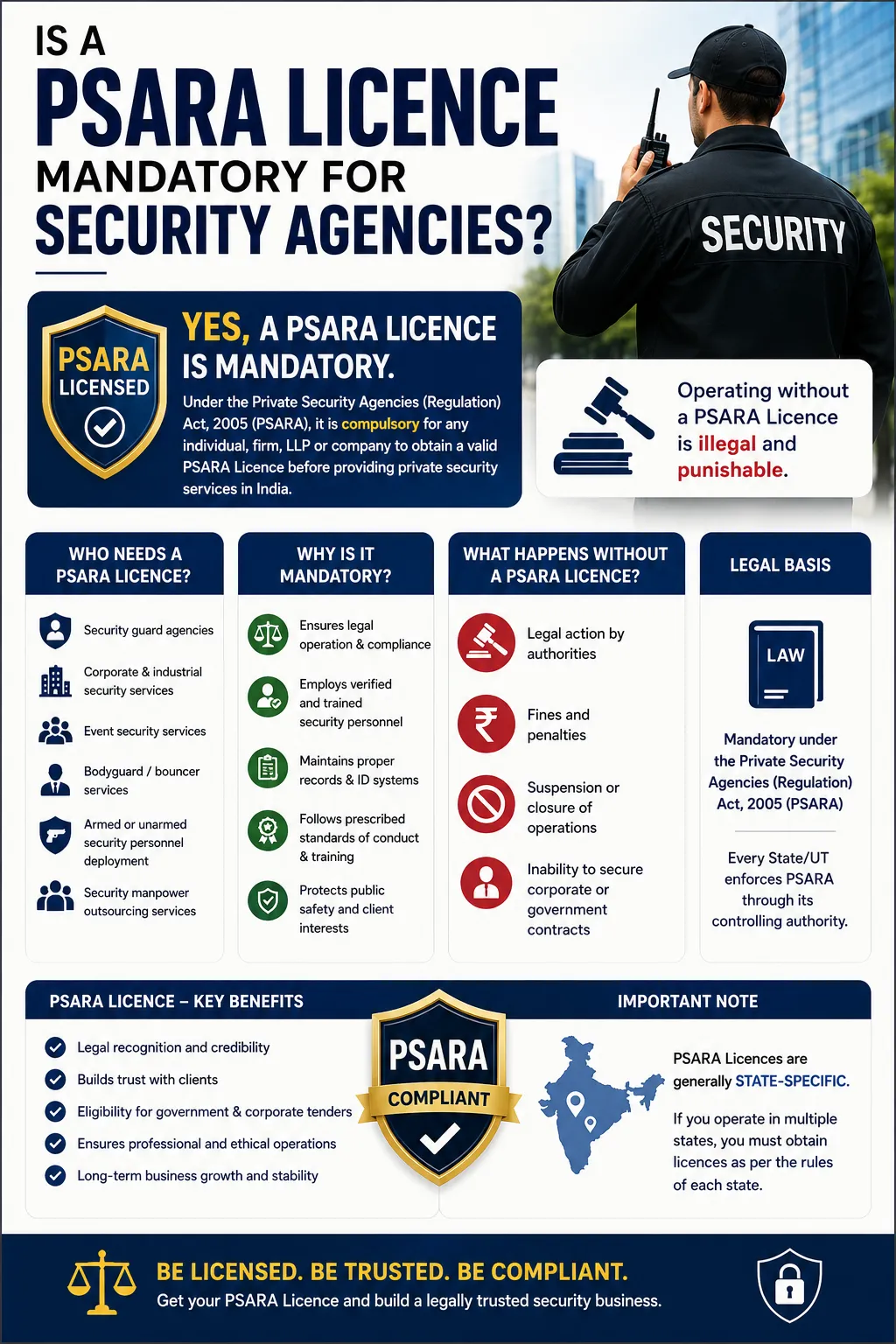
Is a PSARA Licence mandatory?
Private security agencies covered by the Act generally need a valid licence to operate lawfully.
Who grants the PSARA Licence?
The licence is issued by the designated licensing authority or Controlling Authority under the applicable regulatory framework.
Does PSARA apply to security guards?
Yes. The framework includes provisions relating to the regulation and training of private security guards.
Can a private security agency operate without a licence?
An agency that falls within the scope of the PSARA Act generally cannot legally provide private security services without the required licence.
Conclusion
The Private Security Agencies (Regulation) Act, 2005 provides the legal foundation for regulating private security agencies in India. Its framework addresses important areas such as licensing, eligibility, police verification, security guard training, geographical scope, and regulatory oversight.
For businesses operating in the private security sector, understanding the PSARA Act is essential because compliance extends beyond obtaining a PSARA Licence. Agencies must also pay attention to licence validity, personnel verification, training requirements, applicable licence conditions, and other business and employment laws.
As India's private security industry continues to evolve in 2026, the principles behind the PSARA framework remain relevant. A well-regulated security industry can help promote accountability, professional standards, and responsible service delivery. At the same time, agency owners should recognize that laws, rules, administrative procedures, and state-level requirements can change. Therefore, anyone planning to establish or operate a private security agency should consult the latest official legal provisions and applicable authorities before making compliance decisions.
Understanding the PSARA Act is ultimately about more than obtaining permission to operate. It is about recognizing the responsibilities that come with providing security services and maintaining an organized, lawful, and accountable approach to private security operations.






















Sign in to leave a comment.