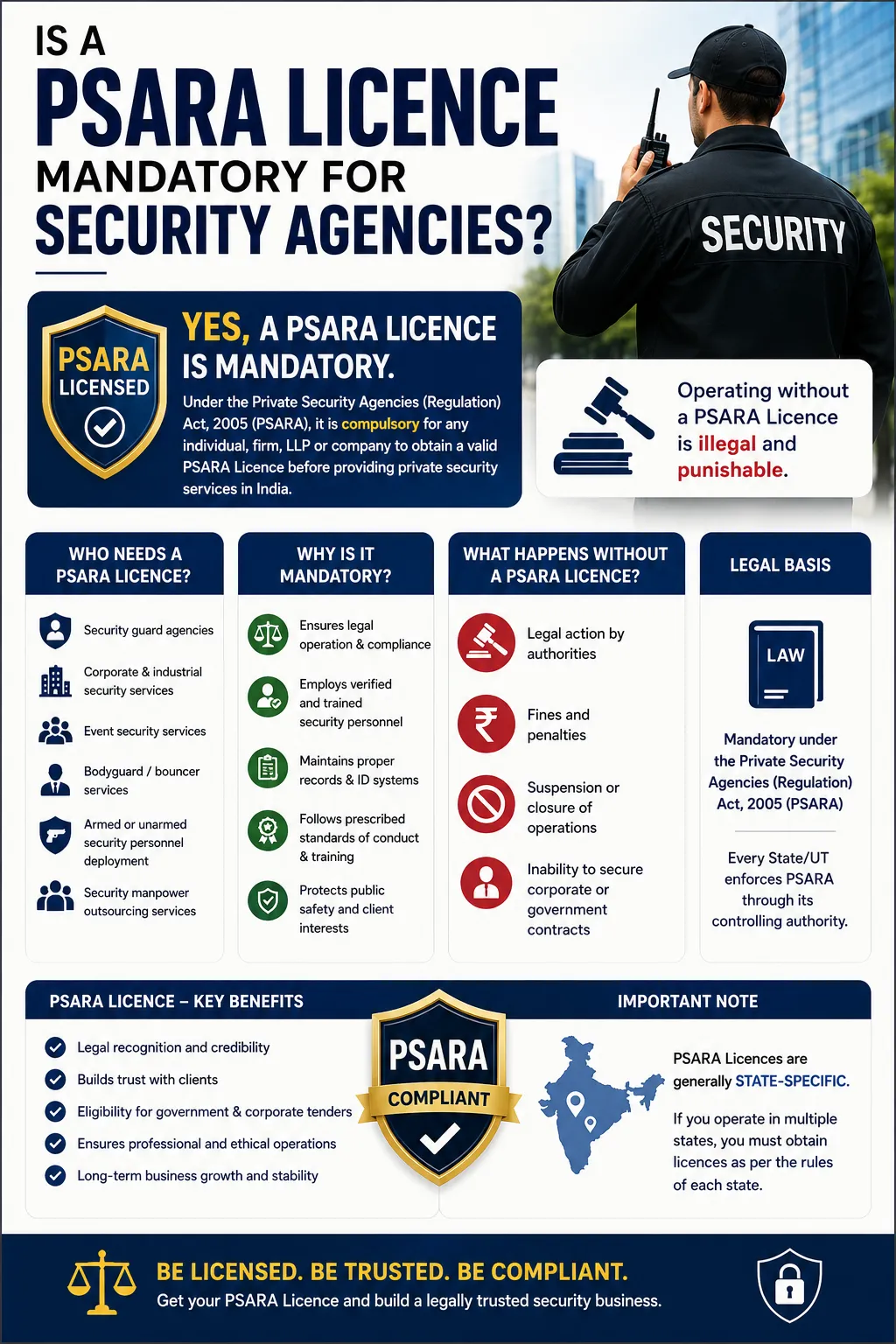

The short answer is yes — unambiguously. A PSARA Licence is legally mandatory for any business that provides private security guard or supervisory services in India, regardless of its size, structure, or how long it has been operating. There is no exemption based on the number of guards deployed, no grace period for new businesses, and no informal way to operate "until you get around to it."
But the question deserves a more complete answer than a single word, because the consequences of getting this wrong are significant — both for the security agency itself and, in important ways, for the clients that engage an unlicensed one. This article examines the legal basis for the mandatory requirement, who exactly it applies to, the narrow exemptions that genuinely exist, what courts have said when agencies have operated without a valid licence, and what happens — for both the agency and its clients — when this requirement is ignored.
The Legal Basis: Section 4 of the PSARA Act
The mandatory nature of the PSARA Licence is not a matter of interpretation or industry convention — it is written directly into the statute. Section 4 of the Private Security Agencies (Regulation) Act, 2005 states that no person shall carry on or commence the business of a private security agency without holding a valid licence issued under the Act.
This is a categorical prohibition, not a conditional one. The provision does not say a licence is required "for agencies above a certain size" or "for agencies operating in more than one location." It applies uniformly to every private security agency, regardless of scale.
Violation of Section 4 is a criminal offence under Section 21 of the Act, which prescribes imprisonment of up to one year, a fine of up to ₹25,000, or both. This is enforced through the criminal justice system — meaning a violation can result in a police case being registered, not merely a regulatory notice or administrative penalty.
Indian courts have applied this provision directly in practice. In a Madhya Pradesh High Court matter, a security agency's contract with a client was terminated specifically because the agency continued operating after its PSARA Licence had expired and had not been renewed — with the client's communication explicitly citing the continuation of agency operations after licence expiry as a violation of Section 4. In another instance, a case was registered against a security agency operator under Section 419 of the Indian Penal Code read with Section 4/20 of the PSARA Act for operating without holding a licence. These are not hypothetical risks — they reflect how the provision is actually enforced and relied upon by both regulators and clients.
Who Exactly Does This Mandatory Requirement Apply To?
The scope of "private security agency" under PSARA is broad by design, and understanding precisely who falls within it removes most of the ambiguity beginners encounter.
The requirement applies to any business — regardless of whether it is structured as a sole proprietorship, partnership firm, LLP, Private Limited Company, or any other entity — that does any of the following for payment:
- Supplies security guards to clients, whether corporate offices, residential societies, banks, hospitals, malls, or industrial sites
- Provides security supervisors who oversee guards on behalf of a client
- Operates a training function specifically to prepare individuals for deployment as private security personnel, where that training feeds into the agency's own deployment of guards
- Provides specialised services such as cash-in-transit security, event security, or executive protection on a commercial basis
The PSARA Act applies regardless of the size or form of the business — sole proprietorship, partnership, LLP, or company — and every entity engaged in offering security guard, supervisory, or training services must obtain a PSARA Licence before starting operations.
This means a two-person operation supplying guards to a single small shop is just as legally obligated to hold a PSARA Licence as a national facility management company deploying thousands of personnel across multiple states. Scale affects which licence tier or fee bracket applies in some contexts, but it does not affect whether the licence is mandatory in the first place.
The Genuine Exemptions Under PSARA
While the requirement is broad, the Act does carve out specific, narrow exemptions — and it is worth being precise about what they actually cover, since misunderstanding the exemptions is a common source of compliance failure.
Government security forces are exempted. The Act does not apply to the armed forces, paramilitary organisations such as the CISF or CRPF, state police departments, or any security function directly controlled and operated by central or state government bodies. These are official law enforcement and defence functions, entirely outside the scope of private security regulation.
The exemption is narrow and entity-specific — not activity-based. It is important to understand that this exemption applies to the government bodies themselves, not to any private contractor that might work alongside or supply personnel to a government department. A private agency supplying guards to a government office still requires a PSARA Licence; the exemption covers the government's own internal security apparatus, not private vendors serving government clients.
In-house security employment is a genuinely grey area. A company that directly employs its own security staff — without supplying those staff to any external client — sits in a more ambiguous position under the Act's definitions. The core question is whether the arrangement constitutes "providing" security services to a client, which is the activity PSARA regulates, or whether it is simply ordinary direct employment for the company's own premises. This distinction matters in practice, particularly for large corporations with sizeable in-house security teams, and it is not always straightforward to resolve from the statutory text alone. Businesses in this position should seek specific legal advice rather than assuming exemption by default.
No other exemptions exist. There is no exemption for new businesses in their first year of operation, no exemption for agencies below a revenue or guard-count threshold, and no exemption for businesses that intend to apply for a licence "soon."
What Happens If a Security Agency Operates Without a PSARA Licence?
The consequences operate on two levels — criminal exposure for the agency, and contractual exposure for everyone involved in the relationship, including the client.
Criminal Liability for the Agency
As established under Section 21, operating without a valid PSARA Licence exposes the responsible individuals — proprietors, partners, or directors, depending on the business structure — to imprisonment of up to one year, a fine of up to ₹25,000, or both. This liability attaches to the people running the business personally, not merely to the business entity in the abstract.
This criminal exposure is not limited to agencies that never applied for a licence. It extends to agencies that held a valid licence at some point but continued operating after it expired without renewal — a distinction that matters because many agencies mistakenly believe that having once been licensed provides some ongoing protection even if the renewal lapses. It does not. An expired licence is, for legal purposes, the same as never having had one.
Contractual Risk for Both the Agency and Its Clients
A less widely understood consequence concerns the enforceability of contracts. Under general principles of Indian contract law, an agreement entered into for an unlawful purpose — or by a party not legally permitted to carry on the business in question — can be treated as void. <cite index="121-1">Section 4 of the PSARA Act establishes that no person shall carry on the business of a private security agency without a licence, and an agreement entered into with an unlicensed agency can be treated as void.</cite>
The practical implications of this run in both directions:
For the security agency: If a client refuses to pay for services rendered, an unlicensed agency has a significantly weakened position to enforce that contract in court. Its own operation was unlawful at the time the contract was formed.
For the client: A business that engages an unlicensed security agency carries its own exposure. If an incident occurs — theft, an assault by a guard, a security failure leading to loss — and it later emerges that the agency supplying the guards was unlicensed, the client's own due diligence and liability position becomes far more difficult to defend. Corporate clients with vendor compliance frameworks increasingly verify PSARA Licence status precisely because of this exposure, and government tenders and large institutional procurement processes treat a valid PSARA Licence as a non-negotiable eligibility condition for exactly this reason.
This is why the mandatory nature of the PSARA Licence is not simply a regulatory formality between the agency and the state — it shapes the legal and commercial risk profile of every contract the agency enters into.
Does the Mandatory Requirement Apply Differently by State?
The underlying legal requirement — that a PSARA Licence is mandatory — is uniform across India, since PSARA is a central Act applicable nationwide. What varies by state is the administrative machinery through which the licence is granted, not the existence of the obligation itself.
Each state government appoints its own Controlling Authority to process applications, conduct verification, and issue licences within that state. This means:
- The licence you hold is valid only within the state that issued it
- An agency operating in multiple states must obtain a separate PSARA Licence from each state's Controlling Authority
- Application forms, specific document formats, and minor procedural details can differ slightly between states, even though the core requirement and eligibility conditions are set by the central Act
A common misunderstanding is the assumption that a PSARA Licence from one state somehow extends informal coverage to neighbouring states or to occasional work outside the licensed state. It does not. The mandatory requirement applies on a state-by-state basis for any agency operating across borders.
What About Agencies Mid-Renewal or Awaiting Approval?
A practical question that arises frequently: is an agency that has submitted a renewal application, but has not yet received the renewed licence, operating legally during that gap?
This is a genuinely sensitive area, and the answer depends significantly on the specific state's rules and the timing of the renewal submission relative to the original expiry date. Some states provide limited continuity protections when a renewal is filed before expiry and is still under processing through no fault of the applicant. However, this is not a universal or automatic protection, and agencies should not assume they are covered simply because a renewal application has been filed.
The safest practice — and the one consistently recommended by compliance professionals — is to file renewal applications well before expiry (most states require submission at least 45 to 90 days in advance) and to treat the period after expiry, if a renewal has not yet been granted, as a genuine compliance risk requiring urgent attention rather than a routine administrative gap.
Why This Matters Beyond Avoiding Penalties
Understanding that the PSARA Licence is mandatory — and precisely why — matters for reasons that go beyond simply staying out of legal trouble.
For a security agency, operating without a valid licence closes off government contracts, most large corporate clients, and insurance coverage, all of which treat PSARA compliance as a baseline requirement rather than a preference. For a business engaging a security agency, verifying that the agency's PSARA Licence is current — not just that one was obtained at some point in the past — is a basic due diligence step that protects the client from contractual and liability exposure if something goes wrong.
The mandatory nature of the licence reflects the underlying purpose of the Act: ensuring that the people entrusted with guarding homes, offices, banks, and public spaces are working for accountable, verified, and regulated organisations. That purpose is undermined just as much by an agency that lets its licence lapse as by one that never obtained one.
A Closing Note
There is no version of operating a private security agency in India that does not require a valid, current PSARA Licence. The requirement is absolute under Section 4, criminally enforceable under Section 21, state-specific in its administration, and reinforced by contract law principles that can render agreements with unlicensed agencies legally vulnerable.
For anyone running or engaging a security agency, the practical takeaway is straightforward: confirm the licence exists, confirm it is current — not expired — and confirm it covers the specific state where the work is being performed. These three checks resolve the overwhelming majority of compliance risk in this area.
































Sign in to leave a comment.