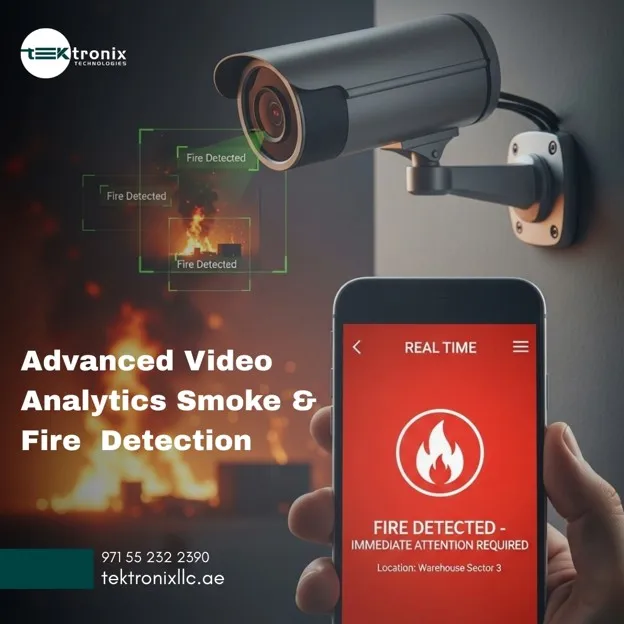

Video Analytics is changing how offices, malls, warehouses, and industrial sites across the UAE detect fire and smoke hazards. As Dubai and Abu Dhabi continue to add high-rise towers, mixed-use developments, and logistics hubs, facility teams are turning to AI-powered video analytics for fire and smoke detection to spot danger the moment it appears on camera, rather than waiting for smoke or heat to physically reach a conventional sensor.
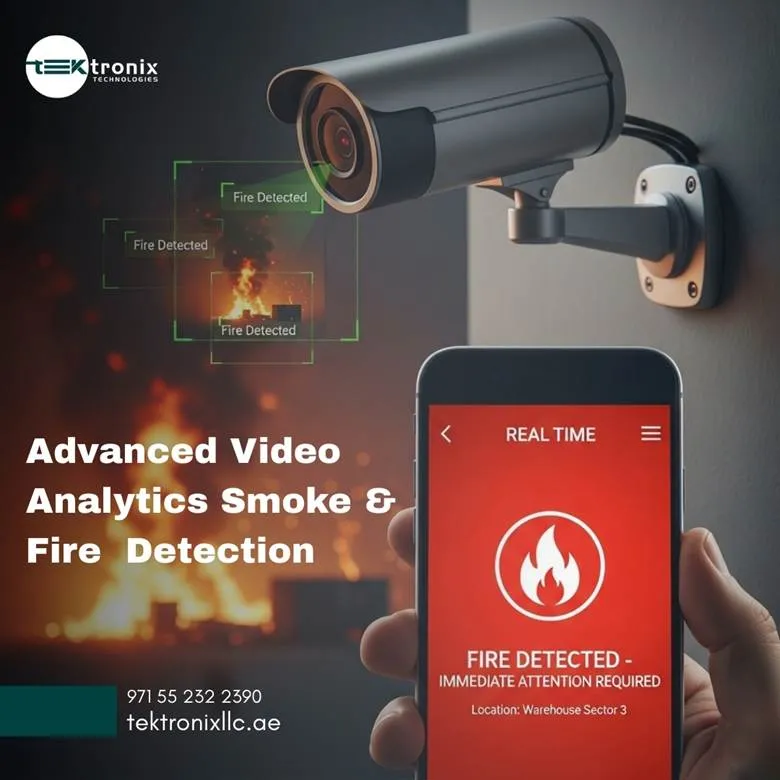
For buildings with dense occupancy, complex floor plans, and high-value equipment, that earlier warning changes the outcome of an incident. This guide explains how the technology works, what it delivers for UAE facilities, and what to look for when choosing a provider.
The Fire Safety Challenge in Modern UAE Buildings
Dubai and Abu Dhabi's skylines have grown faster than almost anywhere else in the region, packing offices, retail floors, server rooms, and multi-level car parks into single towers. Conventional smoke detectors and heat sensors were built for simpler layouts — they react only once smoke or heat physically reaches the device, which in an open-plan office, atrium, or basement car park can mean several critical minutes of delay before an alarm sound.
High ambient temperatures, heavy air-conditioning loads, and a fast-growing number of electric-vehicle charging points in basement parking have all added new ignition risks. Facility owners across the region are responding by layering camera-based detection on top of their existing fire systems, rather than relying on point sensors alone.
What Is AI-Powered Video Analytics for Fire & Smoke Detection?
AI-Powered Video Analytics uses computer vision and machine learning models trained on real fire and smoke footage to recognise flame colour, smoke density, and heat distortion directly from existing CCTV or IP camera feeds. Instead of waiting for particles to drift into a sensor, the video analytics software analyses every frame continuously, comparing it against trained fire-and-smoke patterns and issuing an alert within seconds of a genuine event.
How the Detection Pipeline Works
- Existing or new IP cameras capture continuous video across offices, lobbies, warehouses, and plant rooms.
- An AI engine screens each frame for flame colour signatures, smoke plumes, and thermal distortion patterns.
- Detections are cross-checked against motion and context to filter out steam, dust, or sun glare.
- Verified alerts are pushed instantly to security control rooms, mobile devices, and the building management system.
- Each event is logged with a time-stamped video clip for post-incident review and audit purposes.
Core Capabilities of Video Analytics Solutions for UAE Buildings
Video Analytics Solutions built for commercial and industrial sites typically combine three capabilities that directly address the gaps left by legacy fire detection.
Real-Time Hazard Detection
Real-Time Hazard Detection means a fire or smoke event is identified the instant it becomes visible on camera — often well before it produces enough heat or particulate matter to trip a conventional detector, giving security teams a critical head start in open-plan offices, atriums, and multi-level car parks.
Automated Emergency Response
Automated Emergency Response connects the detection engine directly to building systems — triggering fire alarm panels, public-address announcements, elevator homing, HVAC smoke-purge sequences, and access-control unlocking for evacuation routes — without waiting for a human operator to manually check every camera feed.
Reduced False Alarms
Reduced False Alarms is one of the most valued outcomes for facility managers. Because the AI distinguishes genuine flame and smoke from steam, cooking vapour, dust, or sunlight glare, buildings avoid the disruption, tenant complaints, and civil-defence call-out costs that come with nuisance alarms triggered by conventional sensors.
Video Analytics UAE: Why Adoption Is Accelerating
Video Analytics UAE deployments have grown alongside the country's smart-city and smart-building initiatives, with civil-defence authorities in Dubai and Abu Dhabi encouraging camera-based hazard detection as a complement to statutory smoke detectors and sprinkler systems. For facility teams managing multi-tenant towers and logistics parks, the appeal is a single camera network that already exists for security and can be extended to cover fire risk without new sensor wiring throughout every ceiling void.
Video Analytics Dubai: A Growing Market for Smart Fire Safety
Video Analytics Dubai installations have expanded quickly across the emirate's business districts, free zones, and mixed-use towers, as developers specify AI-based hazard detection from the design stage and existing buildings retrofit it onto their current CCTV estate. Dubai's dense commercial real estate market, combined with high-value tenants and rapid new construction, has made early fire detection a competitive differentiator for building owners as much as a safety requirement.
Why Tektronix LLC Is a Trusted Video Analytics Partner
Tektronix LLC designs, deploys, and supports AI-powered fire and smoke detection for offices, corporate towers, warehouses, and industrial sites across the UAE. The team's engineers hold certifications in networked video systems and life-safety integration, and every deployment is benchmarked against internationally recognised fire-detection performance guidance.
- Experience: multi-year track record integrating video analytics with CCTV, BMS, and fire-alarm infrastructure across UAE commercial towers.
- Expertise: in-house engineering team trained on camera placement, AI model tuning, and false-alarm calibration for office and high-rise environments.
- Authority: solutions built on established computer-vision and machine-learning frameworks aligned with recognised fire-safety principles.
- Trust: transparent project scoping, post-installation testing, and ongoing maintenance support for every deployment.
Building owners evaluating Tektronix LLC's video analytics solutions can review site-specific deployment plans covering camera coverage, integration points, and expected response times before committing to installation.
Business Case: Cost, Compliance & Return on Investment
Beyond life safety, UAE facility owners are adopting camera-based detection for its measurable operating impact. Fewer nuisance alarms mean fewer disrupted workdays, fewer emergency call-out charges, and less wear on evacuation procedures that erode staff confidence when triggered unnecessarily. Insurance providers are also beginning to recognise AI-based early-warning systems as a risk-reduction factor when underwriting commercial property, particularly for towers with high tenant density or server infrastructure.
Because the technology runs on camera infrastructure many buildings already operate for security, the incremental cost of adding fire and smoke analytics is typically far lower than installing a parallel sensor network — making it an efficient upgrade path for both new developments and retrofit projects across Dubai and Abu Dhabi.
Implementation Best Practices for UAE Facilities
- Conduct a site walkthrough to map coverage gaps in offices, lobbies, warehouses, basements, and car parks.
- Prioritise high-risk zones first: server rooms, kitchens, EV charging bays, and electrical switchgear areas.
- Integrate the detection engine with the building management system, fire alarm panel, and access control before go-live.
- Calibrate detection sensitivity on-site to account for lighting, glare, and steam sources unique to each floor.
- Train security and facilities staff on alert workflows, escalation paths, and evacuation triggers.
- Schedule periodic testing and firmware updates to keep detection accuracy aligned with evolving AI models.
Conclusion
Video Analytics and AI-Powered Video Analytics are becoming a standard layer of protection for offices and towers across the UAE, closing the response gap that conventional smoke and heat sensors leave open.
built around Real-Time Hazard Detection give facility teams earlier warning and clearer visibility into every incident as it unfolds.
From Video Analytics Dubai towers to wider Video Analytics UAE deployments, the combination of Automated Emergency Response and Reduced False Alarms is helping building owners protect people, reduce disruption, and meet rising regional safety expectations.























Sign in to leave a comment.