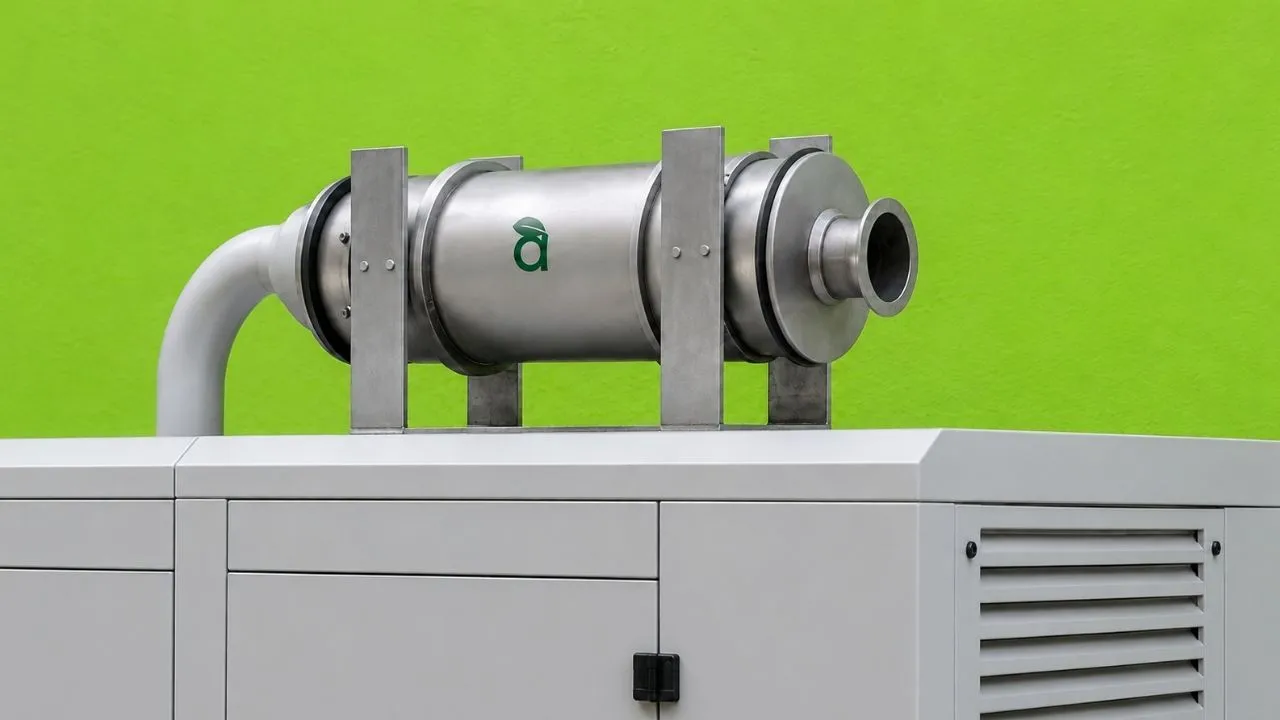

Choosing the right RECD system for industrial generators starts with understanding the generator itself, not simply comparing manufacturers or prices. An industrial DG set may operate under demanding conditions, and the retrofit device needs to be evaluated against the engine, gross mechanical power, exhaust arrangement, operating pattern and applicable technical requirements.
For buyers, specifications and compliance documentation should be reviewed together. A product may have attractive technical features, but that does not automatically mean it is appropriate for every generator. Similarly, a general “CPCB approved” statement should not replace verification of the exact RECD model and its documented application. For a 2026 procurement, industrial users should therefore combine technical evaluation with the latest information available from CPCB and other applicable authorities.

Start With the Generator's Technical Identity
The first specification on an RECD purchase document should not be the filter size or equipment price. It should be the identity of the generator for which the system is being proposed. The engine manufacturer, exact engine model, gross mechanical power, rated speed, DG rating and existing exhaust configuration should be established before selecting an RECD.
This is especially important because industrial facilities commonly operate several generators from different manufacturers or different production years. Two DG sets may have similar kVA ratings but different engine configurations, meaning the appropriate RECD application may need separate verification. CPCB's published RECD material specifically connects the retrofit device to the engine application and gross mechanical power.
Gross Mechanical Power Is a Key Specification
Buyers often begin with the DG's kVA rating because that is the figure most commonly used in commercial discussions. For RECD evaluation, however, gross mechanical power in kW is also important. The CPCB procedure covers diesel power-generating-set engines up to 800 kW gross mechanical power.
CPCB's published manufacturer information also uses specific engine-power ranges when identifying RECD applications. This means an industrial buyer should not assume that a device advertised for a particular kVA category is automatically suitable for every engine operating at that rating. The actual engine documentation should be supplied to the manufacturer before a final model is selected.
Understand the RECD Configuration
RECD technology differs from one product to another. Depending on the design, a retrofit system can incorporate components such as a Diesel Oxidation Catalyst (DOC), Diesel Particulate Filter (DPF), regeneration functions, sensors and electronic control systems. The exact combination should be confirmed in the product specification.
Aceget currently describes DPF, DOC and SCR technologies within its RECD product platform and publishes model-specific information for different DG applications. A DPF may be used to capture particulate matter, while a DOC can support oxidation of certain exhaust constituents. A controller and sensor package can provide operating information and support functions such as regeneration depending on the system architecture.
The buyer should therefore compare the actual configuration rather than simply counting the number of components.
Application Range Should Be Explicit
One of the most important items in the technical documentation is the application range. The manufacturer should identify which engine category and gross mechanical power range the specific RECD model is intended for. CPCB's current manufacturer information lists manufacturers against specified power ranges and Phase I or Phase II applications.
This is useful because a product's suitability is not determined solely by its physical dimensions. For an industrial plant, the buyer should ask the supplier to provide a written statement or technical document connecting the proposed model with the specific DG engine being considered.
Type Approval Is a Core Compliance Document
Type Approval is one of the most important areas to examine before purchase. CPCB's procedure states that applicable OEMs and importers submit applications for Type Approval to certification agencies approved under the procedure. CPCB identifies testing agencies including ARAI, ICAT, IIP and VRDE, along with provisions for eligible NABL-accredited testing and certification agencies meeting the specified requirements.
The Type Approval documentation should be reviewed at the model/application level. A buyer should be able to determine the exact RECD family or model covered, the applicable engine application and the testing agency associated with the approval.
This is more meaningful than simply receiving an image stating “CPCB approved.”
What the Testing Framework Looks At
The CPCB procedure is not limited to one performance number. The technical framework includes emission-related evaluation and other parameters such as particulate matter, smoke, specific fuel consumption, regeneration characteristics and exhaust back pressure.
This matters when comparing manufacturer brochures.
Suppose one supplier advertises a very high PM-reduction figure while another provides a lower headline percentage. The figures should not be compared without understanding which engine was tested, which RECD model was used and what test conditions applied. The strongest comparison is based on equivalent documentation rather than marketing percentages alone.
Exhaust Back Pressure Needs a Place on the Checklist
Industrial exhaust systems can be complicated. Long pipe runs, multiple bends, silencers and restricted installation spaces can make retrofit planning very different from one site to another. CPCB's RECD testing framework includes exhaust back pressure as a technical parameter.
For the buyer, this means the exhaust arrangement should be assessed before final installation. The installer should review the pipe dimensions, flange arrangement, silencer, supports and proposed mounting location. The relevant engine and product documentation should then be used to establish the applicable technical limits.
A site survey can help identify fabrication requirements before the equipment is delivered.
Regeneration Is an Important Specification
Where an RECD uses particulate filtration, regeneration should be clearly explained to the operating team. The filter accumulates particulate matter during operation, and the product needs an appropriate method for managing that accumulation.
The regeneration approach can vary by manufacturer. Aceget's current model-specific pages identify automatic/passive regeneration on several published RECD products. An industrial buyer should ask how the selected system handles regeneration, what operating conditions are required and what the controller displays when regeneration-related conditions change.
This is particularly useful where generators operate under different load profiles.
Controller and Sensor Specifications Matter Too
A modern RECD may include sensors and a controller in addition to the exhaust-treatment components. Depending on the model, these can support monitoring of temperature, pressure, regeneration-related conditions, alarms or other system information.
Aceget's current website describes features such as integrated automation, touch display and IoT communication within its RECD platform. However, these features should not be assumed to exist in every model. The exact quotation should identify what controller, sensors and communication functions are included.
For a multi-DG industrial facility, the ability to obtain useful operating information can also simplify maintenance planning.
Material and Construction Should Be Reviewed
The physical construction of the RECD matters because the equipment operates in a high-temperature exhaust environment. The buyer should understand the housing material, mounting arrangement and relevant construction specifications for the selected model.
Aceget's model-specific product pages list stainless-steel housing for several published products. Construction details should be evaluated in conjunction with the operating environment and manufacturer's technical specifications rather than treated as an isolated quality indicator.
Installation Is Part of the Specification
The technical specification should not end at the RECD itself. A complete proposal should explain the installation requirements, fabrication, mounting, controller and sensor connections, commissioning and required site preparation.
This is particularly important for industrial facilities because the generator room may be difficult to access or may have an exhaust arrangement that differs substantially from a standard configuration. A professional supplier should conduct or support an application assessment before finalizing the installation.
Maintenance Requirements Should Be Written Down
An industrial RECD should be evaluated over its entire operating life. The manufacturer should provide the maintenance interval, inspection requirements and information about serviceable components. The facility should understand what is expected from operators and what work requires trained technical personnel.
Aceget's model-specific product information provides maintenance-related guidance for listed products. The exact interval should always be taken from the documentation for the installed model rather than copied from another product. Maintenance records should include operating hours, service dates, observations and replaced components.
Warranty Should Be Compared Alongside Specifications
Warranty can significantly affect the practical value of an RECD. The buyer should confirm how long the warranty lasts, when it begins, which components are covered, whether installation workmanship is covered and how warranty service is handled.
Aceget's current model-specific RECD pages publish one-year standard warranty information for several products. The terms can vary by product, so buyers should obtain the actual warranty conditions for the model included in their quotation.
Reviewing RECD manufacturers in India
When comparing RECD manufacturers in India, the buyer should consider documented application range, Type Approval information, technical capability, manufacturing arrangements, installation experience, warranty and service support. CPCB's currently published manufacturer list identifies 14 manufacturers for specified RECD applications and power ranges, including Aceget, Automoto Genset Solutions, Chakr Innovation, Cummins Technologies India, JBDS Power Project International and other manufacturers. The current document available on CPCB's website is dated 30 June 2026.
This list is useful for verification and shortlisting, but it should not be treated as an official ranking of product quality.
The exact RECD model still needs to be matched with the generator application.
How to Compare Specifications Fairly
Suppose three suppliers are quoting RECD systems for the same industrial DG. One offers a lower price but gives limited information about the controller and installation. Another offers extensive monitoring features but has a different application range. A third offers a complete installation package with detailed documentation.
The procurement team should not decide based only on the lowest price. Instead, compare the same technical and commercial parameters for each proposal: engine application, gross mechanical power range, exact RECD model, Type Approval documentation, performance information, regeneration method, exhaust requirements, controller configuration, installation scope, warranty and service.
That produces a much more meaningful comparison.
Product Traceability Should Continue After Delivery
The final RECD installed at the facility should be traceable to its purchase documentation. CPCB's procedure contains product-identification and conformance-labelling requirements covering information such as the manufacturer or Type Approval certificate holder, manufacturing plant, RECD model, class, identifying part number, unique identification number, manufacturing date and Type Approval certificate number.
The facility should record this information against the individual DG set. This becomes particularly valuable when a site operates multiple generators with similar capacities.
Do Not Confuse Type Approval With Complete Site Compliance
A Type-Approved RECD is an important part of the technical framework, but it should not automatically be described as proof that every aspect of a site is compliant. The overall regulatory position can depend on the generator, engine category, RECD model, installation, location and current regulatory requirements.
For this reason, industrial buyers should verify the latest CPCB information and any applicable State/UT, local or other competent-authority requirements before making a compliance claim. The official CPCB information should take priority over older articles, outdated vendor lists or unsupported marketing statements.
A Practical Specification File for the Purchase
Before releasing a purchase order, the facility should maintain a single technical file containing the DG engine details, proposed RECD model, application range, relevant Type Approval/testing information, product specifications, installation requirements and warranty.
The file should also record the final delivered model and product identification. For a multi-generator facility, this should be maintained separately for each DG even when the same manufacturer supplies several units.
That simple practice makes future maintenance and verification significantly easier.
Frequently Asked Questions
What are the most important RECD specifications?
The key specifications include the intended engine application, gross mechanical power range, exact RECD model, emission-control technology, regeneration method, controller/sensor configuration, exhaust requirements and installation conditions.
Is gross mechanical power more important than DG kVA?
Both can be relevant, but CPCB's RECD framework specifically uses gross mechanical power in kW and evaluates the RECD in relation to the engine application.
What certification should an industrial buyer request?
Ask for the relevant Type Approval/testing documentation identifying the exact RECD model or family, applicable engine/application and associated testing or certification agency.
Does a CPCB-listed manufacturer guarantee that every product is suitable?
No. CPCB's list identifies manufacturers for specified applications and ranges. The exact product still needs to be matched with the particular DG engine.
What should I check during RECD installation?
Review exhaust connections, mounting, fabrication, sensor/controller installation, commissioning and the applicable technical requirements for the selected engine and RECD.
Conclusion
Selecting an RECD system for industrial generators requires a specification-driven approach. The generator's engine, gross mechanical power and operating conditions should establish the starting point. The exact RECD model should then be matched to the documented application and supported by relevant Type Approval or testing information. Aceget currently publishes model-specific RECD information, including applications, technical features, regeneration, warranty and installation/service information, and identifies its Noida manufacturing facility. The strongest RECD specification is one that clearly connects the generator, the exact product, the supporting documentation and the installation requirements—giving the facility a technical record it can rely on long after the purchase is completed.

























Sign in to leave a comment.