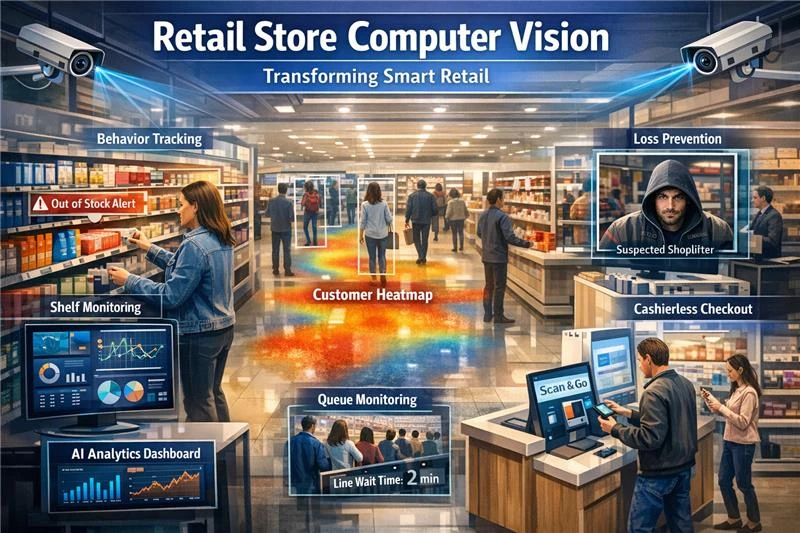

Retail businesses are constantly searching for innovative ways to enhance customer experience, improve store operations, and increase profitability. One of the most promising technologies helping retailers achieve these goals is retail store computer vision. By using advanced cameras, artificial intelligence, and data analytics, computer vision systems can analyze in-store activities in real time and provide valuable insights for better decision-making.
In today’s competitive retail landscape, adopting retail store computer vision is becoming a strategic move for businesses looking to modernize their operations and create smarter shopping environments.
What is Retail Store Computer Vision?
Retail store computer vision refers to the use of AI-powered visual recognition systems that analyze images and videos captured by cameras inside retail spaces. These systems interpret customer behavior, product movement, shelf conditions, and store traffic patterns automatically.
Unlike traditional surveillance cameras that only record footage, computer vision systems actively process the data to generate actionable insights. This technology helps retailers monitor operations, optimize store layouts, and improve inventory management.
Key Applications of Retail Store Computer Vision
Retailers are implementing computer vision technology in several areas to improve efficiency and enhance the customer journey.
1. Customer Behavior Analysis
Understanding how customers move through a store is essential for improving sales strategies. Retail store computer vision tracks customer movement, identifies popular product areas, and measures dwell time in different sections.
With this data, retailers can optimize product placement, design more effective store layouts, and create targeted promotions that attract customer attention.
2. Shelf Monitoring and Inventory Management
Empty shelves can lead to lost sales and customer dissatisfaction. Computer vision systems can automatically detect out-of-stock items, misplaced products, or incorrect shelf arrangements.
Store managers receive real-time alerts, allowing them to restock products quickly and maintain well-organized shelves. This ensures that customers always find what they are looking for.
3. Loss Prevention and Security
Retail theft and shrinkage are major concerns for businesses. Retail store computer vision can identify suspicious activities such as shoplifting, unauthorized access, or unusual product handling.
By analyzing patterns and behaviors, these systems help security teams respond quickly and reduce losses without creating an uncomfortable shopping environment for customers.
4. Queue Management
Long checkout lines can negatively impact the customer experience. Computer vision can monitor queues at billing counters and notify staff when additional checkout lanes are needed.
This helps reduce waiting times and ensures a smoother shopping process, ultimately improving customer satisfaction.
5. Heatmaps and Store Layout Optimization
Computer vision systems generate visual heatmaps showing which areas of a store receive the most foot traffic. Retailers can use this information to position high-demand products in prime locations and adjust displays to maximize visibility.
By optimizing store layouts based on real customer behavior, businesses can significantly boost product engagement and sales.
Benefits of Retail Store Computer Vision
The adoption of retail store computer vision provides multiple advantages for modern retailers.
Improved operational efficiency: Automated monitoring reduces the need for manual inspections and improves overall store management.
Better customer experience: Insights into customer behavior allow retailers to design stores that are easier to navigate and more engaging.
Reduced losses: Advanced monitoring helps prevent theft and inventory discrepancies.
Data-driven decision making: Retailers can rely on real-time analytics to refine marketing strategies and product placements.
Enhanced staff productivity: Employees can focus on assisting customers instead of spending time checking shelves or managing queues.
Challenges and Considerations
Despite its benefits, implementing retail store computer vision also comes with challenges. Retailers must ensure proper data privacy measures are in place when collecting visual data from stores. Transparent policies and secure data management systems are essential to maintain customer trust.
Additionally, integrating computer vision with existing retail systems such as point-of-sale platforms and inventory management tools requires careful planning and technical expertise.
The Future of Computer Vision in Retail
As artificial intelligence technology continues to evolve, retail store computer vision will become even more advanced and widely adopted. Future systems may offer deeper insights into customer preferences, automate store operations further, and enable fully autonomous retail environments.
From smart shelves to cashier-less stores, computer vision is playing a crucial role in shaping the next generation of retail experiences.
Conclusion
Retail store computer vision is revolutionizing how retailers manage stores, understand customers, and improve operations. By leveraging AI-powered visual analytics, businesses can gain real-time insights, reduce operational inefficiencies, and create seamless shopping experiences.
As the retail industry continues to embrace digital transformation, computer vision will remain a powerful tool that enables smarter, more efficient, and customer-centric retail environments.


























Sign in to leave a comment.