
When Capt. Edward John Smith said, “Even God himself cannot sink this ship” you might say he was slightly exaggerating. Though the people onboard actually believed him. Today we know what happened, and we also know no ship’s unsinkable. However, many ships complete their life journey and survive the rough water tides without submerging into the water. What happens to those ships? Nothing lasts forever, so where do these old vessels go? Well, the answer can vary depending on which approach the ship owner opts for. Ships in their last days can either be abandoned or sold to cash buyers. These cash buyers are the mediators between the ship owners and the ship recycling company. They buy a vessel and then sell it to recyclers for various purposes.
Recycling ships is not a simple task, and using the word recycling doesn’t make the process environment-friendly. There are two sides to this coin; we need to look at both to understand the industry better.
Ways the retired vessels are recycled.
Beaching- Many ship recycling companies use a process called Beaching. In this process, the vessel is laid on a tide mudflat, and it is grounded during the high tides where the breaking happens during the low tides when the ship is out of the water. This is a commonly used method in South Asian countries because the breaking of ships happens in intertidal areas, and the toxins released during the breaking process get released into the water. Besides the environmental hazard, beaching is commonly linked with unsafe working conditions. Unlike green ship recycling methods, beaching severely damages the coastal ecosystem.
Alongside- In this recycling method, the ship is brought to a wharf or quay in a sheltered harbor or river. Then, using cranes, the vessel is dismantled. The operation continues until the bottom section of the main body can be lifted in one piece. Then the final cutting operation happens in a fully contained area. This method is popular in America, Europe, and China. This method is not an example of green ship recycling but is safer than beaching.
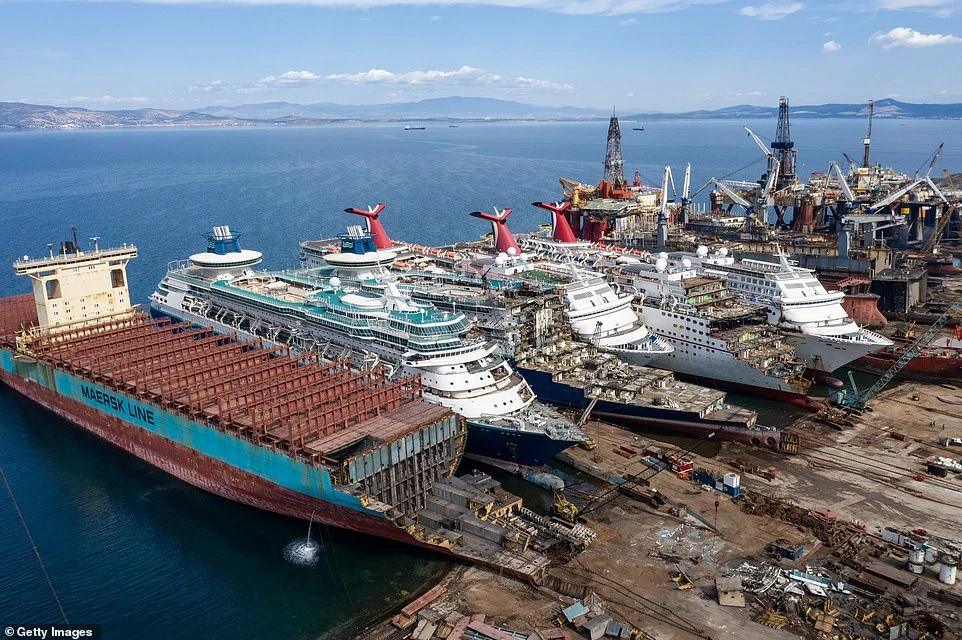
Landing- The landing method is used when there is no tidal difference. It is one of the environmentally safer ways of ship recycling. Ships are driven ashore or on a slipway extending to the sea. The front of the ship is brought above the drainage system while the back remains afloat. As the ships get cut down, more portion of the ship is brought out of the drainage system. This method is widely popular in Turkey.
Dry Dock:- This is also a method of the green ship recycling process. In this method, the ship is driven to a flooded enclosed dock, where the water is pumped out after the process is complete. The ship here is dismantled into pieces in a fully contained area. The heavy parts get lifted by cranes. This significantly minimizes the risk of environmental damage. A fun fact is that most ships are built in dry docks, and as per international law, ship owners must bring their vessels to dry docks for inspection.
These are some methods that are used in the ship recycling process. We can’t turn a blind eye to this huge industry, where there is lots of need for improvement. If ships are appropriately recycled, water pollution and marine life damage can be reduced significantly. Even proper regulation on ship recycling will enforce a safe work environment for people working in ship scrap yards. The materials acquired from the recycling process will help boost the economy.
0

























Sign in to leave a comment.