
Corrosion maintenance is one of those jobs that everyone knows is necessary and almost nobody specifies properly.
The pattern repeats across shipyards, tank farms, bridges, boiler houses, and any plant with steelwork more than a decade old. A coating fails somewhere. Someone is sent to clean it back and repaint. The tool they take is whatever was on the rack. The prep is adequate rather than correct. Eighteen months later the same patch is bubbling again, and the maintenance budget absorbs a repeat job that should have lasted ten years.
The tools are not the whole story, but they are the part most easily got right.
Surface preparation is the variable that decides coating life
Paint manufacturers are direct about this and it is worth repeating: the single largest determinant of how long a protective coating lasts is the condition of the surface it went onto.
A high-specification epoxy applied over poorly prepared steel will fail earlier than a modest coating applied over properly prepared steel. Money spent on premium paint over inadequate prep is largely wasted money.
Preparation standards exist precisely because "cleaned up nicely" is not a specification. ISO 8501-1 defines visual grades for hand and power tool cleaning, commonly cited as St 2 and St 3. The SSPC standards used widely in North America cover comparable ground, with SP 3 for power tool cleaning and SP 11 for power tool cleaning to bare metal, the latter requiring a defined surface profile.
Know which grade your coating system specifies before choosing a tool, because the tool determines what grade you can actually reach.
What a needle scaler does that a grinder cannot
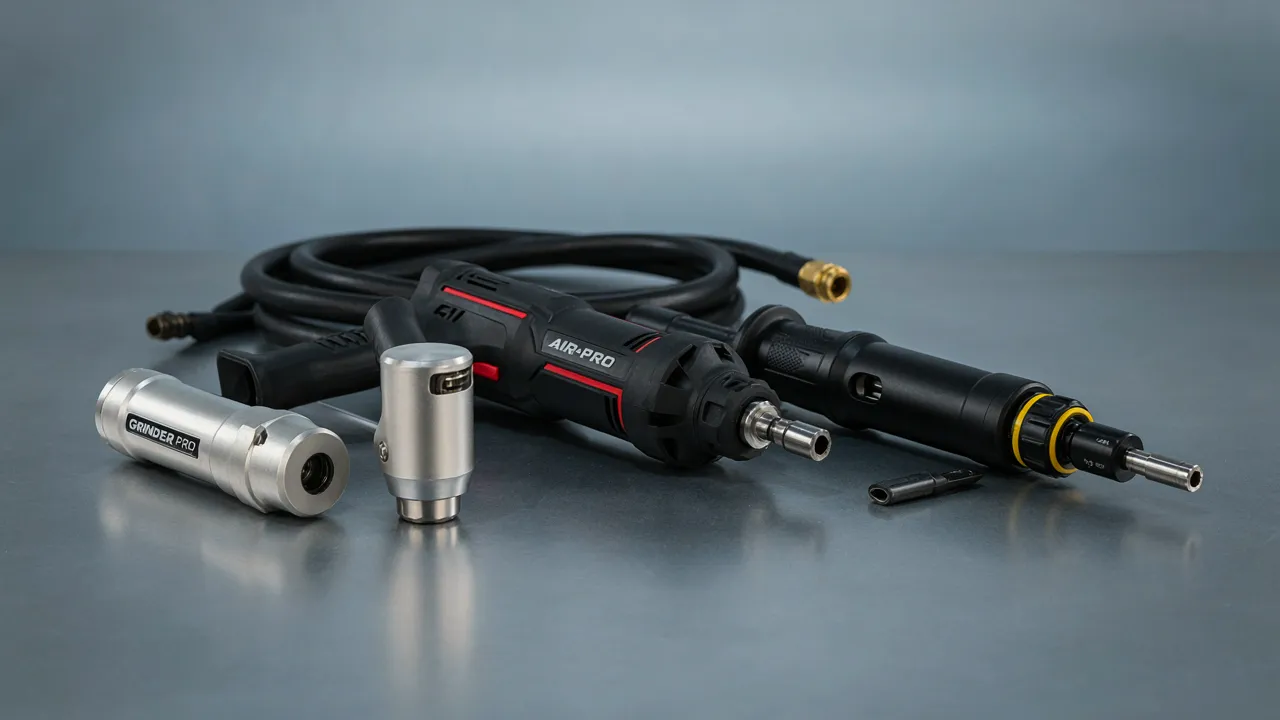
A needle scaler is a reciprocating pneumatic tool driving a bundle of hardened steel needles against the work surface. Typical configurations run nineteen or twenty-eight needles at three or four millimetres diameter, delivering several thousand blows per minute.
The characteristic that matters is that each needle moves independently. The bundle conforms to whatever shape it is pressed against, which makes the tool effective on exactly the surfaces where abrasive discs struggle:
- Weld seams and the irregular geometry around them
- Corners, angles, and the inside of channel sections
- Riveted and bolted joints
- Pitted and heavily corroded surfaces where the profile is no longer flat
- Around brackets, gussets, and pipe penetrations
The second useful property is that a needle scaler removes scale, slag, and failed coating without aggressively cutting the parent metal. A grinder in the hands of a tired operator will thin the section it is cleaning. Needles work by impact rather than abrasion, and while they are not incapable of damage, the failure mode is far more forgiving.
Common applications where it is the right tool rather than a compromise:
Weld slag and spatter removal. Faster than chipping, and it reaches the toe of the weld properly.
Mill scale on structural sections. Particularly where blasting is not available.
Spot repair on coated steel. Where you need to feather back to sound coating around a small failure without stripping a whole panel.
Concrete laitance removal. On repair work, before applying a bonded overlay.
Confined and containment-restricted areas. Tank interiors, ballast spaces, and anywhere abrasive blasting is impractical or the containment cost is prohibitive.
That last point is often the deciding one. Blasting a large open area is faster and produces a better profile. Blasting a two square metre patch inside a tank, once you have accounted for containment, media handling, and disposal, frequently is not.
When specifying a needle scaler, pay attention to needle diameter and count relative to the work. Fewer, thicker needles hit harder and suit heavy scale. More, finer needles give better coverage on lighter deposits and leave a more uniform finish. Body configuration matters too, since much of this work happens overhead or at awkward angles where tool length and balance determine how long an operator can sustain it.
Vibration is not a footnote on this tool
Needle scalers sit at the high end of hand-arm vibration exposure among commonly used tools. This is inherent to the mechanism, not a defect in any particular model.
Vibration is measured under ISO 5349, and where regulatory exposure limits apply they are calculated over an eight hour reference period, which means a high-magnitude tool can exhaust a daily allowance in a surprisingly short run time.
Practical implications for a maintenance operation:
- Ask suppliers for measured vibration data rather than accepting general assurances
- Specify anti-vibration models with isolated handles for any sustained descaling work
- Rotate operators through descaling tasks rather than assigning one person all of it
- Track actual trigger time, not shift length, because they are very different numbers
Hearing protection is equally non-negotiable. These tools are loud, and the noise is impulsive rather than steady, which is more damaging than the average reading suggests.
The other half of structural repair work
Descaling rarely happens in isolation. Corrosion maintenance on steelwork usually runs into fastener work: drilling out seized bolts, removing rivets, opening up holes for replacement plate, tapping new fixings.
This is where a pneumatic drill continues to earn its place despite genuinely good cordless tools existing.
No electrical arc. In tank interiors, near solvent storage, in paint booths, or in any classified area, this is the entire argument and nothing else needs to be said.
Tolerance of wet and dirty conditions. Marine environments, washdown areas, and outdoor structural work destroy battery tools over time. Air motors tolerate it.
Continuous duty. No thermal shutdown, no battery rotation, no charging logistics on a remote site.
Stall tolerance. Jam a bit in a seized bolt and an air motor simply stops. It does not burn out.
Power to weight. On overhead and extended-reach work, which describes a great deal of structural maintenance, the difference accumulates across a shift.
An air drill specified for this work should be chosen against the largest hole and hardest material the job will realistically see, not the average. Free speed and torque trade against each other within a frame size, so a tool selected for speed in thin sheet will disappoint the first time it meets a 16 mm hole in structural plate. Decide on pistol grip, straight, or angle configuration based on the access you actually have, because operators will otherwise adopt postures that eventually cost you an injury claim.
Air supply undermines both tools if you let it
Both tool types are rated at a stated inlet pressure, commonly around 6.2 bar or 90 psi, measured at the tool while it is running rather than at the compressor gauge.
Air motor output falls faster than pressure. A useful field rule is that a ten percent pressure loss costs roughly twice that in power. On a needle scaler this shows up as reduced blow energy and a job that takes half as long again. On a drill it shows up as an operator leaning harder into the tool, which is how bits break.
On site work in particular, watch for:
- Long hose runs without a diameter step-up
- Coiled hoses, which restrict more than straight hose of the same length
- Cheap quick couplers, frequently the narrowest point in the entire circuit
- Compressors sized against the sum of average consumption figures rather than concurrent peak draw
- No point-of-use filtration and lubrication, which on a wet site is a fast route to worn vanes
Put a gauge at the tool inlet while it is running before concluding that a tool is underpowered. A significant proportion of "this tool is no good" complaints are supply problems.
A short specification checklist
- What surface preparation grade does the coating system actually require?
- Is the geometry flat and open, or irregular and confined? That decides needle scaler against abrasive.
- What is the measured vibration figure, and what daily trigger time does it allow?
- What is the largest hole and hardest material the drill will see?
- What is the inlet pressure at the working position with the tool running?
- Is the area classified, wet, or subject to washdown?
- What is the lead time on vanes, needles, bearings, and chucks?
That last question decides more about long-run cost than the purchase price does. A tool waiting a month for a part while a coating window closes is not a cheap tool, whatever the invoice said.


























Sign in to leave a comment.