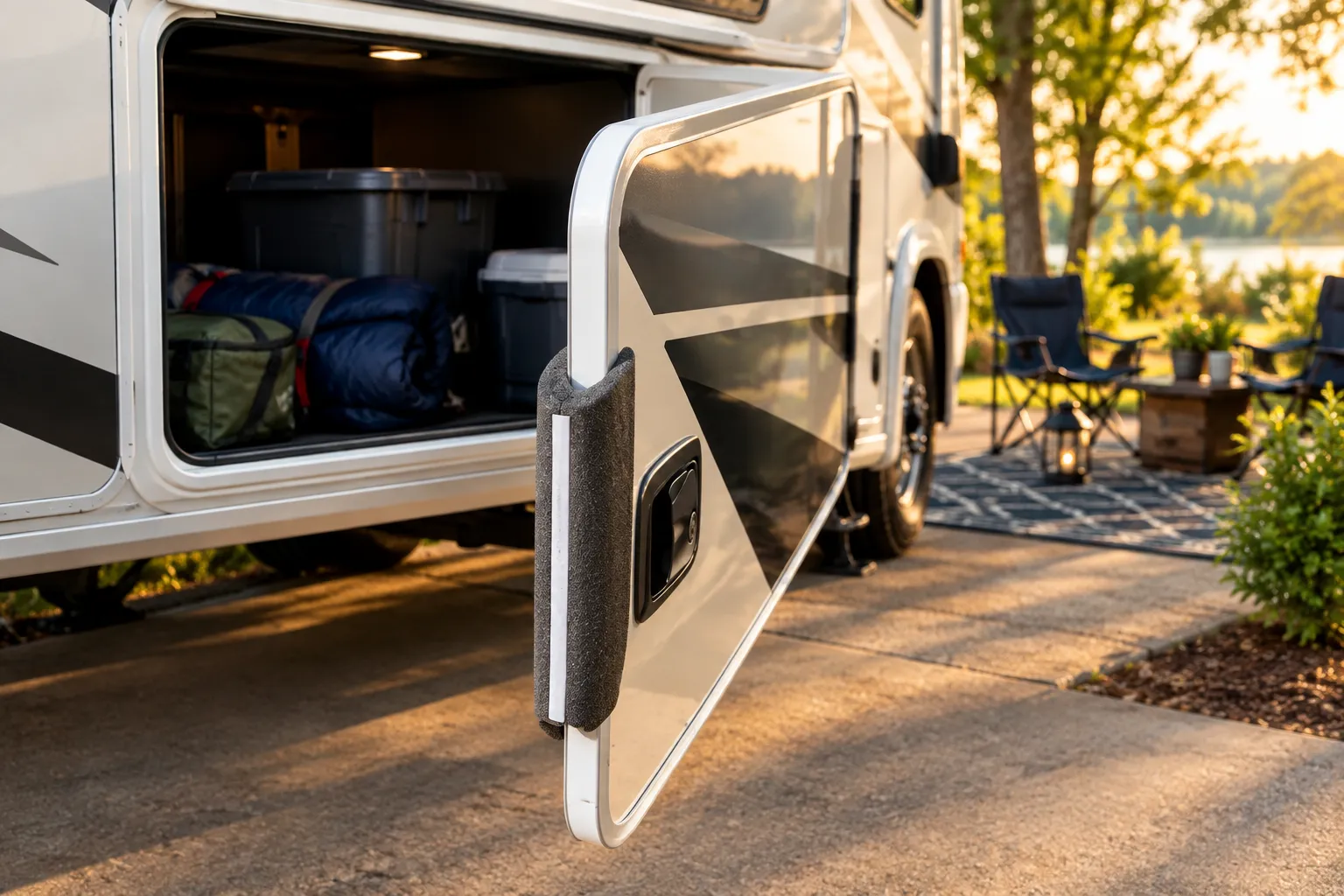

RV slide-out sharp corners are easy to ignore until someone walks into one. An owner can spend an afternoon checking seals, batteries, tracks, and alignment, then step outside after sunset and discover the most obvious hazard was never mechanical at all. A projecting metal edge at forehead height can turn a calm campsite into a painful reminder that slide-out safety includes the space around the RV, not only the system inside it.
That distinction matters because slide-outs change the footprint of a parked rig. Once extended, they create new edges, narrower walking routes, and corners that may be easy to see in daylight but much less obvious after dark. For owners who travel with family, children, friends, or campground guests, the practical goal is simple: reduce the chance that someone meets a hard edge unexpectedly.
Key Takeaways
- Sharp slide-out corners can become contact hazards even when the slide mechanism is working normally.
- Visibility, walking paths, and cushioning matter as much as mechanical condition.
- Temporary fixes can help in some situations, but they need to stay secure and remain easy to notice.
- A good safety routine checks the campsite from a person’s point of view, not only from the RV owner’s point of view.
Why Do RV Slide-Out Sharp Corners Become a Problem?
An extended slide-out creates valuable interior space by moving part of the RV body outward. That extra room is one of the features many owners appreciate most, but the extension also places rigid exterior edges farther into the campsite.
The risk is often about geometry rather than failure. A corner can sit above eye level when someone approaches from one direction and near forehead height when that person bends, turns, carries a bin, or steps around a chair. A taller guest may encounter the same edge differently from a shorter owner who knows exactly where it is.
The Centers for Disease Control and Prevention reported nearly 2.8 million traumatic brain injury-related emergency department visits, hospitalizations, and deaths in the United States in 2013. That figure is not specific to RVs or slide-out impacts, so it should not be treated as a measure of campsite risk. It does, however, show why avoiding preventable blows to the head is worth taking seriously.
The Hazard Is Often Outside the Owner’s Field of Attention
Most slide-out advice naturally focuses on operation. Owners are told to clear furniture, inspect seals, remove roof debris, watch alignment, check battery power, and stop if the mechanism grinds, binds, or moves unevenly. Those are important maintenance habits.
But a mechanically healthy slide can still create an exterior contact point. In fact, the better the system works, the easier it may be to assume the job is finished once the room reaches full extension.
RV owners regularly describe bumping into thick metal edges, trying pool noodles or pipe insulation, and discovering that improvised padding may fall off or fail to stay where protection is needed. That is a different problem from a stuck slide. It is a campsite design problem.
Benjamin Franklin’s familiar line, “An ounce of prevention is worth a pound of cure,” fits this situation unusually well. A few seconds spent noticing an exposed corner before anyone starts moving around camp can be more useful than repeatedly warning people after the hazard is already in the path.
What Makes a Slide-Out Corner Hard to Notice?
A sharp corner becomes more troublesome when several ordinary campsite conditions overlap.
First, contrast changes. A dark trim edge against a shaded RV wall may be obvious at noon and almost disappear at dusk. Second, attention is divided. People carry chairs, coolers, hoses, groceries, tools, or pets while talking and looking toward a door, storage bay, or picnic table. Third, familiarity is uneven. The owner may know the exact shape of the rig, while a visitor does not.
That is why RV slide out safety should be evaluated from the walking path outward. Stand where people actually move. Look from the entry door toward the vehicle. Walk from the picnic table to the exterior storage compartments. Check the route to hookups. Then repeat the scan after dark.
Use the SEE Method Before Someone Finds the Corner
A simple framework makes the problem easier to remember: SEE stands for Spot, Expose, and Ease.
Spot the Contact Points
Walk around the extended slide and identify every corner or edge that projects into a normal route. Pay extra attention to the outer lower corners, edges near storage access, and any point that requires someone to duck or turn sideways.
Also include exterior storage compartment doors in the same scan. Open doors can create temporary edges in places that are otherwise clear.
Expose the Hazard Visually
If a corner blends into shadows or the RV body, make it easier to notice. Useful lighting can help, but lighting alone is not always enough because glare and changing angles can still hide a rigid edge.
High-visibility RV slide out corner protectors can serve two purposes when they are appropriately designed: they can make an exposed corner easier to see and add a softer contact surface.
Ease the Consequence of Accidental Contact
No campsite setup can guarantee that nobody will ever bump into something. The realistic goal is to reduce both the chance of contact and the harshness of the contact if it happens.
That is where cushioning matters. A thin visual marker may improve awareness but provide little impact protection. A thick piece of improvised foam may cushion well but fail if it slides off, twists, becomes waterlogged, or is forgotten.
| Safety Question | What to Look For | Better Response | Weak Response |
| Is the edge in a walking path? | Repeated foot traffic | Redirect traffic or protect the corner | Warn people verbally |
| Is it visible after dark? | Low contrast or shadows | Improve visibility | Assume campsite lights are enough |
| Will padding stay put? | Secure fit in normal conditions | Use a purpose-fit solution | Balance loose foam on the edge |
| Does protection interfere with operation? | Clearance during retraction | Remove or position correctly | Forget it before moving the slide |
| Is the slide behaving normally? | Smooth, even motion | Maintain or service the system | Treat padding as a mechanical fix |
Pool Noodles Solve One Problem but Can Create Another
Pool noodles are popular because they are inexpensive, soft, bright, and easy to cut. For some RV owners, they may be useful as temporary cushioning on an edge where the material can be fitted securely.
The frustration appears when the foam will not stay attached. Owners with thick metal slide edges may find pieces falling off or refusing to grip the sides where protection is actually needed. Pipe insulation can have the same limitation depending on the edge shape.
A makeshift solution is only useful while it remains where the hazard is. If someone has to reinstall it repeatedly, tape it to a finished surface, or remember which piece goes where every time camp is set up, the solution may become less dependable.
Purpose-built RV corner protectors are worth considering when owners want a cleaner fit, stronger retention, weather resistance, or better visibility without improvising a new attachment method at each stop.
What Should Owners Do Before Extending the Slide?
Sharp corners are only one part of safe slide use. Mechanical preparation still matters.
Before extension, clear the area outside the RV and check inside for furniture, rugs, cabinet doors, or loose items that could obstruct movement. Confirm that the RV is positioned and leveled according to the manufacturer’s instructions for that specific system. Watch the slide as it moves.
If it hesitates, grinds, binds, moves unevenly, or sounds strained, stop. Do not assume additional pressure on the switch will solve the problem.
Routine RV slide out maintenance may include cleaning seals, clearing debris, inspecting visible hardware, checking power supply, and following the lubrication guidance supplied by the RV or slide-system manufacturer. Different mechanisms have different requirements, so generic lubricant advice should never override the manual.
Do This, Not That Around Exposed Corners
A safer campsite does not require complicated rules. It requires a few consistent choices.
Do This
- Walk the campsite from the routes guests will actually use.
- Recheck exposed edges after sunset, not only during setup.
- Keep chairs, coolers, toys, and frequently used gear away from low slide corners.
- Choose cushioning that fits securely and remains visible.
- Stop operating a slide that shows abnormal movement or noise.
Do Not
- Do not assume everyone sees a corner because the owner sees it.
- Do not rely only on repeated “watch your head” warnings.
- Do not treat loose padding as dependable protection if it keeps falling off.
- Do not place gear where people must repeatedly duck under the slide.
- Do not use a corner protector to hide or ignore a mechanical problem.
The difference is small but important. Good RV Slide Out Buddys removes avoidable surprises instead of expecting every person to remember where every edge sits.
A Common Campsite Situation That Is Easy to Miss
Imagine a Class A motorhome arriving before dinner. The owner extends the slide, checks that it moves smoothly, connects utilities, and opens an exterior storage compartment to unload chairs. Everything appears normal.
A guest walks from the picnic table toward the storage bay carrying a folded chair. The guest is looking down to avoid a leveling block, then turns toward the RV. A dark metal corner sits directly above that route.
Nothing has malfunctioned. No seal has failed. No motor has stalled. Yet the campsite still contains a predictable hazard.
The safer response begins before that walk happens. The owner notices the route, closes storage doors when they are no longer needed, moves gear out of the traffic line, and adds visible cushioning to the projecting edge. That is prevention built into setup rather than added after somebody gets hurt.
When Is Professional Service the Right Call?
Corner protection addresses exposed edges, not slide mechanics. Owners should separate those two jobs clearly.
If the concern is simply a rigid corner in a walking area, campsite layout, visibility, and suitable cushioning may address the practical hazard. If the slide jerks, grinds, leans, leaks, stalls, repeatedly blows fuses, shows visible misalignment, or fails to seal correctly, it is time to follow the manufacturer’s troubleshooting guidance or involve a qualified RV technician.
The same distinction applies to RV slide out maintenance. Cleaning and visual inspection may be reasonable owner tasks. Alignment, hydraulic problems, structural damage, electrical faults, or persistent operating issues can require professional diagnosis.
Safety works best when the right solution is matched to the right problem.
Final Thoughts: Make Sharp Corners Easier to Live With
RV slide-outs are designed to make life inside the rig more comfortable. The exterior should not become unnecessarily uncomfortable as a result.
The most useful approach to RV slide out corner protectors is not to treat them as decorations or substitutes for maintenance. They are part of a broader campsite habit: notice where people walk, identify hard edges, improve visibility, add cushioning where appropriate, and keep mechanical problems in the hands of proper maintenance or service.
For RV owners who are tired of loose foam, awkward homemade fixes, and hard-to-see metal corners, Slide Out Buddys offers an RV-specific way to cushion and highlight exposed slide-out and exterior storage compartment edges without turning campsite setup into another project.
Once the corner is easier to see and less punishing to meet, everyone can spend less time thinking about the edge of the RV and more time enjoying the space the slide-out created. That small change can make arrival routines feel calmer for everyone nearby.
Frequently Asked Questions
What makes a good RV slide-out corner protector?
A good protector should provide noticeable cushioning, stay securely in place, remain visible in different lighting conditions, and withstand normal outdoor use.
What are the best practices for RV slide-out safety?
Keep walking paths clear, check exposed corners after extending the slide, improve nighttime visibility, and use secure protection on hard edges that people may accidentally contact.
Why do people put pool noodles on RV slide-outs?
Pool noodles are inexpensive and soft, so some RV owners use them as temporary padding. The drawback is that they may slip, fall off, or fit poorly on certain slide-out edges.
When should an RV slide-out be professionally inspected?
Seek professional help if the slide grinds, jerks, moves unevenly, stalls, leaks, appears misaligned, or repeatedly develops electrical or mechanical problems.
Can RV corner protectors replace slide-out maintenance?
No. RV corner protectors help reduce the hazard of exposed edges, while regular RV slide out maintenance focuses on the system’s seals, alignment, power, and operating components.























Sign in to leave a comment.