
You sit across from your partner, the room filled with an uncomfortable silence after another loop of the same old argument. Or perhaps you are sitting alone at your desk late at night, staring at a blank screen and wondering why your personal connections always seem to hit the same invisible ceiling. You want things to change, but taking that initial step toward professional guidance feels daunting.
Taking the initiative to seek support is a powerful choice. However, real transformation rarely begins during the initial consultation itself. It starts the moment you decide to prepare your mind, your heart, and your expectations for the work ahead. Taking time to work through a relationship coaching checklist helps you transition from feeling overwhelmed to stepping into your first conversation with clarity and confidence.
Key Takeaways
- Preparation transforms initial sessions from reactive venting into focused, goal-oriented progress.
- Clarifying personal boundaries and communication patterns helps you get maximum value from your investment.
- Choosing professional guidance focuses on actionable growth rather than assigning blame or dwelling on past failures.
What Does Prep Work for Coaching Actually Achieve?
Preparing for your first consultation allows you to organize your chaotic thoughts into actionable goals. A direct prep strategy transforms raw emotion into constructive themes, saving you time and ensuring your session focuses on real solutions rather than endless backstory.
When people book a consultation without prior reflection, they often spend the first few hours simply trying to figure out where to start. Preparing beforehand allows you to enter the room with a clear map of your current emotional landscape.
According to data compiled by Pew Research Center, 58 percent of married adults report that their relationship is going "very well," while 41 percent of cohabiting adults report the same. Proactive preparation ensures that couples who are experiencing friction can intentionally realign their daily communication habits to reach that higher standard of partnership.
Why Preparation Changes Your Entire Experience
- Reduces Anxiety: Knowing what you want to discuss lowers the nervous tension of starting something new.
- Saves Time: Clear priorities mean you jump straight into meaningful exploration.
- Encourages Honesty: Private reflection helps you acknowledge uncomfortable truths before sharing them aloud.
- Builds Ownership: The simple act of taking notes shifts your perspective from passive participant to active collaborator.
"Unexpressed emotions will never die. They are buried alive and will come forth later in uglier ways." — Sigmund Freud
What Questions Help You Ready Your Mind?
To gain maximum value from your coaching journey, start by asking yourself pointed, reflective questions:
- What specific outcome would make this experience worthwhile for me?
- How do I typically react when I feel unheard or misunderstood?
- Am I truly ready to hear uncomfortable feedback about my own habits?
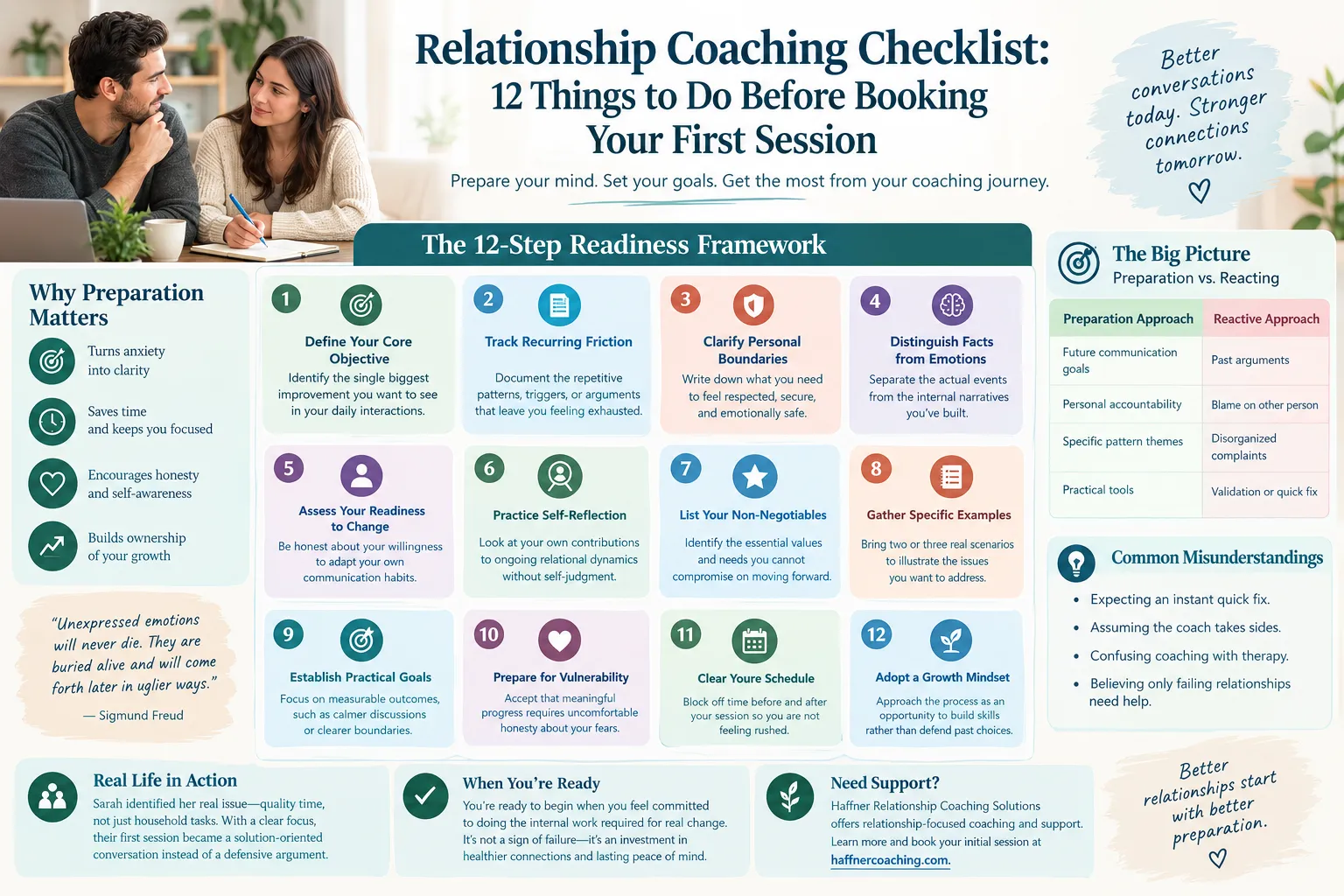
The 12-Step Readiness Framework
1. Define Your Core Objective Identify the single biggest improvement you want to see in your daily interactions.
2. Track Recurring Friction Document the repetitive patterns, triggers, or arguments that leave you feeling exhausted.
3. Clarify Personal Boundaries Write down what you need to feel respected, secure, and emotionally safe.
4. Distinguish Facts from Emotions Separate the actual events from the internal narratives you have built around them.
5. Assess Your Readiness to Change Be honest about your willingness to adapt your own communication habits.
6. Practice Self-Reflection Look at your own contributions to ongoing relational dynamics without self-judgment.
7. List Your Non-Negotiables Identify the essential values and needs you cannot compromise on moving forward.
8. Gather Specific Examples Bring two or three real scenarios to illustrate the issues you want to address.
9. Establish Practical Goals Focus on measurable outcomes, such as calmer discussions or clearer boundaries.
10. Prepare for Vulnerability Accept that meaningful progress requires uncomfortable honesty about your fears.
11. Clear Your Schedule Block off time before and after your session so you are not feeling rushed.
12. Adopt a Growth Mindset Approach the process as an opportunity to build skills rather than defend past choices.
Preparing vs. Reacting
| Preparation Approach | Reactive Approach |
| Focuses on future communication goals | Focuses entirely on past arguments |
| Accepts personal accountability | Places all blame on the other person |
| Identifies specific pattern themes | Delivers disorganized lists of complaints |
| Seeks practical interaction tools | Looks for validation or a quick fix |
Common Misunderstandings About the Process
- Expecting an Instant Quick Fix: Real growth takes time, practice, and consistent effort between meetings.
- Assuming the Coach Takes Sides: A professional stays neutral and focuses on health and clarity rather than declaring a winner.
- Confusing Coaching with Therapy: Coaching emphasizes present dynamics and practical goals rather than processing deep historical trauma.
- Believing Only Failing Relationships Need Help: Proactive support helps already strong connections become even more resilient.
An Everyday Illustration of the Checklist in Action
Consider Sarah and Mark, a couple struggling with busy schedules and misaligned priorities. Before their initial meeting, Sarah worked through a relationship coaching checklist. Instead of entering the room ready to list every time Mark forgot a household task, she identified her core issue: a lack of dedicated, quality time together.
Because she did this prep work, their opening conversation avoided defensive arguments. They immediately focused on practical schedule shifts and clearer communication habits.
Knowing When You Are Ready to Begin
You are ready to reach out when you feel committed to doing the internal work required for real change. Seeking support is not a sign of failure. It is a deliberate choice to invest in healthier connections and lasting peace of mind.
Working through a thorough relationship coaching checklist ensures you enter your experience with focus, courage, and purpose. Real growth starts the moment you choose to engage honestly with yourself.
For readers who would like additional guidance with communication, connection, or relationship challenges, Haffner Relationship Coaching Solutions offers relationship-focused coaching and support. Learn more about booking an initial session at https://haffnercoaching.com/.
FAQs
How does a relationship coaching checklist help me prepare?
A relationship coaching checklist helps you organize your thoughts, identify specific communication goals, and step into your initial consultation with clarity. It ensures you maximize your time and focus on real solutions from day one.
What is the main purpose of an initial consultation?
The initial consultation helps you clarify your needs, discuss current challenges, and evaluate whether professional guidance aligns with your personal goals for growth and better communication.
Can I use a relationship coaching checklist for individual sessions?
Yes. A relationship coaching checklist works exceptionally well for individuals seeking to improve personal boundaries, navigate workplace dynamic issues, or build confidence in personal interactions.
How does coaching differ from traditional counseling?
Coaching focuses primarily on present action, communication tools, and future goals, whereas counseling often focuses on healing historical emotional wounds and clinical mental health diagnoses.
How many sessions are usually required to see results?
The number of sessions varies based on your specific goals, but establishing clear priorities early on helps track noticeable progress within just a few focused meetings.
What should I bring to my first session?
Bring your prep notes, a list of key questions, an open mind, and a clear idea of the personal or relational outcomes you hope to achieve.






























Sign in to leave a comment.