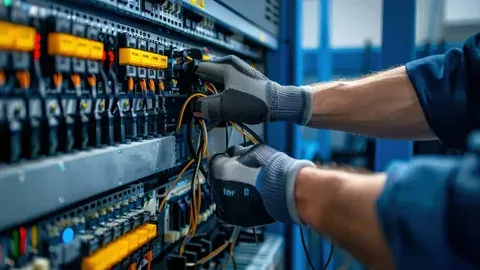

A breaker trips while dinner is cooking. The lights dip when the air conditioner starts. At a small business, a new piece of equipment cannot be added because the breaker box has no open space. None of these moments automatically proves the entire electrical panel must be replaced. They do prove that the system is asking for attention.
The difficult part is deciding whether a focused panel repair can restore safe, reliable performance or whether a panel upgrade is the better long-term answer.
The right choice begins with diagnosis. A licensed electrician should evaluate the panel’s condition, service capacity, connected loads, grounding, breaker compatibility, and future plans before recommending either path. Professional Electrical Solutions should explain what failed, why it failed, and what each option will change.
This article offers general educational information. It is not a substitute for an on-site electrical inspection or emergency assistance.
Key Takeaways
- Panel repair is best for isolated defects in otherwise suitable equipment.
- A panel upgrade addresses broader capacity, condition, or planning problems.
- Repeated symptoms across several circuits usually require deeper evaluation.
- Burning odors, smoke, arcing, or severe heat demand urgent action.
What Do Panel Repair and Panel Upgrade Actually Mean?
A panel repair corrects a specific fault without replacing the entire distribution panel or increasing the property’s electrical service capacity. It may involve replacing a compatible failed breaker, correcting a damaged connection, repairing a particular circuit, or resolving another localized defect.
A panel upgrade is broader. It may replace aging or damaged equipment, provide more breaker spaces, support a larger electrical load, improve circuit organization, or prepare the property for additions such as electric heating, commercial equipment, a renovated kitchen, or vehicle charging.
An upgrade is not always the same as a service upgrade. Some projects also require changes to service conductors, metering, grounding, or utility equipment.
Could Panel Repair Be the Smarter Fix?
A repair can be the sensible option when the problem is isolated and the panel remains appropriate for the building. The enclosure should be sound, the bus and connections should be serviceable, compatible parts should be available, and the system should have enough capacity for normal and planned use.
Common repairs include replacing one compatible failed breaker, correcting a damaged circuit or termination, improving labeling, or resolving another localized fault.
The crucial phrase is otherwise healthy. Replacing one breaker does not fix widespread corrosion, recurring heat damage, inadequate service capacity, or an obsolete design. Reliable Panel Repair Services should confirm the cause rather than treating every trip as a bad breaker.
Troubleshooting also matters because flickering or outages may originate in a circuit, device, connection, or utility supply rather than the panel.
When Does an Electrical Panel Need More Than a Repair?
A panel upgrade becomes more likely when the problem affects the system as a whole rather than one component.
Warning signs include widespread corrosion, damaged bus connections, persistent heat, recurring failures on several circuits, unavailable compatible equipment, no practical room for required circuits, or planned loads that exceed the present system’s capability.
The U.S. Energy Information Administration reports that the average American household consumes about 10,500 kilowatthours of electricity per year. Actual use varies, but modern properties often support loads never considered when older systems were installed.
Capacity becomes especially important before adding electric appliances, HVAC equipment, workshop machinery, commercial refrigeration, or charging equipment. ENERGY STAR advises owners to review the main breaker rating and available breaker spaces, then discuss planned loads with a licensed electrician.
Panel Repair vs. Panel Upgrade: A Clear Comparison
| Decision factor | Panel repair may fit | Panel upgrade may fit |
| Scope of problem | One identifiable component or circuit | Multiple defects or system-wide limitations |
| Panel condition | Clean, sound, compatible equipment | Corrosion, overheating, damage, or obsolescence |
| Capacity | Adequate for current and planned use | Insufficient load capacity or breaker space |
| Future projects | No major electrical additions planned | Renovation, new equipment, or electrification ahead |
| Long-term value | Restores an otherwise suitable system | Reduces repeated work and creates future flexibility |
| Project coordination | Limited outage and localized work | Permits, inspection, and possible utility coordination |
Price should not decide the issue alone. The strongest Electrical Solutions compare the immediate correction with expected life, future demand, and the risk of repeat work.
How Does Electrical Capacity Change the Decision?
Electrical capacity is not determined by counting appliances or guessing from panel appearance. An electrician evaluates the service rating, conductor sizes, connected equipment, demand factors, available spaces, and how loads operate together.
A full panel does not always require a larger utility service, and an empty breaker space does not prove enough capacity exists for a major new load.
ENERGY STAR notes that homes preparing for added electric equipment should check both panel amperage and room for new breakers. It also explains that some projects can require dedicated circuits even when a complete service upgrade is unnecessary.
Commercial properties have different demand patterns, so Panel Repair Services should not approve new loads before the system is assessed for the intended use.
The SAFE Framework for Panel Repair Decisions
The SAFE framework gives property owners a practical way to understand the recommendation:
- S — Scope: Is the defect limited to one component, or does it affect the wider system?
- A — Adequacy: Can the existing service support normal use and planned additions?
- F — Future: Will renovations, equipment, or occupancy changes create more demand?
- E — Equipment condition: Is the panel sound, compatible, dry, and free from heat damage?
When all four answers support continued use, repair may be reasonable. When condition or capacity fails the test, an upgrade may offer the safer and more economical long-term path.
W. Edwards Deming wrote,
“Quality does not just happen: it is built in.”
The same idea applies here. A dependable electrical system comes from correct design, compatible components, qualified workmanship, and verification, not from repeatedly resetting a breaker and hoping the symptom disappears.
What Should a Professional Panel Assessment Include?
A useful assessment should go beyond a quick glance at the breaker labels. Depending on the property and complaint, it may include:
- visual inspection for corrosion, heat, damage, and improper modifications;
- testing related to the reported symptoms;
- review of breaker and panel compatibility;
- evaluation of grounding and bonding;
- load calculations for current and planned equipment;
- review of available breaker spaces;
- identification of permit, inspection, and utility requirements; and
- a written explanation of repair and upgrade options.
Massachusetts guidance directs property owners dealing with unpermitted electrical installations to obtain a properly licensed electrician, have that electrician review the work, obtain a permit, bring the work into compliance, and arrange inspection by the local inspector of wires. The guidance reinforces why qualified, permitted work matters when equipment is altered or replaced.
An estimate should separate required corrections from optional improvements and explain outage time, inspection, and utility coordination.
Do This, Not That: Avoid Costly Panel Mistakes
Do arrange troubleshooting when breakers repeatedly trip.
Do not keep resetting them without identifying the cause.
Do document which loads are operating when symptoms appear.
Do not assume the panel is responsible for every flicker or outage.
Do ask whether a repair changes capacity.
Do not confuse a new breaker with a larger electrical service.
Do verify that replacement parts are listed and compatible.
Do not install whatever physically fits.
Do plan for future loads before renovating.
Do not wait until new equipment arrives to discover the system cannot support it.
Do use licensed professionals for internal panel work.
Do not remove the cover or attempt energized repairs.
Government recalls demonstrate why model-specific evaluation matters: the Consumer Product Safety Commission has directed owners of certain recalled load centers to obtain trained-electrician inspections to determine whether repair or replacement is required.
What Does This Choice Look Like in a Real Property?
Consider a familiar residential scenario. A homeowner reports that one kitchen breaker trips when several countertop appliances run together. The panel is clean, compatible parts are available, and it has room for another circuit.
The electrician may find that the panel itself is suitable and recommend circuit correction or a dedicated circuit rather than replacement.
Now consider a commercial property with repeated trips, moisture damage, no open spaces, and new equipment planned. Individual breaker repairs would not address the wider condition or future load.
Neither recommendation should be made from one symptom alone. The decision becomes clear when condition, capacity, cause, and future use are considered together.
Could This Electrical Problem Be an Immediate Hazard?
Smoke, visible arcing, melting, a strong burning odor, severe heat, water inside electrical equipment, or exposed energized parts can indicate immediate danger. People should move away and contact emergency services when fire or active electrical danger is present.
Without an active fire, affected equipment should remain unused until evaluated. Owners should not open the panel or touch damaged components.
Recurring trips, buzzing, corrosion, or unexplained partial outages may not look dramatic, but they still deserve prompt Panel Repair Services. Waiting can turn a limited defect into wider damage and a longer interruption.
Conclusion: Fix Today’s Fault Without Creating Tomorrow’s
The best decision is the solution that addresses the defect, supports electrical demand, meets applicable requirements, and reduces the chance of paying twice.
Panel repair can restore an otherwise suitable system when the issue is isolated. A panel upgrade becomes the stronger choice when damage, obsolescence, limited capacity, or future plans make continued repair impractical.
For professional residential and commercial evaluation, dependable Electrical Solutions, and a clear recommendation between repair and upgrade, turn to ARC Electrical Solutions Inc.
Frequently Asked Questions
1. What Makes a Good Panel Repair Recommendation?
It identifies the exact defect, confirms the surrounding equipment is suitable, and explains why repair is expected to restore safe operation.
2. When Should a Property Owner Choose a Panel Upgrade?
An upgrade may be appropriate when the system is damaged, obsolete, out of space, inadequate for planned loads, or experiencing widespread recurring problems.
3. How Can Owners Compare Panel Repair Services?
Compare licensing, diagnosis, written scope, compatible equipment, permit handling, testing, and whether the recommendation addresses future demand.
4. Can a New Breaker Increase Electrical Capacity?
No. A breaker replacement may correct a failed component, but overall capacity depends on the service, conductors, panel rating, and calculated load.
5. What Affects Panel Repair or Upgrade Cost?
Cost varies with diagnosis, equipment, service size, access, permits, utility coordination, related wiring, and the extent of required corrections.


























Sign in to leave a comment.