

Wasp nests are one of the most common summer callouts for pest controllers across Manchester, and for good reason. If you are searching for Manchester Wasp Nest Removal services, it helps to know why this problem is so widespread. A single nest can house thousands of wasps by late summer, and what starts as a small papery structure tucked under a roof eaves or inside a garden shed can quickly become a serious safety concern for the whole household. If you have spotted increased wasp activity around your Manchester property, understanding how nests form, why they are dangerous, and how professional removal works can help you deal with the problem quickly and safely.
Why Wasp Nests Appear Around Manchester Homes
Manchester's mix of older terraced housing, semi detached properties, and homes with mature gardens creates plenty of sheltered spots that wasps find ideal for nesting. Roof voids, loft spaces, cavity walls, garden sheds, and even children's play equipment can all become nesting sites. Queens typically begin building nests in spring, and by the height of summer, a colony can grow rapidly as worker wasps expand the structure outward.
Areas such as Chorlton, Didsbury, Whalley Range, and the wider Greater Manchester suburbs, where gardens and hedgerows are common, tend to see higher numbers of wasp nest callouts during July and August. Warmer, drier summers in recent years have also extended the active wasp season, meaning nests can remain a problem later into September than many homeowners expect.
How to Identify a Wasp Nest
Spotting a nest early makes removal far easier and safer. Common signs include a steady stream of wasps flying in and out of a single point, such as a roof tile gap, air brick, or shed corner, a soft buzzing or rustling sound coming from within a wall cavity or loft space, and a visible grey, papery structure if the nest is in an accessible location like a shed or tree branch.
Nests often start out no bigger than a golf ball in spring but can grow to the size of a football or larger by late summer, at which point they may house several thousand wasps. The bigger the nest, the more dangerous removal becomes without proper protective equipment and training.
Why DIY Wasp Nest Removal Is Risky
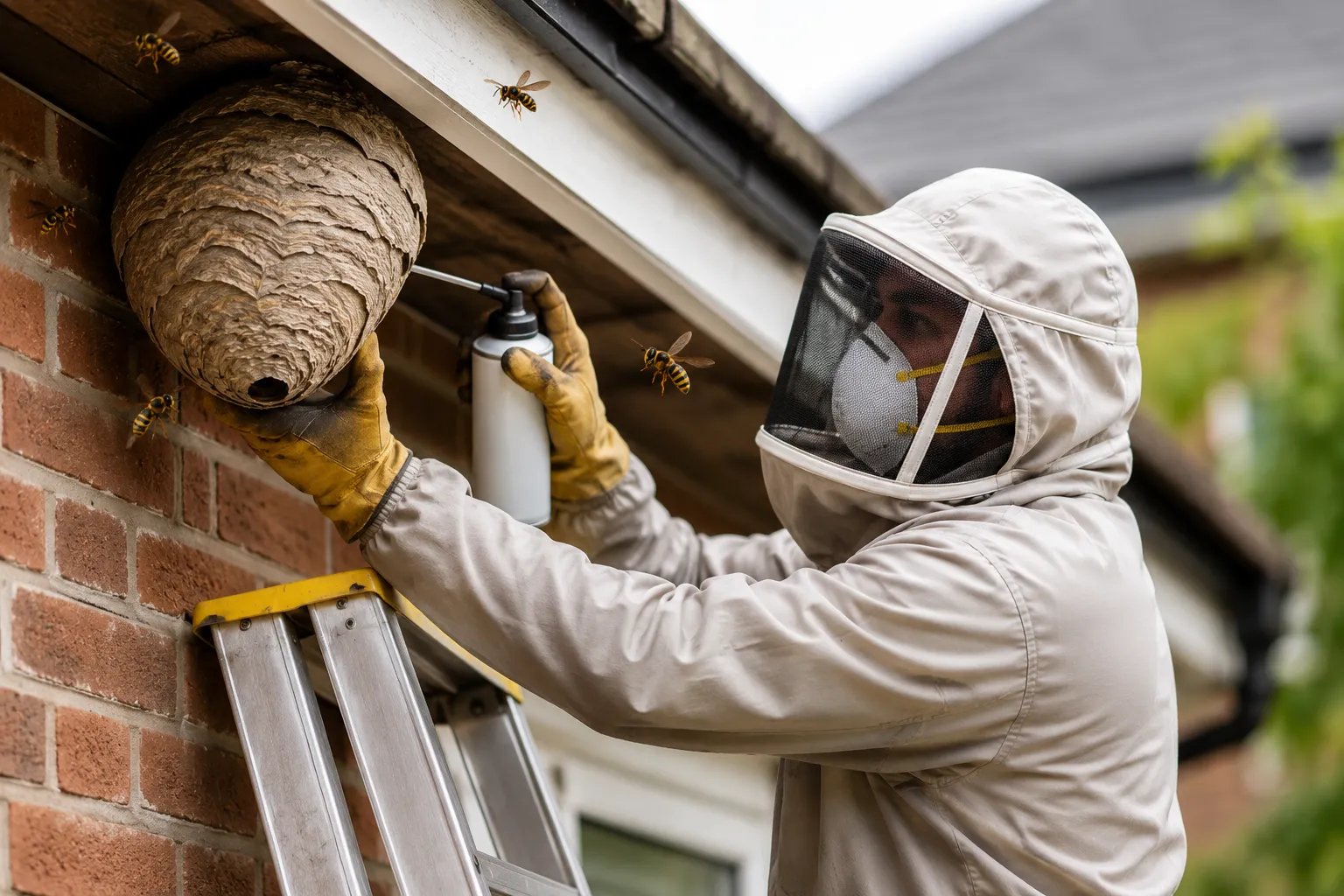
Many homeowners are tempted to deal with a wasp nest themselves using shop bought sprays or foams, but this approach carries significant risks. Wasps release an alarm pheromone when threatened, which signals the rest of the colony to attack, meaning a DIY attempt can quickly result in multiple stings rather than just one. This is particularly dangerous for anyone with a wasp sting allergy, where a reaction can escalate to anaphylaxis within minutes.
Reaching nests located high up under roof eaves or deep within loft spaces also often requires ladders or access equipment that most homeowners are not equipped to use safely. Incomplete treatment is another common issue, since surface sprays may kill visible wasps but fail to reach the core of the nest, allowing the colony to rebuild or relocate within the same property.
DIY Methods vs Professional Removal
| Approach | Safety Level | Effectiveness | Speed |
|---|---|---|---|
| Shop bought wasp spray | Low, high sting risk | Often only treats visible wasps | Immediate but temporary |
| Blocking entry points | Low | Can trap wasps inside walls, causing bigger issues | Slow |
| DIY nest removal at height | Very low | Inconsistent results | Risky and slow |
| Professional treatment | High, protective equipment used | Full colony elimination | Usually same day |
Blocking what appears to be the only entry point is a mistake many homeowners make, since it often forces wasps to find an alternative way into the living space, sometimes through wall cavities into bedrooms or living areas. Professional treatment avoids this by targeting the nest itself with insecticidal dust or foam designed to spread through the colony and eliminate it from the source.
What Happens During Professional Wasp Nest Removal
A professional pest controller will first locate the nest and assess its size and accessibility. Protective clothing, including a full bee suit and gloves, is worn throughout the process to prevent stings. Treatment usually involves applying an insecticidal dust or foam directly into the nest entrance, which worker wasps then carry back into the colony, spreading the treatment throughout the structure over the following hours.
Most nests are fully eliminated within twenty four to forty eight hours of treatment, and increased wasp activity immediately after treatment is normal as the colony reacts before dying off. Nests are not usually physically removed straight away, since doing so before the treatment has taken effect can disturb surviving wasps and increase sting risk. A second visit is occasionally needed for particularly large or hard to reach nests, though most Manchester properties only require a single treatment visit.
Same Day Service and Why Speed Matters
Wasp nests grow quickly during peak season, and delays in treatment can mean the difference between a manageable nest and one that has expanded into a wall cavity or loft space that is harder to access. Same day wasp nest removal services have become increasingly popular across Manchester precisely because of this urgency, particularly for households with young children, pets, or anyone with a known allergy to stings.
Booking treatment as soon as a nest is spotted, rather than waiting to see if the problem resolves on its own, is almost always the safer and more cost effective choice. Nests do not relocate or disappear on their own during the active season, and colony numbers only continue to grow until autumn.
Preventing Future Wasp Nests
Once a nest has been treated and removed, taking a few preventative steps can reduce the chance of new nests forming in following seasons. Sealing small gaps around roof tiles, air bricks, and soffits during autumn and winter, when wasps are inactive, helps limit new nesting sites. Regularly checking sheds, garages, and loft spaces during spring, when queens are searching for nesting locations, allows early nests to be spotted and dealt with before they grow.
Keeping bins sealed and food waste covered outdoors also reduces the chances of attracting wasps to the garden in the first place, particularly during late summer when natural food sources become scarcer and wasps are drawn to sugary substances.
Choosing a Wasp Nest Removal Service in Manchester
When comparing wasp nest removal providers, look for a company offering a fast response time, particularly during peak summer months, fully protected and trained technicians, treatment that targets the full nest rather than just visible wasps, and clear guidance on what to expect in the days following treatment. A provider familiar with Manchester's housing types, from older terraces with shared roof spaces to newer builds with cavity walls, will also be better placed to locate and treat nests efficiently.
Rodent X Pest Control provides fast, reliable wasp nest removal across Greater Manchester, including Salford, Bolton, and Warrington, with a strong focus on safety and same day response wherever possible. The team arrives fully equipped with protective clothing and professional grade treatments designed to eliminate the entire colony from the source, not just the wasps visible at the entry point. Whether the nest is tucked into a loft space, hidden within a cavity wall, or sitting in plain sight in a garden shed, Rodent X Pest Control has the experience to handle it safely and effectively, giving Manchester homeowners peace of mind throughout the wasp season.




























Sign in to leave a comment.