

Low-code platforms have moved far beyond small internal tools. Today, enterprises are using them to build mission-critical systems, automate complex workflows, and accelerate digital transformation. But scaling is where most teams struggle. What works for a department often breaks at an enterprise level, governance gets messy, performance dips, and security risks multiply.
This guide breaks down exactly how to scale Low-Code Apps in Large Organizations without losing control, quality, or speed. The focus is practical, battle-tested, and enterprise-ready.
Low-code platforms offer speed and agility, but scaling them in large organizations is not automatic. As adoption grows, enterprises face challenges around architecture, governance, integration, and long-term maintainability. To scale successfully, Low-Code & No-Code Development must be treated as a disciplined engineering approach, aligned with IT standards, security controls, and business objectives, rather than a quick shortcut.
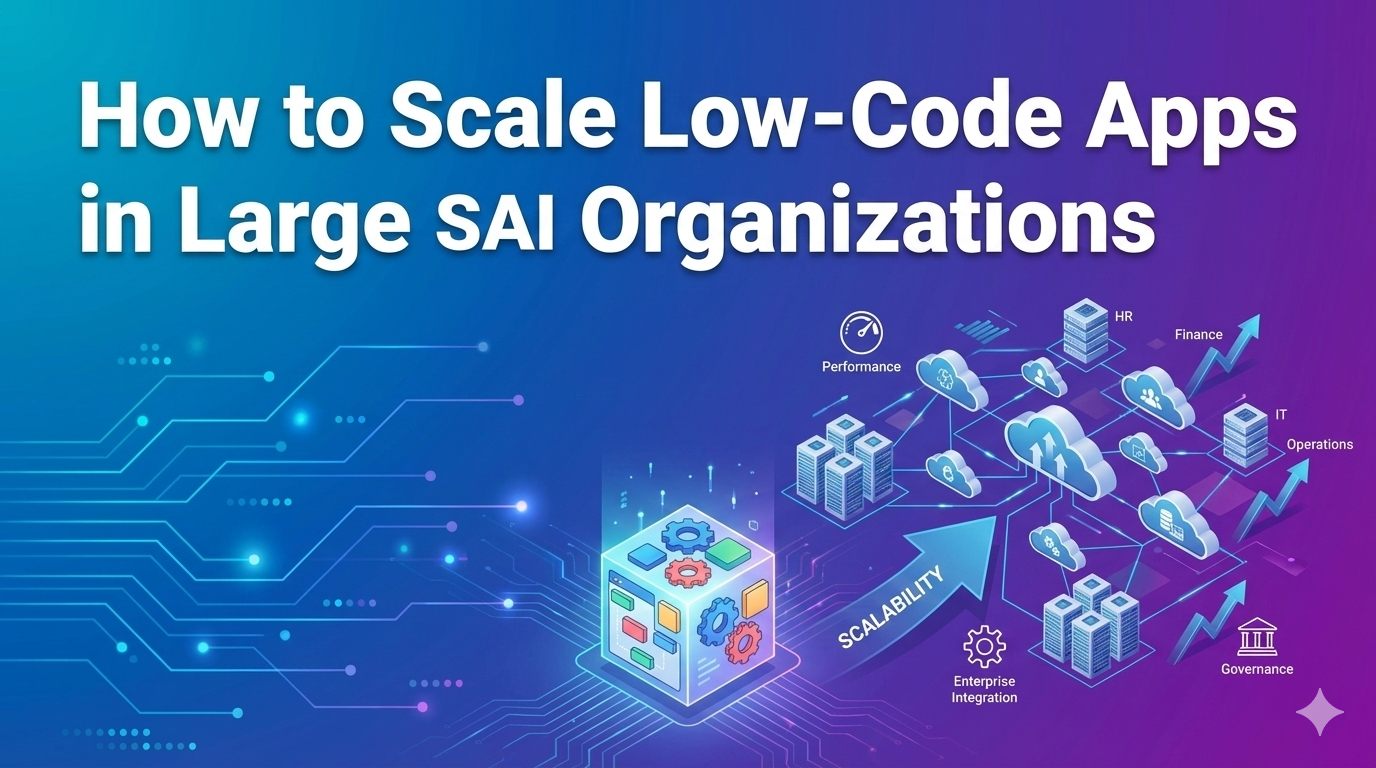
1. Align Low-Code Strategy With Business and IT Goals
Scaling fails when low-code is treated as a side experiment. Enterprises must define why they are adopting it and where it fits in the broader technology landscape.
Start by identifying:
- Which use cases are ideal for low-code
- Which systems must remain custom-built
- How low-code supports long-term digital transformation
When business leaders and IT agree on ownership, scope, and success metrics, low-code becomes a strategic asset rather than a shadow IT risk.
Clear alignment ensures that low-code apps solve real problems and integrate into enterprise roadmaps instead of becoming isolated tools.
2. Design an Enterprise Ready Architecture From Day One
Scaling Low-Code Apps in Large Organizations Requires Architectural Discipline
Architecture matters just as much in low-code as in traditional development. Many early failures happen because teams build apps without considering future scale, data volume, or integration complexity.
Best practices include:
- Separating data, logic, and presentation layers
- Using APIs instead of direct database connections
- Designing for modularity and reuse
- Avoiding hard-coded logic tied to one team or process
An enterprise-ready architecture ensures apps can evolve without being rewritten, even as users, data, and integrations increase.
3. Establish Strong Governance Without Slowing Teams
Governance does not mean bureaucracy. It means clarity.
At scale, organizations must define:
- Who can build what
- Where apps can be deployed
- How data access is controlled
- What compliance standards must be met
The key is automation. Approval workflows, environment controls, and policy enforcement should be built into the platform, not handled manually.
Good governance protects the organization while allowing teams to move fast within clearly defined boundaries.
4. Create a Center of Excellence (CoE)
A Low-Code Center of Excellence acts as the backbone of scaled adoption. It is not a gatekeeper it is an enabler.
A strong CoE typically:
- Defines standards and best practices
- Reviews high-impact applications
- Supports teams with training and guidance
- Evaluates new platform features and updates
The CoE also acts as a bridge between IT and business units, ensuring collaboration instead of conflict as adoption grows.
5. Standardize Components, Templates, and Patterns
Reinventing the wheel at scale is expensive and risky. Standardization is one of the fastest ways to improve quality and speed.
Enterprises should invest in:
- Reusable UI components
- Pre-built workflows
- Approved data connectors
- Secure authentication templates
When teams start from proven building blocks, they build faster and make fewer mistakes. Standardization also simplifies maintenance and onboarding.
6. Integrate Seamlessly With Core Enterprise Systems
Low-code apps rarely operate in isolation. They must connect to ERP, CRM, HR, finance, and data platforms.
To scale integration:
- Use API-first integration strategies
- Centralize connectors and integration logic
- Avoid point-to-point dependencies
- Monitor and version APIs
Strong integration design ensures that Low-Code Apps in Large Organizations remain reliable even as underlying systems evolve.
7. Plan for Performance, Scalability, and Load
Performance issues often surface only after adoption grows. By then, fixes are costly.
Enterprises should proactively plan for:
- Concurrent users and peak loads
- Data growth and query optimization
- Background jobs and long-running processes
- Caching and asynchronous execution
Load testing should be part of the release cycle, not an afterthought. Scalable apps protect user trust and business continuity.
Final Thoughts
Low-code can absolutely scale in large organizations, but only with the right mindset and structure. Speed without discipline leads to chaos. Discipline without speed leads to stagnation.
The organizations that succeed treat low-code as a first-class development approach. They invest in architecture, governance, security, and people just as seriously as they do in traditional engineering.
By following the strategies above, enterprises can unlock real scale, real impact, and real returns from low-code without compromising control or quality.


















Sign in to leave a comment.