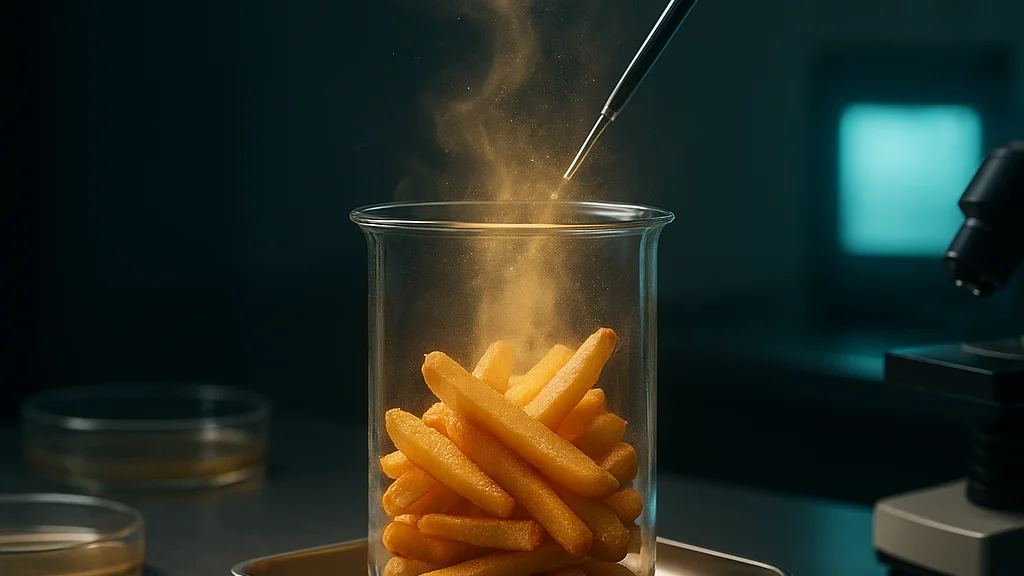

A French fry is usually a tiny engineering failure we all agree to enjoy. Crisp outside, soft inside, suspiciously able to defeat most diet plans by 7:14 p.m.—and now, according to recent reporting, it may also be getting a scientific redesign.
The breakthrough drawing attention comes from researchers studying how to make fries healthier by changing the way potatoes are treated before frying. The central issue is not merely fat content, though that matters. It is also the formation of acrylamide, a chemical compound that can develop in starchy foods cooked at high temperatures, especially during frying, roasting, or baking. That is the bit that makes food scientists sit up straighter than the rest of us. According to MSN’s report on the healthier French fry finding, scientists identified a method that may reduce harmful compounds while preserving the texture and flavour people actually want. Which is useful, because a healthy fry nobody eats is just a sad potato with paperwork.
This matters well beyond the takeaway counter. Fries are a global industrial product sold by restaurant chains, frozen-food giants, school cafeterias, pubs, football stadiums, and home cooks with air fryers that beep like needy office printers. A small tweak in processing can scale into a major public-health and commercial story. If one pre-treatment lowers acrylamide, limits oil uptake, or improves consistency, manufacturers notice. Regulators notice. Consumers notice—usually when the bag claims “crispier” in a font large enough to be seen from orbit.
What follows is a complete guide to the French fry breakthrough: what scientists found, why it matters, how it works, what it means for restaurants and home kitchens, and what to watch in 2026 as healthier frying moves from lab bench to production line. The potato, somehow, remains dramatic.
Why French fries became a scientific problem in the first place
Fries look simple because they are familiar. Industrially, they are anything but. The ideal fry must survive cutting, blanching, drying, frying, freezing, shipping, reheating, and the sort of kitchen handling that would make a lab technician resign. It also has to deliver a narrow sensory target: golden colour, crisp shell, fluffy centre, and enough structural integrity not to collapse into oily shoelaces. That balancing act is where food science enters the frame—wearing sensible shoes and carrying a moisture meter.
The biggest health concern attached to fries in recent decades has been the combination of oil absorption and acrylamide formation. Acrylamide became a major food-safety topic after researchers found that it can form in carbohydrate-rich foods when amino acids and sugars react at high temperatures through the Maillard reaction. This same reaction is also what gives fries their appealing brown colour and roasted flavour. Nature does enjoy a contradiction.
Regulators have paid close attention. The European Food Safety Authority has previously highlighted acrylamide as a public-health concern, and food manufacturers across Europe and elsewhere have spent years adjusting raw materials and cooking processes to reduce it. That has included changing potato varieties, managing storage temperatures to limit sugar buildup, tweaking blanching times, and controlling final fry colour. The fries on your plate are, in effect, the result of a long-running negotiation between chemistry and appetite.
There is also a supply-chain angle. Potatoes do not behave identically across seasons, regions, or varieties. Sugar levels can rise during cold storage, which can lead to darker fries and more acrylamide during frying. Processors therefore track reducing sugars carefully. A lot of what consumers think of as “just a potato” is actually a raw material with variable starch chemistry, moisture content, and cell structure. IKEA furniture has fewer hidden dependencies.
For readers wanting a quick primer before going deeper, WriteUpCafe’s earlier piece on Scientists Have Made a French Fry Breakthrough outlines the core claim neatly. The newer question is whether this remains a clever lab result or becomes a durable change in how fries are made at scale.
French fry science is not about making indulgence virtuous; it is about reducing avoidable harm without destroying the product people came for.
What the breakthrough actually appears to be
The recent attention centres on a processing method designed to make fries healthier before they ever hit hot oil. Based on coverage summarized by MSN, the researchers explored a treatment that can reduce the formation of harmful compounds and improve the nutritional profile of the finished fry. Reports on this kind of work often focus on the headline outcome—“healthier fries”—but the mechanism is the important part.
In food processing, pre-treatments can include soaking, blanching, pulsed electric fields, ultrasound, edible coatings, or adjustments in pH and mineral content. These interventions aim to alter the potato’s surface chemistry, moisture movement, sugar availability, or cell structure. If done well, they can reduce acrylamide precursors, lower oil uptake, and preserve texture. If done badly, they produce fries with the emotional tone of wet cardboard.
The broad scientific logic is straightforward:
- Lower the amount of reducing sugars available on or near the surface.
- Control how moisture leaves the potato during frying.
- Create conditions that limit excessive browning at very high temperatures.
- Maintain enough surface dehydration to preserve crispness.
That combination matters because acrylamide tends to form most readily in browned, low-moisture zones exposed to high heat. A treatment that changes the chemistry of that surface layer can therefore have an outsized effect. One reason these findings attract industry interest is that they do not necessarily require consumers to change behaviour. A reformulated process is easier to scale than asking millions of people to fry less enthusiastically.
There is also a commercial incentive beyond health claims. Better process control can mean fewer dark batches, more consistent colour, improved yield, and reduced waste. In large-scale frozen fry production, tiny percentage gains matter. A one- or two-point improvement in oil uptake or defect rate can translate into serious savings across factories producing thousands of tonnes. Potatoes are humble; the margins are not.
For a more cautionary angle, the companion WriteUpCafe article on Common Mistakes in the Healthier French Fry Breakthrough is useful because it highlights where interpretation often goes wrong—particularly the assumption that one healthier processing tweak turns fries into a wellness product. It does not. It turns them into a better-managed indulgence, which is still progress.
A healthier fry is still a fry. Science can improve the risk profile, but it cannot transform deep-frying into steamed broccoli by force of optimism.
The chemistry behind crispness, colour, and acrylamide
To understand why the breakthrough matters, it helps to know what happens in the fryer. Raw potatoes are mostly water and starch, with small but crucial amounts of sugars and amino acids. When cut potatoes enter hot oil, water near the surface rapidly heats and evaporates. Steam pushes outward, helping to keep oil from flooding in immediately. As frying continues, a dry crust forms. That crust is the stage on which flavour, colour, and trouble all arrive together—like a sitcom dinner party where every guest has unresolved issues.
The Maillard reaction drives the browning that makes fries appealing. It occurs when reducing sugars react with amino acids, especially asparagine, under high heat. The same family of reactions creates many desirable roasted notes. Yet under those conditions, acrylamide can also form. More browning usually means more flavour—but also a greater chance of elevated acrylamide. That is why processors often target a golden-yellow finish rather than a deeper brown.
Several variables influence the outcome:
- Potato variety: Different cultivars have different sugar and dry matter levels.
- Storage conditions: Cold storage can increase reducing sugars through “cold sweetening.”
- Cut size: Thin fries have more surface area and can brown faster.
- Blanching: Pre-cooking in hot water can leach sugars and alter texture.
- Drying: Surface moisture affects crust formation and oil absorption.
- Frying temperature and time: Higher heat and longer exposure raise browning and acrylamide risk.
This is why the best interventions tend to be process-based rather than magical. There is no single “healthy fry switch.” Researchers instead look for leverage points—ways to alter sugar availability, heat transfer, or cell permeability so the final product lands in a better zone. Some methods can reduce oil uptake by strengthening the surface or changing how moisture exits. Others lower acrylamide by removing precursors before frying. The ideal method does both while preserving sensory quality, which is a sentence easier to write than to manufacture.
According to reporting by MSN, the new work is significant because it suggests that healthier fries need not be a compromise product. That claim will matter most if independent follow-up and commercial trials show reductions in harmful compounds without obvious sacrifice in taste or texture. Food history is full of worthy reformulations that consumers met with the expression usually reserved for software updates.
There is a home-cooking lesson here too. Even without industrial equipment, cooks can influence outcomes by soaking cut potatoes, rinsing off surface starch, drying thoroughly, and avoiding over-browning. Those steps are not identical to the scientific breakthrough, but they follow the same logic: control the surface, control the fry.
How the industry could use this in 2026
By 2026, the fry business is already under pressure from several directions at once: health scrutiny, volatile potato harvests, energy costs, seed-oil debates, menu inflation, and consumers who expect restaurant fries to taste identical in Melbourne, Manchester, and Minneapolis. Any technology that improves consistency while supporting a healthier profile gets a serious hearing. The question is not whether companies like healthier claims. Of course they do. The question is whether the process fits existing lines without wrecking throughput.
Large fry manufacturers typically operate at high speed with tightly calibrated stages—washing, peeling, cutting, blanching, drying, par-frying, freezing, and packaging. A breakthrough that requires only a modest pre-treatment adjustment is far more realistic than one demanding a full plant redesign. That is why process innovations often spread fastest when they can be inserted into current operations with limited capital expenditure. Factory managers, much like airline passengers, dislike unnecessary surprises.
Here is where the 2026 context matters:
- Restaurants continue to market premium fries, loaded fries, skin-on fries, and “crispy hold” products that stay crunchy during delivery.
- Frozen-food companies are competing on texture retention in ovens and air fryers, not just in deep fryers.
- Health-conscious consumers increasingly read labels and respond to lower-fat or reduced-harm positioning—provided taste survives.
- Supply disruptions and climate variability have made raw-material efficiency more valuable.
If the new method lowers oil absorption even modestly, that can improve both nutrition and cost control. If it reduces acrylamide, it also helps manufacturers manage regulatory and reputational risk. Those two incentives together are powerful. A company does not need to become altruistic overnight when the spreadsheet is doing the lobbying.
WriteUpCafe’s Scientists Achieve Major Breakthrough in Healthier French Fries frames this industry angle well, particularly the idea that food science now sells on three fronts at once: safety, sustainability, and sensory performance. The modern fry has to clear all three.
Recent commercial trends also suggest that “healthier indulgence” remains a durable category rather than a passing slogan. Air fryers normalized the idea that consumers will accept process changes if the result still tastes familiar. That cultural shift gives manufacturers more room to introduce reformulated fries, especially in frozen retail. People who willingly compare basket preheat times on social media are not hard to pitch process innovation to. They are already halfway there.
What this means for restaurants, fast food, and home cooks
Restaurants operate under a different set of constraints from factories. They care about hold time, fryer recovery, labour simplicity, and customer expectations that can turn mutinous if the chips arrive pale. A scientifically improved fry only becomes commercially useful in foodservice if it survives rush-hour reality—salted, boxed, delivered, and eaten ten minutes later while someone argues over a group chat. That is the actual field trial.
For chain operators, the most attractive outcomes from this research would be:
- Lower acrylamide formation without changing kitchen procedure.
- Reduced oil uptake, which can improve mouthfeel and lower costs.
- More consistent colour across stores and batches.
- Better crispness retention for takeaway and delivery.
Independent restaurants may benefit differently. They often have more flexibility to experiment with soaking, blanching, double-frying, coatings, or cultivar selection. A science-backed method that can be adapted to a smaller kitchen could help them market a better fry without sounding like they are serving a thesis. Diners want delicious; “reduced harmful compounds” is best delivered quietly, perhaps below the fold.
Home cooks, meanwhile, can borrow the principles even if they cannot replicate the exact research protocol. The practical playbook is surprisingly familiar:
- Choose high-starch potatoes where possible.
- Cut evenly so pieces cook at the same rate.
- Soak or rinse to remove some surface starch and sugars.
- Dry thoroughly before frying or air-frying.
- Avoid excessive browning; golden is the target.
- Use controlled temperatures rather than guessing by vibes.
That last point is underrated. Over-browned fries are often treated as evidence of rustic charm. They are more often evidence that the oil was too hot, the batch too small, or the cook was distracted by a podcast. We have all been there.
The broader consumer takeaway is not that fries are suddenly “healthy.” It is that food science can make a widely eaten product less problematic without stripping out its identity. That is a more mature and useful frame than the old binary of junk versus virtue. Most people do not eat by moral philosophy anyway; they eat by convenience, budget, habit, and whether the food still crunches.
The limits of the breakthrough—and the claims to treat carefully
Every food breakthrough arrives with a halo effect. Suddenly one processing improvement gets stretched into a story about guilt-free comfort food, public-health transformation, and perhaps world peace if the press release is feeling ambitious. The sensible response is to separate the real achievement from the marketing fog.
First, a reduction in acrylamide is meaningful, but the size of that reduction matters. Was it modest, substantial, or highly dependent on specific conditions? Without standardized commercial data across multiple potato varieties and fry formats, broad claims should remain cautious. Lab success can weaken when scaled to industrial throughput, where raw materials vary and process windows narrow.
Second, lower oil uptake is beneficial, but not all lower-fat fries are better fries. Texture can suffer if crust development changes too much. Consumers are remarkably good at detecting disappointment, often before they can name it. Any company adopting the new method will need sensory validation, repeat-purchase data, and quality control robust enough to avoid batch drift.
Third, healthier processing does not erase portion size, sodium, or meal context. A scientifically improved side order can still sit next to a calorie-dense burger, a sugary drink, and three sauces behaving badly. Public health is rarely transformed by one menu item. It moves through accumulation—lots of small improvements, applied consistently, over time.
That is why the most credible interpretation of the breakthrough is also the least flashy: it is a potentially important step in reducing avoidable risk in a massively consumed food category. No cape required.
For readers following the trend line, French Fry Innovation: A 2026 Culinary Breakthrough is worth reading alongside this guide because it places the current research within the broader shift toward precision processing, cleaner labels, and texture engineering. The fry is becoming a designed object in a way consumers increasingly notice—even when they pretend not to care.
The most durable food innovations are usually boring in the best possible way: they fit existing habits, improve outcomes quietly, and stop needing headlines once they become standard practice.
What to watch next as the science moves from headline to habit
The next phase is not about whether the breakthrough sounds impressive. It is about whether it can survive contact with factories, fryers, regulators, and ordinary eaters. There are four developments worth watching through the rest of 2026 and beyond.
One: commercial validation. If major processors test the method at scale, expect attention on throughput, yield, colour consistency, and sensory acceptance. A process that works on pilot equipment but slows production lines will face resistance. Industry adoption tends to follow operational practicality, not romance.
Two: regulatory and labeling implications. If the method reliably lowers acrylamide or oil content, manufacturers may seek ways to communicate that advantage. The challenge is phrasing it accurately without overstating benefits. Food labeling law is not famous for its sense of humour.
Three: crossover into adjacent products. The same principles could influence hash browns, potato wedges, formed potato snacks, and even other starchy foods prone to acrylamide formation. Once a process tool proves useful, product developers rarely leave it sitting in one category.
Four: consumer education. As more people cook fries in air fryers and convection ovens, there is room for better public guidance on browning, temperature control, and potato preparation. The healthiest commercial innovation in the world still shares shelf space with home methods that can undo some of the benefit through overcooking.
What should readers take away from all this? Start with proportion. This breakthrough matters because fries are eaten at vast scale, and small process improvements can produce large cumulative benefits. Add realism. A healthier fry is still an indulgence, but one shaped by better chemistry and smarter manufacturing. And keep a little skepticism handy. The strongest food innovations are the ones that hold up after the headline has cooled.
There is something pleasingly absurd about a potato strip becoming the site of serious scientific progress. Yet that is how food systems change—not always through grand reinventions, but through targeted fixes to familiar things. The French fry, against all odds, has entered its optimization era. Somewhere, a lab technician is probably very proud. Fair enough.




























Sign in to leave a comment.